Levels 1-10
Levels 11-20
Levels 21-30
Levels 31-40
Levels 41-50
Levels 51-60
Levels 61-70
Levels 71-80
Levels 81-90
Levels 91-100
Levels 101-110
Levels 111-120
Levels 121-130
Levels 131-140
Levels 141-150
Levels 151-160
Levels 161-170
Levels 171-180
Levels 181-190
Levels 191-200
Levels 201-210
Levels 211-220
Levels 221-230
Levels 231-240
Levels 241-250
Levels 251-260
Levels 261-270
Levels 271-280
Levels 281-290
Levels 291-300
Levels 301-310
Levels 311-320
Levels 321-330
Levels 331-340
Levels 341-350
Levels 351-360
Levels 361-370
Levels 371-380
Levels 381-390
Levels 391-400
Levels 401-410
Levels 411-420
Levels 421-430
Levels 431-440
Levels 441-450
Levels 451-460
Levels 461-470
Levels 471-480
Levels 481-490
Levels 491-500
Levels 501-509

If you’re stuck on a hard level in Sand Loop, odds are you’re not “playing bad” — you’re losing the one fight that actually matters: time vs throughput. Hard levels aren’t asking you to be perfect. They’re asking you to be fast, consistent, and waste-aware. And yeah, the game absolutely baits you into panic-holding the stream like that’ll fix things. (It won’t. It usually makes it worse.)
Here’s the full toolbox I use when a level keeps timing out.
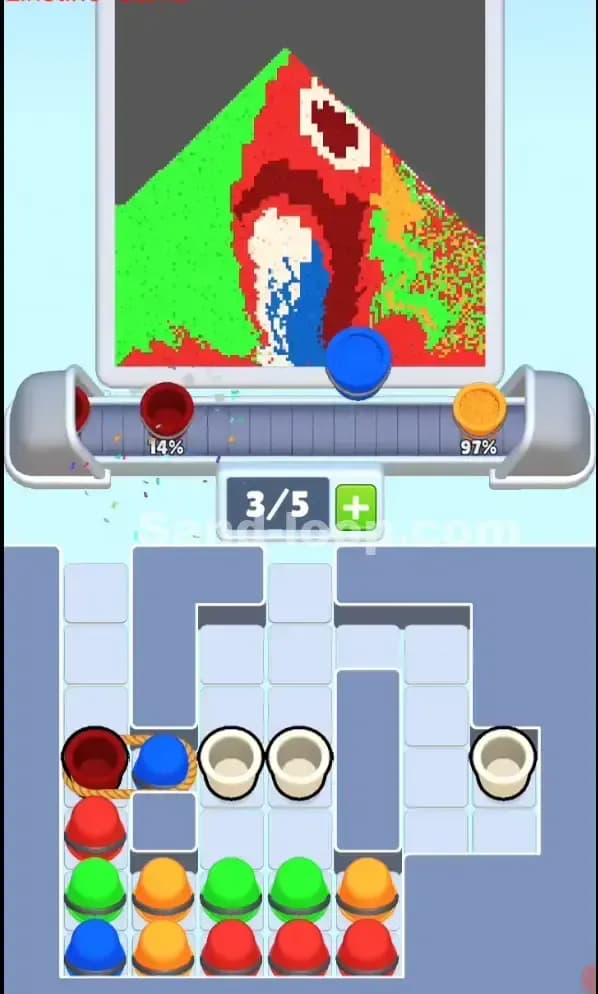
Buckets move on a conveyor rhythm. If you wait until the bucket is under the stream, you’re already late — especially on faster belts or when the drop distance is tall.
Fix: Start your pour before alignment. Think “lead the target,” not “hit the target.”
On easy levels, small spills don’t matter. On hard levels, gap bleed is a silent run-killer. A few little leaks across 20 cycles = you basically threw away a whole bucket’s worth of progress.
Fix: Learn to stop early. Not “when the bucket leaves,” but one beat before the gap arrives.
The biggest trap: you get one bucket to 80–90%, then you obsessively “perfect it”… while three other buckets slide by empty. Time runs out and you feel robbed.
Fix: Play for coverage first, perfection later. Get everyone “in the game,” then clean up.
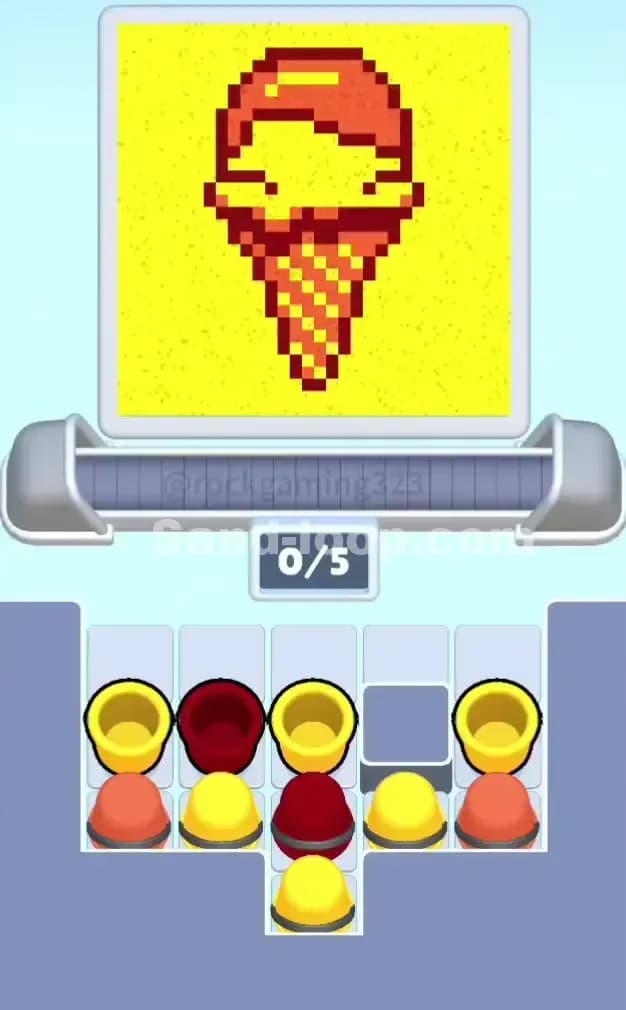
Sand Loop’s control is deceptively simple: you tap/hold to release sand. But the output is analog — the longer you hold, the more sand you dump, and physics makes that dump messy.
So your goal isn’t “hold longer.” Your goal is shape the flow.
Long holds create:
Micro-bursts create:
If you take only one thing from this article: learn to pulse.
Before you even start pouring, do a quick mental pass:
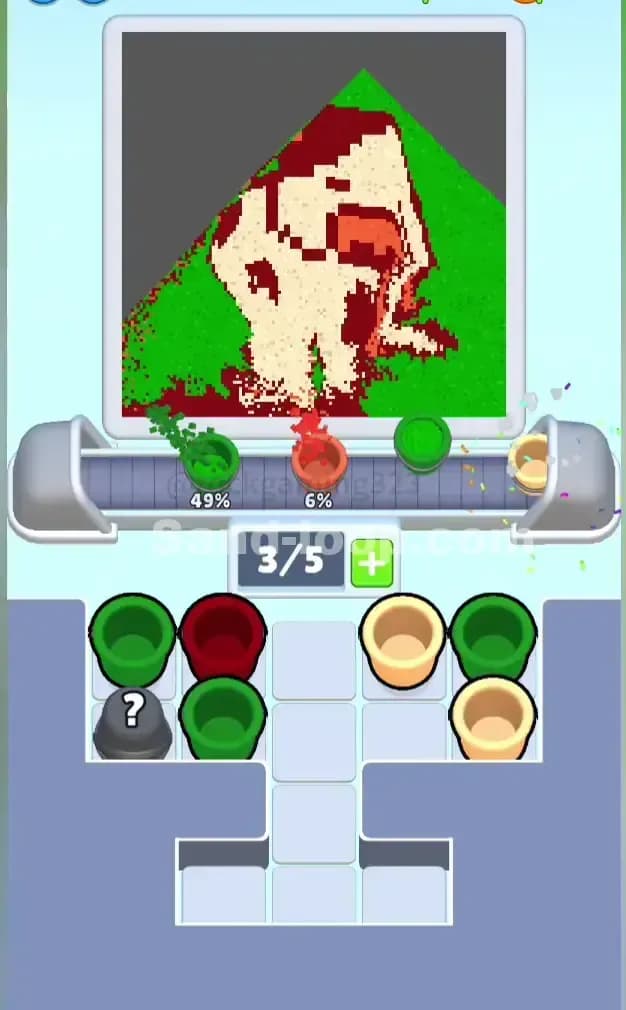
Which target is smallest / most awkward / most threatened by gaps or speed? That’s your priority bucket.
Is it:
Some buckets won’t cycle back soon (or they’ll come back when things are even harder). If you skip them, you’re basically accepting a future time-out.
Your plan should be: hardest first, rarest first, no-return first.
Hard levels demand prediction. The stream has travel time. The belt has motion. You need to pour where the bucket will be, not where it is.
A simple mental trick:
It feels wrong to stop early when you’re behind. But stopping late creates spills, and spills steal the time you’re trying to save.
If you’re timing out, you don’t need more sand. You need less waste.
Don’t play bucket-by-bucket. Play in pairs:
Thinking in pairs prevents you from tunneling and missing half the belt.
On most time-out levels, you want to get every required bucket to about 60–80% first. Why?
Then, once everything is “alive,” you can top off with quick pulses.
If you’re constantly making tiny adjustments, you’re spending attention and time for minimal gain. Hard levels punish indecision.
Better pattern:
If one color only shows up in a limited window (or is paired with an awkward bucket), treat it like a boss mechanic. Handle it early, while you still have time.
If you suspect a bucket won’t come back soon, don’t get greedy elsewhere. You might be trading 2 seconds now for an unwinnable endgame later.
If targets are spread across lanes/positions, bouncing your focus every cycle will scramble your rhythm. Pick a dominant lane to stabilize first, then expand.
Rotors punish continuous pouring. You need timed bursts.
A practical timing cue:
If you’re getting clipped, you’re not unlucky — your window is too late or your burst is too long.
If the sand source moves while the bucket moves, your brain wants to aim at the bucket. That’s how you miss.
Fix: Aim at the meeting point.
Blockers aren’t just “in the way.” They’re rhythm disruptors.
If you have boosters, blocker-heavy levels are usually the best place to spend them — because blockers can deny you entire cycles.
After a mistake, give yourself 3 seconds to stabilize. If you’re still in chaos after that, restarting is often faster than “salvaging” into a slow death timeout.
Pick one:
Trying to fix everything at once is how the run collapses.
If you’re behind, your instinct is to hold longer. That usually causes overflow/spill, which makes you more behind. Pulse harder, not longer.
Do a run where your only goal is: never pour into a gap. Even if you lose, you’re training the skill that wins hard levels.
Force yourself to only use short taps. You’ll feel underpowered at first — then you’ll notice how much cleaner and faster your cycles become.
Watch two full belt cycles without pouring much. Learn when the hard buckets appear and how long gaps last. Hard levels reward memorization way more than people admit.