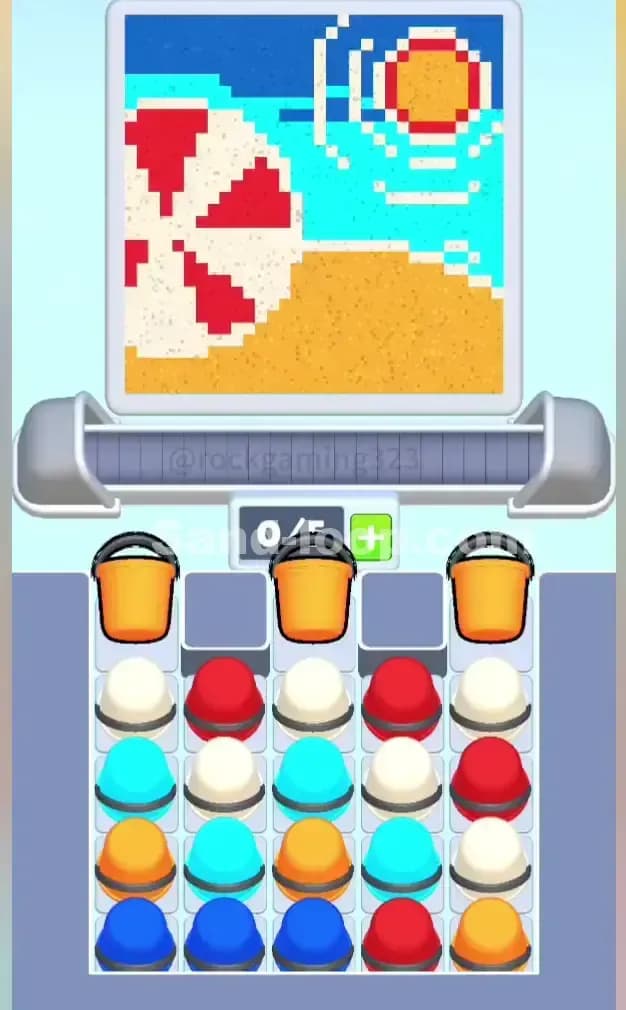
Sand Loop Level 10 Solution Walkthrough | Sand Loop 10
How to solve Sand Loop level 10? Get instant solution for Sand Loop 10 with our step by step solution & video walkthrough.

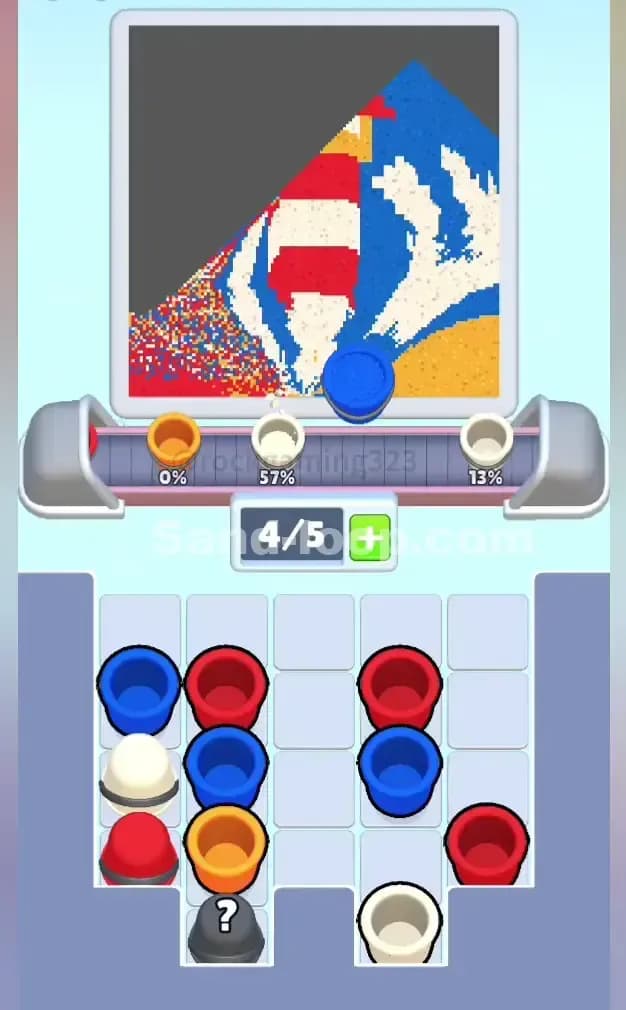


Sand Loop Level 10 Snapshot
The Canvas You're Filling
Sand Loop Level 10 presents a charming lighthouse scene dominated by a rich blue sky, a striking red and cream-colored lighthouse tower, and a golden sand base. The background is mostly blue, with cream accents forming the sky and clouds. The lighthouse itself requires precise fills: red stripes, a golden lantern room at the top, cream sections in the tower, and that golden sand foreground. You're not just painting random patches—you're building a cohesive, recognizable image. The color progress meters show you how close you are to meeting the target amounts for blue, red, cream, and gold, so you'll know exactly when to stop pouring each hue.
Your Starting Setup
You begin Sand Loop 10 with a 0/5 conveyor slot capacity—meaning five cups can ride the belt at once, and you've got none loaded yet. The supply tray below reveals your puzzle: you've got orange cups (which dispense gold), blue cups, red cups, and cream cups available in the upper rows. Several cup positions are marked with question marks, which means those slots are either locked or contain unknown cups you'll unlock as you clear others. The conveyor belt is completely empty, so your first moves are about selecting and loading cups in the right order without jamming yourself early.
Win Condition
Fill the lighthouse canvas by meeting the target amounts for blue, red, cream, and gold—without overfilling any single color and without wasting pours on empty conveyor slots or wrong-color accidents. The level succeeds when all four colors reach their goal percentages and the image is complete. You've got the slots and the cup variety; the challenge is sequencing them correctly and respecting the conveyor's timing.
Why Sand Loop 10 Feels Hard (The Actual Bottleneck)
The Real Puzzle: Blue Overfill Risk
Here's the thing about Sand Loop 10—blue dominates the background, so it's tempting to load blue cups aggressively and let them pour for a long time. That's exactly the trap. If you keep blue cups on the conveyor too long or pour continuously without gaps, you'll overfill the blue target before you've finished the detail work (the red stripes, the gold lantern, the cream tower sections). Once blue maxes out, any additional blue pour is wasted sand that doesn't advance your progress. I've choked the timing here twice, watching my meter slam to 100% and then realizing I still needed three more red pours to finish the lighthouse body.
Traps to Avoid
Trap #1: Loading all blue immediately. Yes, blue is the biggest area, but loading three blue cups at the start guarantees you'll overshoot before the detail colors have their moment.
Trap #2: Forgetting the conveyor delay. Your tap happens now, but the cup doesn't reach the pour point until it rolls down the belt. If you tap a blue cup, wait two seconds, and tap another blue cup, both might pour almost simultaneously once they reach the dispenser—creating an accidental double-pour that wastes your slot control.
Trap #3: Ignoring the question-mark cups. Several cups in the tray are locked. If you carelessly load cups without freeing blocked ones, you'll run out of the colors you actually need mid-level.
Why It Looks Easy but Isn't
The image is simple and nostalgic—just a lighthouse. The cup variety seems plentiful. But Sand Loop 10 demands that you respect color ratios and conveyor economics. It's not a "pour blue forever" level; it's a "pour blue smart, then switch colors precisely" level.
Step-by-Step Walkthrough to Beat Sand Loop Level 10
Opening Rhythm: First Three Moves
Start by loading a single blue cup and one orange (gold) cup in the first two slots. Don't fill all five slots immediately—you need empty room to maneuver and swap. Tap the blue cup first so it begins its journey down the belt. Then, before tapping the orange cup, pause for a breath (count to two internally). This stagger ensures the two cups won't collide or trigger back-to-back pours. Watch the blue meter climb slightly as that first pour starts, and keep one or two slots visibly empty on your belt display. The goal of these first three moves is to prove to yourself that you can control the timing and see the lead delay between your tap and the actual pour.
Unblocking Plan: Freeing the Color Stack
Once you've got your first blue and gold cups rolling, look back at the supply tray. You'll see several question-mark cups blocking access to the deeper stack. Rather than tapping random cups, focus on clearing the top rows first. Load a red cup into the third belt slot (again, don't overfill the belt). As it pours, the red target will begin climbing. Watch which colors jump forward most; this tells you which cups are most plentiful and which are harder to access. If you see cream cups partially visible, load one next. The key is to un-bury the hidden cups by loading and clearing the ones in front of them. Within the first 20–30 seconds of active pouring, you should have visibility on most of your cup colors and a clearer sense of your supply chain.
Mid-Game Control: Cycling and Gaps
Now Sand Loop Level 10 enters its rhythm phase. You're not pouring continuously—you're cycling. Load a blue cup, let it finish its pour, then immediately load a red cup. Watch the color meters climb. When blue reaches about 60–70% and red is still under 30%, you know you need to shift your emphasis. Load two red cups in a row, but insert an empty-slot gap between them (load red, wait for it to clear, load red again). This prevents the double-pour accident and gives you visual breathing room. Keep your conveyor at 3–4 cups max, never jamming all five slots. As you approach the halfway point (roughly 50% across all colors), your decision-making becomes tighter: which color is furthest behind? Load that one next. Which color is dangerously close to full? Skip it and swap it for its slower neighbor. This is where the level separates casual players from steady solvers.
End-Game Precision: The Final 10–20%
The last stretch of Sand Loop 10 is nail-biting because every pour matters. By now, one color is probably very close to its target (likely blue at 90%+). Your remaining gaps on the canvas are the detail zones: the red stripes, the gold lantern, the cream patches in the tower. Load a red cup, watch it pour, and check the meter—if red jumps from 75% to 85%, you've got maybe one more red pour before it maxes. Load your last red cup, then pivot hard to cream. Cream often lags because players don't load enough cream early. Tap a cream cup, let it pour, and watch the cream meter creep forward. The gold lantern room might need one or two more gold pours. Stay disciplined: no double-taps, no panic-loading five cups at once. Each of your final four or five pours is a deliberate choice. When all four colors hit 100%, the lighthouse lights up and you've beaten Sand Loop Level 10.
If You Mess Up: Recovery Tactics
Overfilled blue early? Don't despair. Switch immediately to red and cream for the next 30 seconds and ignore blue entirely. You can still win if the other three colors catch up before you run out of cups.
Loaded the wrong cup (tapped a blue by mistake when you needed red)? You can't undo it mid-pour, but you can compensate: as soon as that blue finishes, load two reds in succession (with a gap) to catch up.
Conveyor jammed with five full cups and nothing's moving? Wait for one pour to complete fully, then immediately load one new cup. The jam clears and you're back in control.
Can't find enough gold/cream cups because they're buried? Load and clear the blocking cups in the upper tray rows, even if they're blue or red. This unearths your hidden reserves.
Why This Strategy Works in Sand Loop 10
Conveyor Lead Time + Slot Economy
The genius of this approach is that it treats the conveyor belt like a pipeline with a lag. When you tap a cup, it's not instant; it travels, then pours. By keeping only 3–4 cups loaded and leaving 1–2 slots free, you avoid jamming and you maintain the ability to react if a color meter spikes unexpectedly. You can always insert a "breather" (an empty slot) between two cups of the same color, which prevents accidental double-pours and gives you a visual checkpoint to reassess the canvas. This respects the delayed feedback loop that makes Sand Loop 10 tricky.
Controlling Waste and the Overfill Trap
The classic Sand Loop 10 failure is watching blue overfill at 85% while red is still at 40%. This strategy frontloads color variety: you're not committing to blue exclusively, even though blue is tempting. By cycling colors and checking meters frequently, you catch overfill risks before they happen. You shift away from a color the moment it climbs past 75%, which leaves just enough room for accidental overage without ruining your run. This active management prevents the "locked out by background" scenario that frustrates so many players.
Consistency Across Multiple Attempts
If you're chasing a high score or working through a move limit, this route gives you a repeatable pattern: open with one blue and one gold, cycle through reds and creams in the middle, then finish with precision on whichever color lags. The sequencing is logical, not random. You'll hit the same cups in roughly the same order every time, making your runs predictable and allowing you to refine your timing with each attempt.
Extra Tips and Adaptations for Levels Like Sand Loop 10
Six Common Mistakes and Fixes
-
Mistake: Tapping cups faster and faster as you panic. Fix: Slow down. Count to two between taps. The conveyor doesn't get faster just because you're nervous; rhythm beats speed.
-
Mistake: Ignoring the meter percentages and pouring by gut feel. Fix: Glance at the progress bars every 10 seconds. When blue hits 70%, make a mental note: "One more blue, then switch." This removes guesswork.
-
Mistake: Loading five cups and watching the belt clog. Fix: Keep one or two slots empty at all times. This is non-negotiable in Sand Loop 10.
-
Mistake: Assuming question-mark cups are useless. Fix: Load the blocking cups to unlock mystery cups. Sometimes a hidden cup is exactly the color you need to catch up.
-
Mistake: Pouring the same color for 15 seconds straight. Fix: Even if blue is low, load one blue, wait for it to pour, then load a different color. Gaps and variety are your friends.
-
Mistake: Forgetting to check the current conveyor state before tapping. Fix: Before every tap, glance at your belt. If it's already at 4/5, wait for one pour to complete before loading the next cup.
Boosters and Special Tools
If your version of Sand Loop 10 includes a booster shop, an extra conveyor slot can be a lifesaver if you're stuck in a jam or running out of moves. However, you shouldn't need it if you follow the slot-economy strategy above. An undo booster is tempting if you've overfilled a color, but it costs resources—better to learn the rhythm and avoid the mistake. If a slow belt booster exists, skip it entirely; a slower belt just makes the delayed timing even more confusing. Save your boosters for levels with genuine randomness, not for Sand Loop 10, which is solvable with pure strategy.
Final Encouragement
Sand Loop Level 10 is a turning point in the game. It's the moment you stop jamming cups randomly and start thinking like a conveyor operator. The lighthouse is beautiful, and the satisfaction of filling it precisely—watching each color creep from 0% to 100% in the right sequence—is genuinely rewarding. You've got the cup variety, you've got the belt capacity, and you've got a solid strategy. Trust the rhythm, respect the gaps, and don't overfill blue. You'll beat it. If you get stuck again, revisit this guide or check out sand-loop.com for more level solutions and community tips. Happy pouring!