
Sand Loop Level 100 Solution Walkthrough | Sand Loop 100
How to solve Sand Loop level 100? Get instant solution for Sand Loop 100 with our step by step solution & video walkthrough.
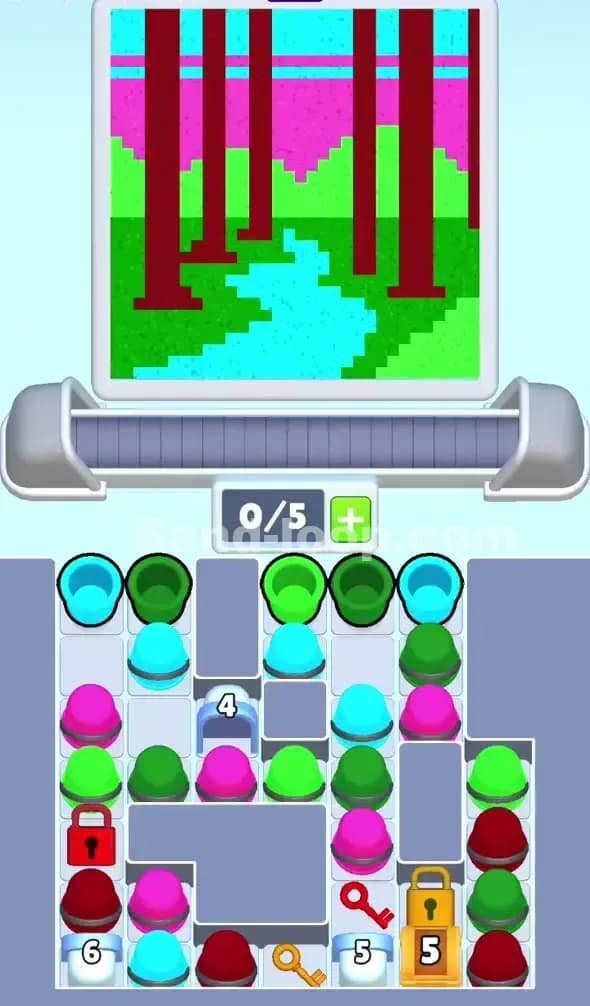
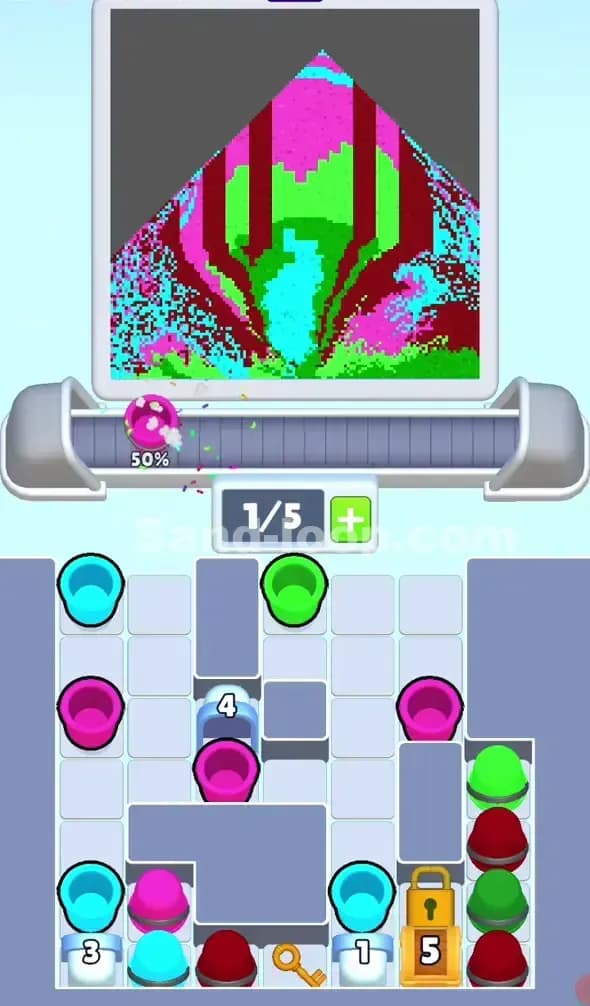
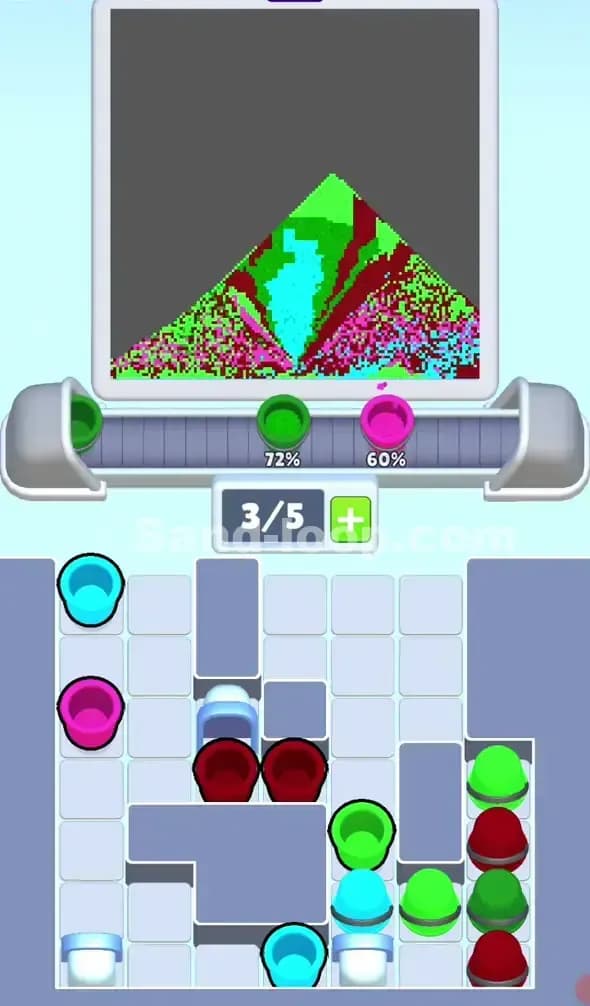
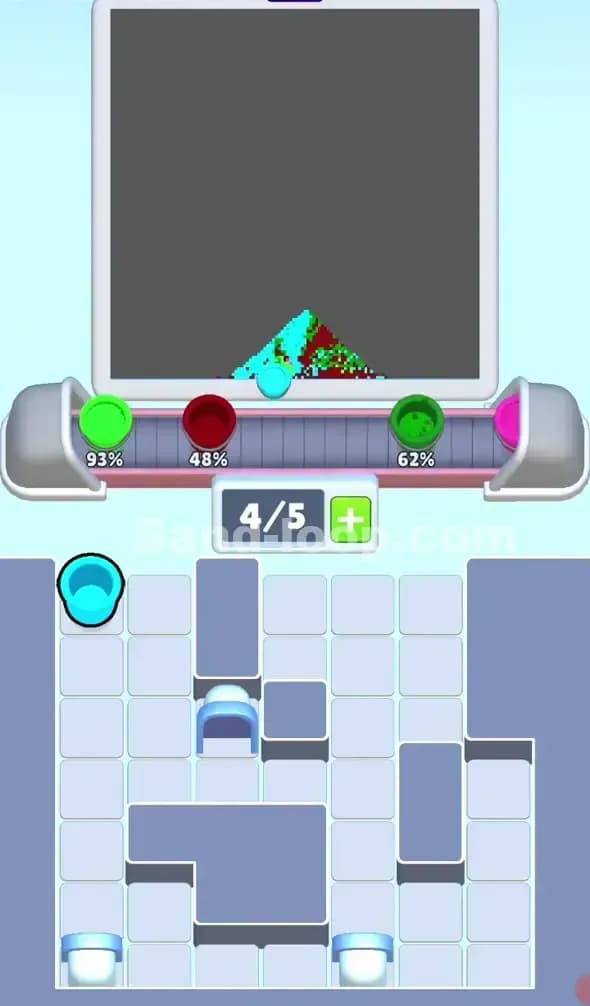
Sand Loop Level 100 Snapshot
Canvas Goal and Color Requirements
Sand Loop Level 100 presents a striking vertical landscape dominated by bright cyan (light blue) and magenta (hot pink) zones, with lime green and dark green sections filling the lower half. Dark red/maroon vertical "pillars" cross the entire picture, creating a structured but challenging fill pattern. The color progress meters tell you exactly what you're up against: you need to balance cyan, magenta, lime green, dark green, and dark red without overshooting any single color. The cyan river flowing through the middle-lower section is a visual clue—that's one of your trickiest zones to fill precisely, and it's easy to waste pours there if you're not deliberate.
Starting Setup and Tray Constraints
You begin Sand Loop 100 with a conveyor belt capacity of 0/5—meaning your slots are completely empty and you have full freedom to load your first cups. However, the supply tray below reveals the real puzzle. You've got 6 numbered positions showing blocked and stacked cups: position 1 (locked, red visible), position 4 (a 4-slot stack), position 5 (a 5-slot stack with magenta on top), and position 6 (locked, cyan visible). Cyan and magenta cups are partially buried, forcing you to unblock them strategically. Dark green, lime green, and additional reds are scattered throughout, but some are trapped under heavier stacks. Your immediate usable cups are the exposed ones on top—but grabbing them in the wrong order will bury the colors you desperately need later.
Win Condition
Fill the Sand Loop 100 canvas by meeting all five color targets: cyan for the sky and river, magenta for the mid-zone strip, lime and dark green for the grassy lower section, and dark red for the vertical pillars. You must complete this without overshooting any color (which locks you out) and without wasting sand on overflow or wrong-color contamination. The level is complete when all progress meters hit 100%, and you'll feel the satisfying "click" when Sand Loop 100 is finally solved.
Why Sand Loop 100 Feels Hard (The Actual Bottleneck)
The Real Bottleneck: Buried Cyan and Magenta
Sand Loop 100's biggest obstacle isn't the color variety—it's that cyan and magenta are both trapped deep in stacks. Cyan is locked under position 6, and magenta is buried in position 5 behind other colors. You can't just spam cups onto the conveyor; you need to free these colors first, which means you have to carefully unblock the stacks without jamming your 5-slot conveyor belt. The temptation is to load everything available immediately, but that's exactly how you deadlock and waste 2–3 attempts.
Three Classic Traps in Sand Loop 100
Trap 1: Loading the wrong stack first. If you grab cups from position 4 (the 4-stack) before positioning yourself to access position 5 (the 5-stack), you'll end up with useless greens filling your slots while magenta remains locked below. Sand Loop 100 punishes impatience.
Trap 2: Forgetting to keep a gap. With a 5-slot belt, you can fill all 5 slots and create a conveyor jam. The system won't move new cups up if you're at capacity, so you'll be stuck watching the pour point waste time while you wait for a cup to cycle through. Keeping 1 free slot keeps the flow smooth.
Trap 3: Pouring dark red too early. The maroon pillars look like they need a lot of sand, but they're actually thin vertical lines. If you pour dark red continuously in the opening, you'll overshoot it by 30%, lock yourself out, and fail Sand Loop 100 with a near-complete canvas.
Why Sand Loop 100 Looks Easy But Isn't
I choked this level twice because the visual layout seemed straightforward—big color blocks, simple target zones. But the moment I started pouring, I realized the stacks were my actual enemy, not the canvas. You're not solving a color puzzle; you're solving a logistics puzzle. The sand dispensers don't care about your plan; they care about which cup is under them at each moment. Sand Loop 100 demands that you think three moves ahead, just like a rhythm game where you tap now for a beat that lands later.
Step-by-Step Walkthrough to Beat Sand Loop 100
Opening Rhythm: First Five Cups and Your Slot Strategy
Start by loading your first cup into slot 1—grab a dark green from an exposed position (not from a locked stack). This gives you a "filler" cup that cycles through safely while you plan. Don't load aggressively; load your second cup (another dark green or lime green) and then pause. You now have 2/5 slots filled and 3 free slots. This is your control zone.
Immediately tap the pour for your first cup to begin the timing cycle. The cup will reach the pour point in about 1.5–2 seconds (in Sand Loop 100, this lead time is crucial). While it's cycling, load your third cup: a cyan cup if you can access one from the exposed layer, or a magenta if cyan is still too deep. The key is this: never fill all 5 slots until you've successfully unblocked both cyan and magenta. Your mantra for Sand Loop 100 is "load sparse, unblock early."
Unblocking Plan: Freeing Cyan and Magenta Safely
Once your first 2–3 cups are cycling through the conveyor, you can now focus on unblocking without jamming the belt. Position 5 (the 5-stack): Carefully remove cups from the top until you expose magenta. Don't panic if it takes 3–4 removals; that's normal. Magenta is your second-priority color after cyan, so getting it accessible now means you can load it into slots 4–5 once your greens finish cycling.
Position 6 (locked cyan): This requires unlocking. The unlock mechanic in Sand Loop 100 demands a key (you can see the wrench icon in position 5's slot). Grab the wrench from position 5's tray area and use it to unlock position 6. Only now is cyan fully available. Load cyan into slot 4 as soon as the wrench frees position 6.
Timing the unblock: Coordinate this unblocking while your first two cups are on the belt (roughly 3–5 seconds into the level). By the time your dark green finishes pouring and cycles off, you'll have magenta and cyan ready to load into the newly freed slots. This keeps your conveyor flowing and prevents the dreaded "empty slot stall" where you're waiting for cups that haven't been unblocked yet.
Mid-Game Control: Cycling Colors and Maintaining the Gap
Once cyan and magenta are loaded (slots 3–4), your pour sequence enters the precision phase. Watch the color progress meters on the canvas. You should see:
- Cyan rising quickly (the river and sky are large zones).
- Dark green rising steadily (the big grassy sections).
- Magenta climbing moderately (the mid-zone strip is medium-sized).
- Lime green and dark red rising slowly (they're smaller areas).
Now, here's the critical move: don't let dark red or lime green load yet. Keep them parked in the tray. Instead, after your magenta and cyan finish their pours, load a dark green into slot 4 to replace the cyan. This keeps dark green flowing, since it's a large zone that needs continuous filling. Maintain a 1-slot gap (so slots 1–4 are occupied, slot 5 is empty). This gap prevents deadlocks and gives you reaction time if a color meter spikes unexpectedly.
Check the meters every 2–3 pours. The moment cyan hits 80%+, stop loading cyan. Switch to magenta if it's below 70%, or dark green if magenta is covered. Sand Loop 100 is won by watching these meters like a hawk, not by auto-pouring one color for 10 seconds.
End-Game Precision: The Last 10–20%
This is where Sand Loop 100 separates passes from fails. By 80% completion, you should have 3–4 color zones nearly full and 1–2 lagging. Typically, dark red (maroon pillars) and lime green (small accent patches) will be your tail-end colors.
Here's the trick: pour lime green in short bursts. Since the lime zones are scattered and small, one full cup cycle might overfill them by 15–20%. Load a lime green cup, pour for 2–3 seconds, then tap to pause. Watch the meter. If it jumps to 85%+, stop immediately and don't load another lime cup. Switch to dark red instead.
Dark red is trickier because those pillars are thin but spread across the canvas. Pour dark red in controlled taps: 1–2 seconds per load, then pause and assess. The maroon meter should climb steadily but slowly. By the time dark red hits 90%, you'll have maybe 1–2 more cups to load. Make them count.
For Sand Loop 100's final 5%, load whatever color is lowest and monitor obsessively. Typically, you'll need to land 1–2 single-second pours to finish without overshoot.
If You Mess Up: Recovery Tactics
Overfilled a color by accident? If cyan or dark green hit 100% and you still have sand to dump, you've locked out those colors. Immediately switch to a different color (magenta or dark red) and finish with what's left. You'll lose some points but can still complete Sand Loop 100 if the overshoot isn't catastrophic. Reload and try again if you overshot by more than 10%.
Loaded the wrong cup into the belt? If you load a dark red when you meant to load magenta, don't panic. Let it pour—1–2 seconds of the wrong color won't ruin the run. Immediately load the correct color into the next slot and resume your meter-watching rhythm.
Jammed your conveyor (belt full, no new cups moving)? This happens if you fill all 5 slots and forget to let cups complete their cycle. Tap the pause button (if available) and let 1–2 cups finish pouring. Your belt will clear, and you can resume loading. In Sand Loop 100, this costs you 3–5 seconds but isn't a hard fail unless you're very low on moves.
Why This Strategy Works in Sand Loop 100
Conveyor Lead Time and Slot Economy
Sand Loop 100's conveyor operates on a ~2-second cycle from load to pour. This means your tap now affects the sand flow in the future. By keeping 1 slot empty, you ensure new cups can always load, which prevents the belt from jamming and gives you a safety buffer to react to meter changes. The strategy of "unblock early, load sparse" leverages this lead time: you unblock colors while your current cups cycle, so you're never waiting for access.
Preventing Overfill and the "Background Flood" Problem
The biggest way to fail Sand Loop 100 is by accidentally flooding the large background colors (cyan, dark green) and locking yourself out. The "load sparse" approach prevents this because you load one color at a time, watch its meter, and pause before it hits 100%. By contrast, jamming all 5 slots with dark green will pour it continuously for 10+ seconds and likely overshoot by 30%. This strategy treats each meter as a precise target, not a "fill until it's done" task. You stay in control because you're pouring deliberately, not continuously.
Move Consistency and Attempt Efficiency
If Sand Loop 100 has an attempt limit (moves), this route is designed to succeed in 1–2 runs for most players. The unblock-early phase costs 5–10 seconds of real time but saves you from trial-and-error restarts. Once magenta and cyan are accessible, the rest is meter-watching, which is repeatable and consistent. You'll find Sand Loop 100 becomes predictable once you internalize the unblock timing—same sequence, same meter hits, same ending. That's how you beat it reliably.
Extra Tips and Adaptations for Levels Like Sand Loop 100
Six Specific Mistakes and Fixes
Mistake 1: Loading cups too fast at the start.
- Fix: Load 1 cup, pour, wait 3 seconds, load cup 2. Let the belt settle into rhythm before you unblock the stacks.
Mistake 2: Forgetting that dark red is thin.
- Fix: Count the dark red zones visually. Those pillars are maybe 8–10% of the total canvas. Pour dark red in quarter-cup doses, not full cups.
Mistake 3: Unlocking position 6 before unlocking position 5's magenta.
- Fix: In Sand Loop 100, unlock position 5 first to expose magenta, then use the secondary key (if available) to open position 6. Order matters.
Mistake 4: Ignoring the meter and pouring by feel.
- Fix: Never pour without glancing at the color progress bar. Sand Loop 100 punishes autopilot; you must be reactive.
Mistake 5: Loading magenta too early.
- Fix: Magenta should start pouring at 25–30% into the level, not at the opening. Let dark green and cyan establish first, then add magenta around the 1-minute mark.
Mistake 6: Not pausing between pours in the end-game.
- Fix: In the final 20% of Sand Loop 100, tap and pause after each color pour. Pause is your friend—it gives you time to assess without wasting sand.
Booster Recommendations for Sand Loop 100
Extra Slot Booster: If Sand Loop 100 has a 6-slot or 7-slot belt upgrade, use it. The extra slots eliminate most jam risk and let you pre-load 2–3 colors at once. This is especially useful if you struggle with timing.
Slow Belt Booster: If your belt moves too fast and you're overshooting colors, a "slow belt" booster (if available) buys you reaction time. This is low-priority but helpful if you're consistently off by 5–10%.
Undo / Rewind: Some versions offer a "undo last pour" feature. Use this only if you overfilled by more than 15% and still have 70%+ of the canvas to fill. Otherwise, restart—rewinding usually costs you equivalent time.
Color Swap: A "swap cup order" booster can rearrange your conveyor belt. Avoid relying on this; it's a last-resort option if you've loaded the wrong sequence and don't want to fail.
Closing Encouragement
Sand Loop 100 is challenging because it demands timing and planning, not just color recognition. Once you nail the unblock sequence and meter-watching rhythm, you'll beat it consistently. The first attempt might feel chaotic, but by your second or third run, you'll see the pattern repeating—and that's when Sand Loop 100 clicks. Trust the strategy, stay patient with the unblocking phase, and remember: a 1-second pause while you read the meters is always better than a 5-second overshoot. You've got this. For more strategies and community solutions for Sand Loop 100 and similar levels, visit sand-loop.com and join thousands of players conquering the conveyor belt challenge.