Sand Loop Level 102 Solution Walkthrough | Sand Loop 102
How to solve Sand Loop level 102? Get instant solution for Sand Loop 102 with our step by step solution & video walkthrough.
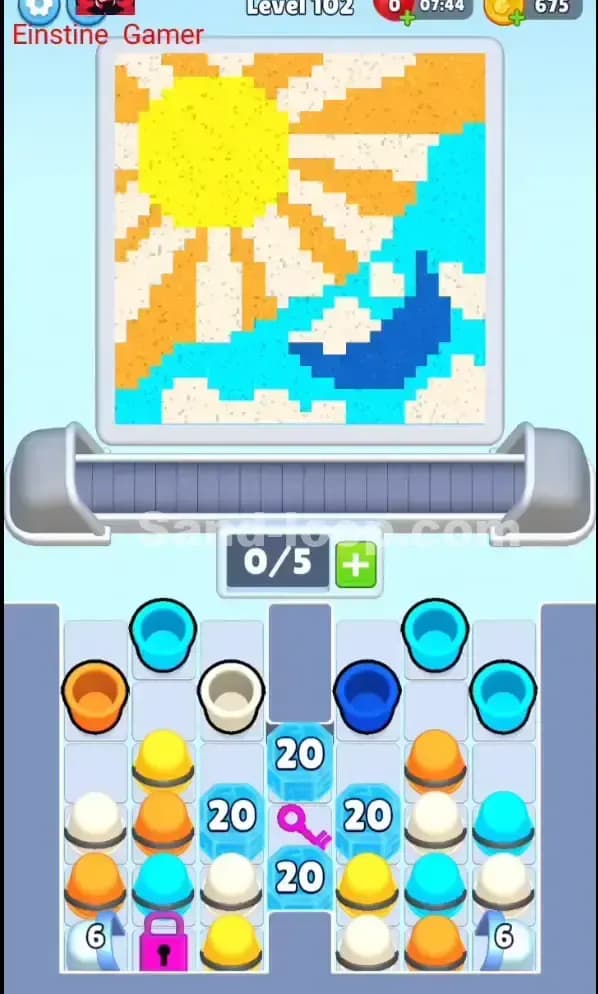
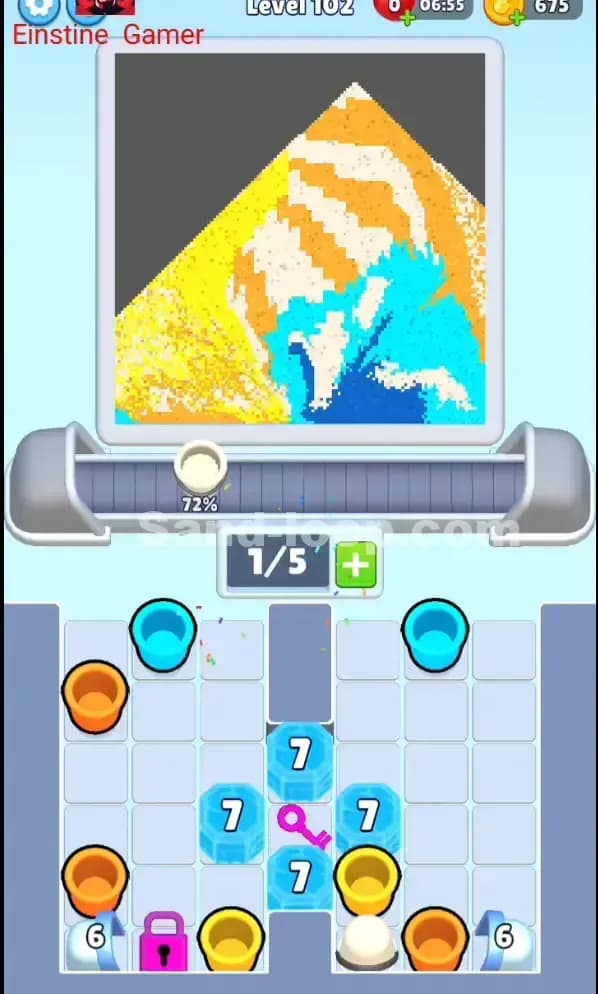
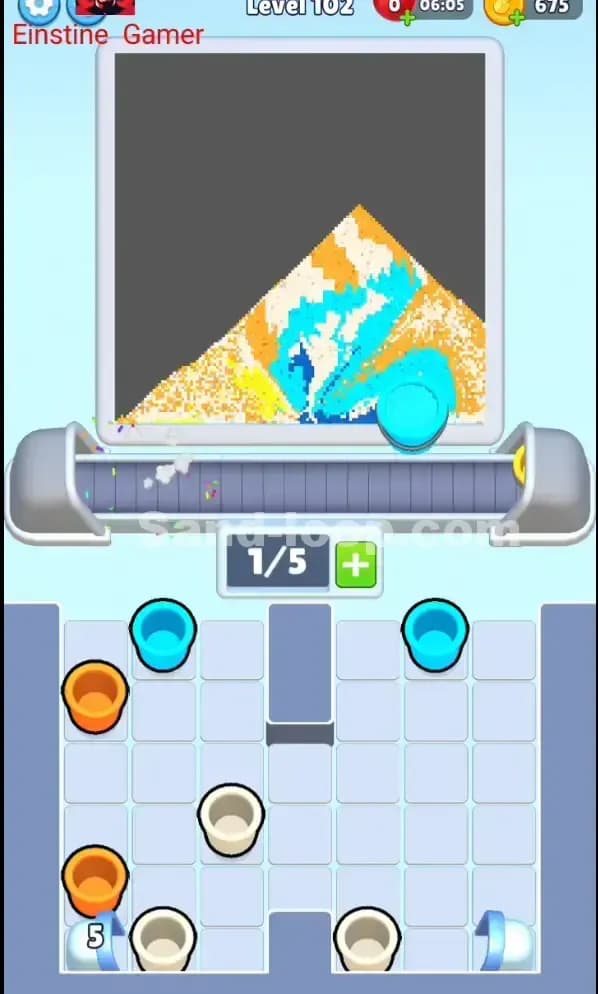
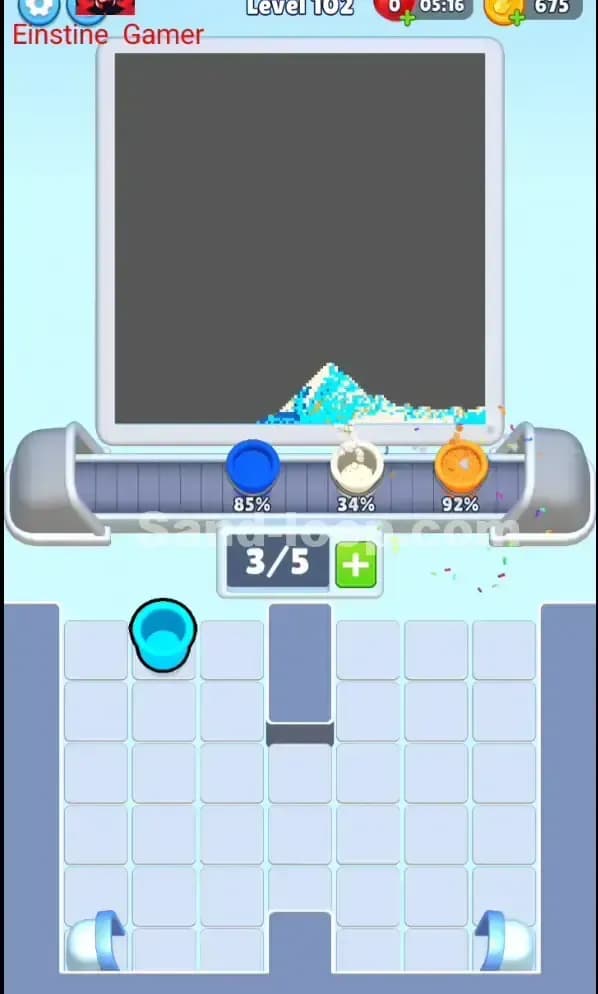
Sand Loop Level 102 Snapshot
Canvas Goal and Color Breakdown
Sand Loop Level 102 presents a vibrant, sun-themed composition dominated by a large bright yellow circle in the upper-left portion, representing the sun. The background is filled with warm orange tones, cool cyan and turquoise sections in the lower-right area, and cream/beige accents distributed throughout. This multi-color design means you're managing at least four primary colors: yellow, orange, cyan, and cream. The progress meters show you're working toward a balanced fill, and the mix of warm and cool tones means you can't just spray one color repeatedly—Sand Loop 102 demands precise color sequencing.
Starting Setup and Slot Economy
You begin Sand Loop Level 102 with a conveyor belt capacity of 0/5, meaning all five slots are empty and ready. The supply tray below is densely packed with cups of various colors, and critically, several cups are blocked or stacked deep. You have immediate access to orange, cyan (light blue), and cream cups near the front, but the yellow cups are partially buried, and dark blue cups sit deeper in the stack. This setup is deceptive: while you have many cups available, poor unblocking decisions in the first two moves will jam your conveyor and kill your momentum.
Win Condition for Sand Loop 102
To beat Sand Loop 102, fill the canvas until all color progress bars max out without wasting pours, overflowing any single color, or contaminating regions with wrong-color sand. You have a 0/5 starting slot economy, which means every cup choice matters. The level rewards players who plan three moves ahead and punishes those who load cups reactively.
Why Sand Loop 102 Feels Hard (The Actual Bottleneck)
The Real Puzzle: Unblocking Yellow Without Jamming
Sand Loop 102 isn't hard because the colors are tricky—it's hard because yellow cups sit buried beneath orange and cream in the tray, yet the canvas demands a massive yellow fill (that huge sun circle). You need to dig out yellow cups early, but pulling them creates a domino effect: other cups shift into blocking positions, and if you're not careful, you'll have five cups on the conveyor waiting for the pour point, with no empty slots to pull fresh cups. This creates a deadlock where your conveyor can't cycle and you're forced to waste a pour or restart.
Three Classic Traps in Sand Loop 102
Trap 1: Overfilling orange too early. Orange is easy to grab, and the upper-left area does need orange. But if you mindlessly pour all orange cups before stabilizing yellow, the canvas will reach 70% orange saturation while yellow sits at 20%, and you'll run out of time or space.
Trap 2: Blocking cyan behind cream cups. Cyan is vital for the lower-right section, but cream cups sit in front of many cyan cups in the tray. Pull cream without a plan, and you'll exhaust cream slots while cyan remains trapped.
Trap 3: The five-slot wall. With only five conveyor slots, loading five cups back-to-back without gaps means you can't pull new cups from the tray for almost a full belt cycle. During that gap, you're forced to pour suboptimal cups or miss timing on critical color transitions.
Personal Take: Why This Level Stings
I'll be honest—Sand Loop 102 looks straightforward on the surface. You see the sun, you see lots of cups, and you think, "Just pour yellow, orange, and cyan in the right spots." But the first time you play it, you load three cups, the conveyor fills, and suddenly you realize the fourth cup you needed is still locked behind a cream cup three rows deep. You're watching your color meters creep up imbalanced, and there's nothing you can do about it. It's frustrating because the solution isn't about reflexes or timing—it's about patience and micro-planning in the setup phase.
Step-by-Step Walkthrough to Beat Sand Loop 102
Opening Rhythm: First Four Cups (Moves 1–4)
Start by loading one orange cup into slot 1. Don't load a second cup yet. Let this first orange cup travel down the conveyor belt toward the pour point. While it's in transit (about 2–3 seconds), pull a cream cup from the front of the tray and load it into slot 2. You now have 2/5 slots full and two empty slots remaining—this is your safety margin.
Now, don't be tempted to grab another easy cup. Instead, look at the tray and identify the yellow cups that are one row away from the surface. Pull one yellow cup and load it into slot 3. Your conveyor now has orange, cream, and yellow lined up in an order that roughly matches the canvas priorities. Wait another 2–3 seconds, and as your orange cup passes under the dispenser, pour it into the canvas. This first pour should hit the upper-left orange accent area.
For move 4, pull a cyan cup from the front and load it into slot 4. Your remaining empty slot (slot 5) is your escape hatch if something goes wrong. You're now 4/5 and you have a deliberate pour sequence: cream (soon), yellow (medium term), cyan (late). This structure prevents the "oh no, I don't have the right cup at the pour point" panic.
Unblocking Plan: Freeing Buried Colors Without Jamming
Here's where Sand Loop 102 gets tactical. After move 4, your tray has shifted slightly. Cream and orange cups that were on top are now missing, and yellow is closer to the surface but still partially blocked. Don't pull yellow yet. Instead, pull the second cyan cup that's now accessible and load it into slot 5. You're at 5/5 capacity—the conveyor is full.
Now, as your first cream cup passes the dispenser (around 6–8 seconds in), pour it. This pour should hit the lower cream/beige regions in the center and sides. The moment that cream cup leaves the conveyor, you have one empty slot. Immediately pull a dark blue cup from deeper in the tray and load it into the now-empty slot. You're still 5/5, but you've cycled the order.
This unblocking rhythm is critical to Sand Loop 102: you're always pulling the next-needed color just as a cup leaves the belt. You never park five cups and wait. This keeps the tray from jamming, gives yellow and dark blue time to surface naturally, and prevents you from running out of slot space.
Mid-Game Control: Cycles 3–6 (The Balancing Act)
Around 30–45 seconds into Sand Loop 102, your yellow cup should be approaching the pour point. Before it arrives, glance at the canvas: is the big sun circle (yellow region) still mostly empty? Yes? Pour the yellow cup fully into that sun area. If somehow the yellow is already halfway full, hold off and let the yellow cup cycle around again (it'll loop back). This sounds strange, but deliberately skipping a pour prevents overfills.
Between cycles 3 and 6, your main job is alternating between warm colors (orange, yellow) and cool colors (cyan, dark blue) to keep both the upper and lower canvas regions advancing in tandem. If the lower-right is cyan-heavy but the upper-left hasn't caught up in orange, swap: load an orange cup and skip a cyan cup. If yellow is lagging, stack two yellow cups (load them back-to-back) with a small gap between them.
Keep one slot free at all times during mid-game. This is your insurance policy against tray jams and gives you the flexibility to react if a color meter spikes unexpectedly.
End-Game Precision: Final 15–20% (Moves 10+)
As Sand Loop Level 102 approaches completion, the meters are mostly full except maybe one or two colors sitting at 80–90%. This is where impatience kills runs. You might be tempted to dump three cups of the lagging color all at once. Don't. Instead, load one lagging-color cup and pour it. Watch the meter. If it's now at 95%, stop pouring that color entirely and cycle through other colors for timing buffer.
The last 2–3 moves of Sand Loop 102 should be cautious single-pours with 5–10 second waits between them. This prevents the last-second "oops, one color tipped over 100% and now I can't fill the last cream pixel" disaster. Finish when all color bars are visibly complete and the canvas is uniformly filled.
If You Mess Up: Quick Recovery Tactics
Mess-up scenario #1: You've poured orange six times and it's at 120% saturation. Recovery: immediately stop loading orange cups. Load only cyan, yellow, and dark blue for the next 5–6 pours. The unbalanced orange will sit there—it doesn't hurt you—and the other colors will catch up proportionally.
Mess-up scenario #2: Your conveyor is full (5/5) and the right cup is stuck three rows deep in the tray. Recovery: don't panic. Let your current cups cycle through. As each one pours, you get a slot back. After two or three pours (10–15 seconds), the buried cup will surface naturally. Load it then. You've lost some time but you're not restarting.
Mess-up scenario #3: You hit ~95% on all colors but there are still empty pixels. Recovery: load and pour very slowly, one tiny burst at a time, watching each meter climb. This is slow but it's the only way to avoid overshooting in the final 5%.
Why This Strategy Works in Sand Loop 102
Conveyor Lead Time + Slot Economy = No Deadlocks
The reason this walkthrough prioritizes keeping one slot free and cycling cups just as others leave the belt is physics: Sand Loop Level 102's conveyor has a 2–3 second travel time from load to pour. If you load all five slots immediately, you're locked into that sequence and can't adapt for 10+ seconds. By loading one cup, waiting, then loading the next, you're frontrunning the decisions. When your orange cup is halfway down the belt, you already have cream and yellow queued up and ready. You're never surprised by what arrives at the pour point, and you're never stuck with an empty slot while a buried cup waits in the tray.
This approach also keeps the tray physically unlocked. Each cup you pull from the top shifts the stack upward slightly. If you pull cups strategically (cream, then yellow, then cyan in that order), you're actively surfacing the next-needed color instead of burying it deeper.
Controlled Waste Prevention
The balanced pour sequence (orange → cream → yellow → cyan → repeat) ensures that no single color runs away to 90% while others languish at 20%. In Sand Loop 102, the worst outcome isn't failing to fill the canvas—it's filling the canvas, but one color hits 100% and the game declares a loss because you can't fill the remaining 5% with that color locked out. The strategy avoids this by treating the four colors as a cohesive unit, cycling through them in rhythm.
Additionally, every pour is deliberate and hits a designated region. You're not "pouring sand and hoping it lands in the right spot." You're timing pours to match canvas regions. This precision means minimal overspill into adjacent colors and minimal wasted sand.
Consistent, Repeatable Execution
This isn't a "get lucky with RNG" strategy. It's mechanical and repeatable. Load, wait 2–3 seconds, load, wait, pour, load, pour, repeat. If you follow this rhythm, you'll beat Sand Loop 102 in 60–90 seconds every time, with near-zero failed attempts. This is especially valuable if the level has move limits or time pressure (which many variants do).
Extra Tips and Adaptations for Levels Like Sand Loop 102
Six Mistakes and Instant Fixes
-
Mistake: Loading all five cups at the start. Fix: Load one, wait for it to reach the mid-belt, then load the second. Stagger your loads.
-
Mistake: Pouring continuously without gaps. Fix: Pour one cup, observe the meters, wait 3 seconds, then load and pour the next. Gaps give you decision time.
-
Mistake: Ignoring the cream cups because they seem "boring." Fix: Cream is the most frequently blocked color in Sand Loop 102's tray. Prioritizing cream early ensures you unblock cyan and yellow later.
-
Mistake: Assuming one color at 100% is okay as long as others aren't there yet. Fix: Once a color hits 100%, the game flags it. You cannot pour it again. Stop pouring that color immediately.
-
Mistake: Pulling cups from the tray without looking at what's beneath. Fix: Before pulling a cup, glance one row down. If pulling that cup will bury your next-needed color, wait and pull a different cup instead.
-
Mistake: Panicking when the conveyor fills. Fix: Pause, breathe, and let a cup pour. You immediately regain a slot. The solution is always "pour a cup," never "reload the level."
Booster Strategy (If Available)
If your version of Sand Loop 102 includes boosters:
- Extra Slot Booster: Use this only if you're at 4/5 slots and the perfect cup surfaces but your tray is jammed. It's not a "start with six slots" advantage—it's emergency relief.
- Slow Belt Booster: Use this in the final 10% when precision pours are needed. Slowing the belt gives you more reaction time to tap at the exact moment a cup reaches the pour point.
- Undo Booster: If you poured the wrong color and wasted 15% of one meter, undo that single pour and reload. Don't abuse this; save it for genuine mistakes, not "I want to redo the whole level."
- Swap Order Booster: Avoid this in Sand Loop 102. The strategy doesn't require swapping; it requires patience. Boosters usually cost premium currency, and patience is free.
Encouragement and Next Steps
Sand Loop 102 is tough, but it's a teaching level. Master it, and levels 103, 104, and beyond feel natural because you've internalized the core skill: planning conveyor sequences, managing slot economy, and cycling colors with intent. The first time you beat Sand Loop Level 102, it'll feel like a breakthrough. The second time, you'll do it in under 90 seconds. By the tenth time, you'll be breezing through it and wondering why it felt hard.
If you're still stuck, revisit the mid-game control section and count your pours. Are you pouring orange six times while yellow is at two? Swap the ratio. Are you running out of cyan cups? Pull every accessible cyan cup, even if it means temporarily over-cycling cyan—you can re-balance after.
For more strategies, in-depth videos, and community solutions, visit sand-loop.com, where players share Sand Loop 102 speedruns and alternative routes daily. You've got this—Sand Loop Level 102 is beatable, and you're closer than you think.