Sand Loop Level 120 Solution Walkthrough | Sand Loop 120
How to solve Sand Loop level 120? Get instant solution for Sand Loop 120 with our step by step solution & video walkthrough.

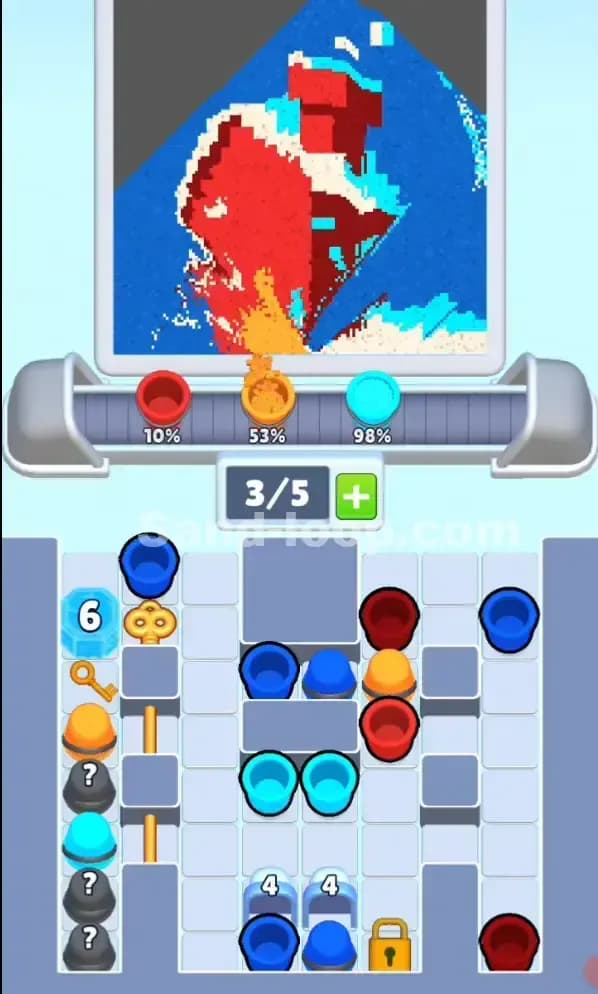
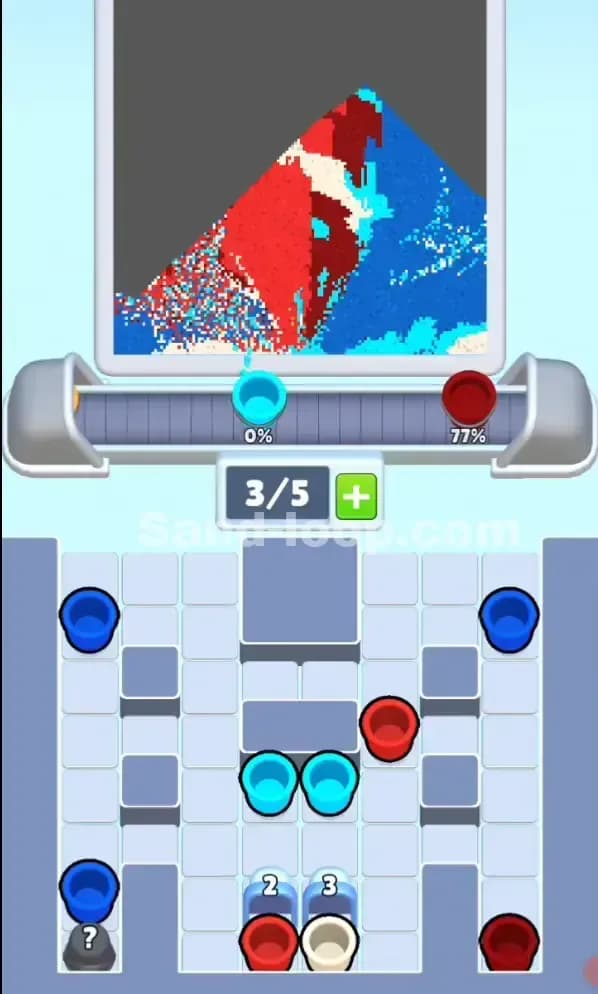
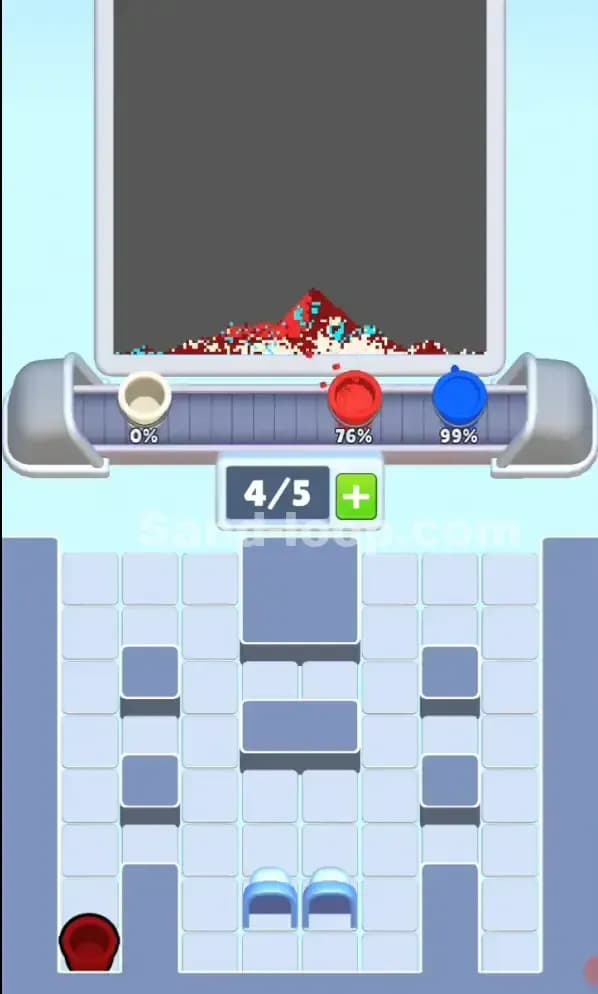
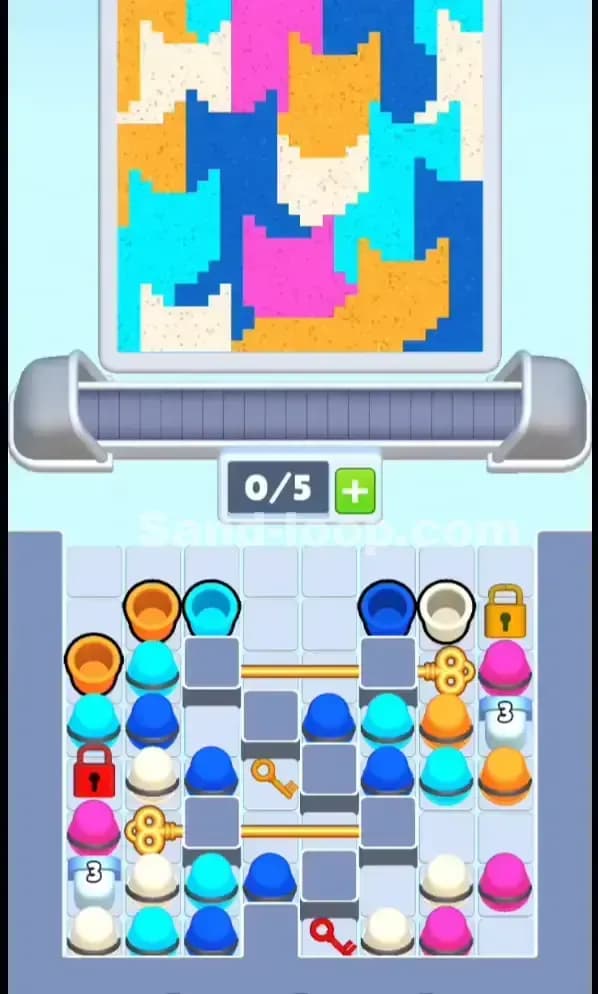
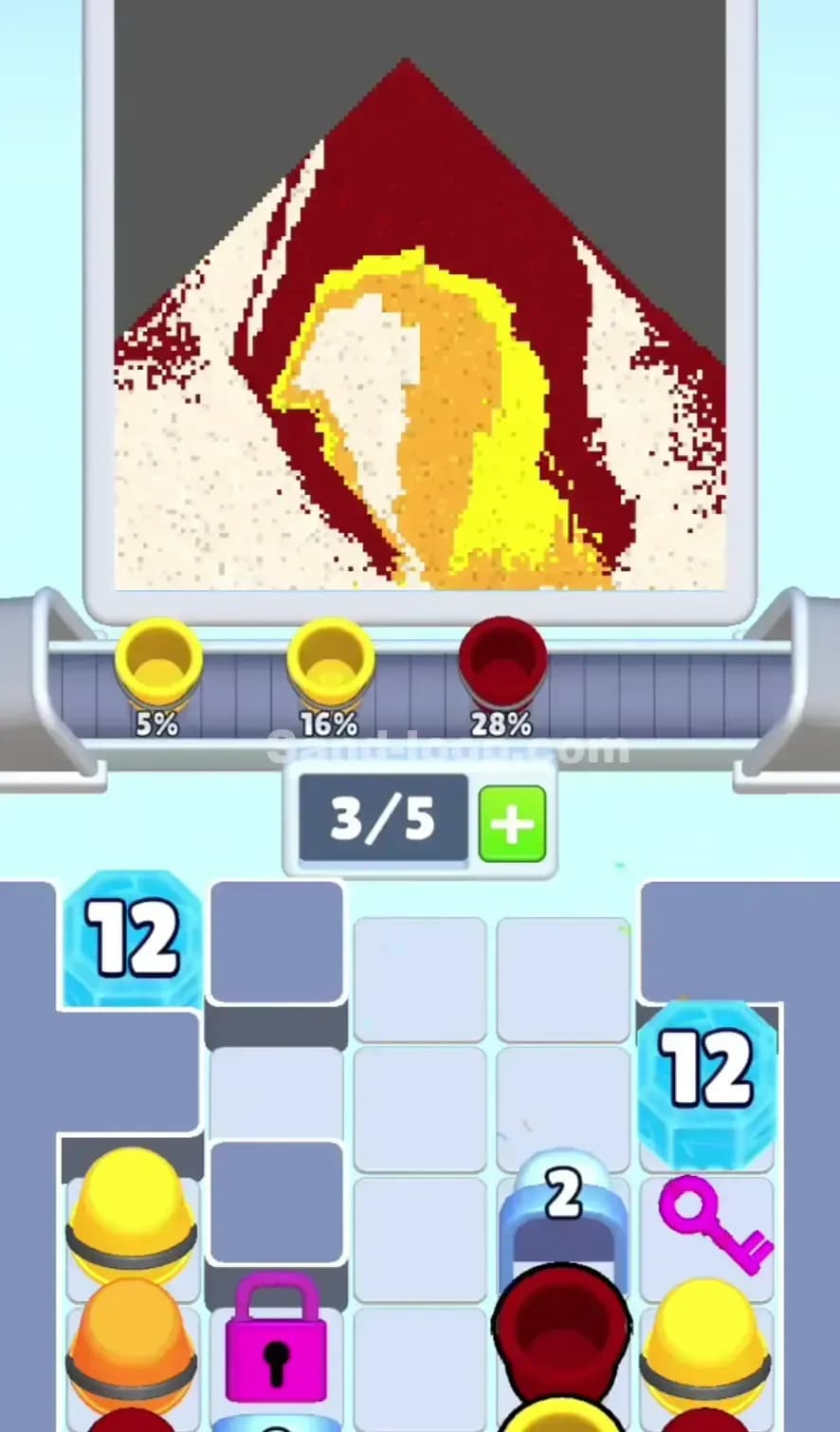
Sand Loop Level 120 Snapshot
The Canvas and Color Goals
Sand Loop Level 120 presents a charming pixel-art house scene dominated by a deep blue background, with a red house structure, cyan accents, cream-colored walls, and a golden door detail. The color progress meter shows 0/5, meaning you need to fill five distinct color zones to complete the level. The deep blue background is the largest region, but the red, cyan, and cream sections are precision targets that require careful management. This isn't just "pour until full"—you're building a specific image with exact color requirements.
Starting Setup and Supply Tray
You begin with a conveyor belt capacity of 0/5 slots, giving you room to queue up five cups before the system locks. Looking at the supply tray below, you've got a mixed collection: multiple golden/yellow cups, dark red cups, cyan cups, cream/white cups, orange cups, and several mystery cups (marked with "?"). Some cups are stacked or slightly blocked, meaning you'll need to carefully plan which ones you pull first. The key insight here is that not all colors are immediately available—you'll have to work through the tray's stack order to unlock the colors you actually need when you need them.
Win Condition
Fill the house image by delivering the correct colors to the canvas while meeting the 5-color target. You win when all five required colors reach their progress thresholds. The trick is doing this without overshooting (which locks you out of precise placement) or wasting pours on the wrong colors at the wrong time.
Why Sand Loop 120 Feels Hard (The Actual Bottleneck)
The Real Puzzle: Supply Tray Order Beats Timing
Most players focus on the conveyor belt and timing, but Sand Loop 120's true bottleneck is the supply tray stack. You're not free to pick any cup you want—you're limited by which cups are on top and unblocked. If you need cyan early but it's buried under two golden cups, you're forced to waste pours or get stuck. The level design forces you to think ahead: "If I pull the golden cup now, do I unlock the cyan I'll need in three rotations?"
Three Common Traps
Trap 1: Overfilling the blue background too early. The blue zone is huge and easy to fill. If you dump too much blue in the first few moves, you'll run out of slots for the precision colors (red, cyan, cream) that finish the image. You'll stare at an 80% complete picture and have no clean way to fill the last 20%.
Trap 2: Blocking yourself with the wrong cup order. If you queue up five golden cups in a row early on, you've wasted your slot economy. By the time you load cyan or red, your conveyor is full of useless pours moving down the belt. The lead time delay means those five golden cups are still delivering when you need to switch colors.
Trap 3: Mystery cups derailing your plan. Those "?" cups are unknown quantities. Load one and suddenly you're pouring an unexpected color, throwing off your color meter ratios and forcing recovery moves you didn't budget for.
Why It Looks Easy But Isn't
Honestly, I choked Sand Loop 120 twice because the house image looks so simple—just a few color blocks, right? But the gap between "I can see what colors I need" and "I can execute the exact sequence without jamming my conveyor or overfeeding blue" is huge. It's a rhythm-game timing problem wearing a puzzle-game skin.
Step-by-Step Walkthrough to Beat Sand Loop 120
Opening Rhythm: The First Three Rotations
Start by ignoring the mystery cups entirely for now. Look at your immediately accessible colors: you should have golden, dark red, and cyan cups visible on top of the tray. Your first move is to load one golden cup to fill the sand/ground section of the image. This buys you knowledge—you'll see how the pour behaves and confirm your color targeting is working. Don't load all golden cups. Instead, pull one, let it rotate through, then reassess.
Next, load one cyan cup immediately. The cyan accents are small but essential to the final image. Getting cyan on the belt early ensures you have it flowing while you manage the bigger colors. Keep at least two slots empty on the conveyor at this point—you want flexibility, not a locked queue.
By rotation three, pull one dark red cup. The house itself is red, so you'll need a steady supply, but don't rush. One cup per color in the first phase confirms all colors are flowing and nothing is blocked or causing overflow.
Unblocking Plan: Freeing the Precision Colors
Once you've confirmed the first three colors work, assess which cups are still stuck. If cream-colored cups are buried under two layers of orange, you need a plan: can you afford to pour orange now, or will that ruin your color ratios? A safe rule: pull blocking cups only if they're also colors you need soon, or if leaving them blocks a critical color you need immediately.
For Sand Loop Level 120 specifically, cream and orange cups are often interleaved. You'll likely need to pour a small amount of orange (or use it as a spacer) to unlock the cream cups you need for the house walls. Don't see this as "wasting" orange—see it as a deliberate unlock sequence. Plan for it: if you know you'll pour orange twice to unblock cream, reduce your golden pours by that amount to stay under the total canvas capacity.
Mid-Game Control: The Balancing Act
Once your conveyor is rotating smoothly, you're in the critical phase: maintaining balance without jamming. Always keep at least one empty slot on the conveyor. This prevents deadlock and lets you react if you accidentally queue the wrong color. If your meter shows 1/5 for red and you're already halfway done with blue, pause, load only red and cyan for the next three rotations, and skip any non-essential colors.
Use natural gaps strategically. When a cup is mid-rotation (traveling from the tray to the pour point), that's when you should load its replacement. This creates rhythm: cup lands, pours, you load the next one. Don't load two cups in rapid succession and then wait idle—that wastes the lead time and throws off your flow.
Watch your color progress constantly. If red is at 4/5 and blue is at 2/5, you're not balancing. Shift your loading pattern: pull more blue cups, fewer red cups. Sand Loop 120 requires you to be adaptive, not robotic.
End-Game Precision: The Final 10–20%
As you approach the goal, the remaining colors are almost always the precision ones: the last bit of cyan, the final cream, maybe one more red section. By now, your supply tray is partially depleted, so your options are narrower. This is where planning pays off.
If you've successfully kept one to two empty slots throughout the mid-game, you're golden. Load your final three cups with laser focus: check which colors are at 4/5 or 3/5, load only those. If a mystery cup is your last option and you've still got progress to earn, load it cautiously (only one), and be ready to adapt if it's a color you didn't expect. Don't panic—mystery cups are often decent colors, not dead-end colors.
The final pour is usually a slow fill. Let it happen. Don't interrupt the last cup mid-rotation; let it deliver fully. You've earned it.
If You Mess Up: Recovery Tactics
Overfilled a color? If blue is at 5/5 and you still have a golden cup on the belt, it's not a total loss. Load your remaining precision colors (red, cyan, cream) and let them deliver into the non-blue zones. You might not fill 100%, but you'll hit the five-color target if you played the early game well.
Loaded the wrong cup order? The lead-time delay is actually your friend here. If you just loaded a cup you realize is wrong, don't panic. You have 2–3 rotations to load a correcting cup. For example, if you meant to load red but grabbed dark red, load a true red next and let the dark red cycle through while you prepare. It's not ideal, but it's recoverable.
Slot economy locked up? This is rarer if you've followed the "always keep one slot free" rule, but if you're stuck with five cups queued and none of them are the color you need, wait it out. Let one cup fully deliver, then load your correcting cup. It's slow, but it works.
Why This Strategy Works in Sand Loop 120
Lead Time and Slot Economy Prevent Jams
By keeping at least one empty slot at all times, you're never painted into a corner. The conveyor's lead time (cups take time to travel from load to pour) means your decisions feel delayed, but that delay is actually a buffer. If you queue a cup now, it won't pour for two–three rotations, giving you time to correct course if needed. The empty slot lets you load that correcting cup without forcing out a cup that's already mid-journey.
This is why "load all five slots immediately" fails: you lose all flexibility. Sand Loop 120 punishes rigid, pre-planned sequences because the tray's blocked cups force you to adapt.
Controlled Waste Avoids the Background Overfill Trap
The "blue overfill trap" catches half of players because blue is so easy to deliver and the blue zone is so large. By treating blue as a steady, moderate pour (not a priority) in the early and mid-game, you reserve your slot economy for the hard-to-reach colors. When you finally fill blue to completion near the end, you've already locked in red, cyan, and cream—the colors that actually make the image recognizable. This approach flips the traditional "fill the big stuff first" logic, but it's the right move for Sand Loop 120.
Consistent Runs Through Planning
If you follow the unblocking plan and maintain the mid-game balance, your runs become predictable. You're not hoping to "get lucky" with cup order; you're actively managing supply. This means fewer 60% fails and more 90%+ completions. Over multiple attempts, that consistency turns into wins.
Extra Tips and Adaptations for Levels Like Sand Loop 120
Six Mistakes and Fixes
Mistake 1: Loading all one color at the start. Fix: Diversify your first five cups. One golden, one cyan, one red, and two flexible cups keep you balanced.
Mistake 2: Ignoring mystery cups until late game. Fix: Load one mystery cup in the mid-game (when you have a safety buffer), learn what it is, and plan accordingly. Don't let mystery cups be a surprise in the final moments.
Mistake 3: Pouring too fast when a cup reaches the pour point. Fix: Tap to pour once and let the game handle the delivery. Don't hold the button or spam-tap—that's how you overfill. One tap, one pour, move on.
Mistake 4: Not watching the color progress meters. Fix: Glance at the 0/5 meter every rotation. If one color is ahead, reduce its pours. If one is behind, prioritize it. This is your real-time compass.
Mistake 5: Filling precision zones before securing the background. Fix: Reverse this. Fill 60% of the background (blue), then nail down the precision colors (red, cyan, cream), then finish blue to 100%. You'll have way more control.
Mistake 6: Panic-loading mystery cups in the final two rotations. Fix: If you haven't loaded all your mystery cups by the 80% mark, just skip them. Let them sit in the tray. You don't need every cup; you just need to fill the five-color zones.
Boosters (if available in your game version)
If your version of Sand Loop 120 includes a Slot Booster (adds one extra conveyor slot), use it only if you're stuck in the late-game with a locked queue and no empty slots. This is a get-out-of-jail card, not a crutch for bad planning.
If there's an Undo Booster (rewind one pour), save it for the final two cups. If you accidentally overfill a precision color in the last rotation, undo and reload a different cup.
A Slow Belt Booster isn't necessary for Sand Loop 120; the standard timing is forgiving if you're patient.
Final Encouragement
Sand Loop 120 is a tough level, but it's absolutely beatable with the strategy above. The house image is charming, and hitting that five-color target is genuinely satisfying. You've got this. If you're still stuck, check out sand-loop.com for additional solutions and video walkthroughs. Now go fill that house!