Sand Loop Level 56 Solution Walkthrough | Sand Loop 56

How to solve Sand Loop level 56? Get instant solution for Sand Loop 56 with our step by step solution & video walkthrough.
Share Sand Loop Level 56 Guide:
Sand Loop Level 56 Gameplay
Sand Loop Level 56 Solution 1
Sand Loop Level 56 Solution 2
Sand Loop Level 56 Solution 3

Sand Loop Level 56 Snapshot

The Canvas: A Vibrant Multi-Color Puzzle

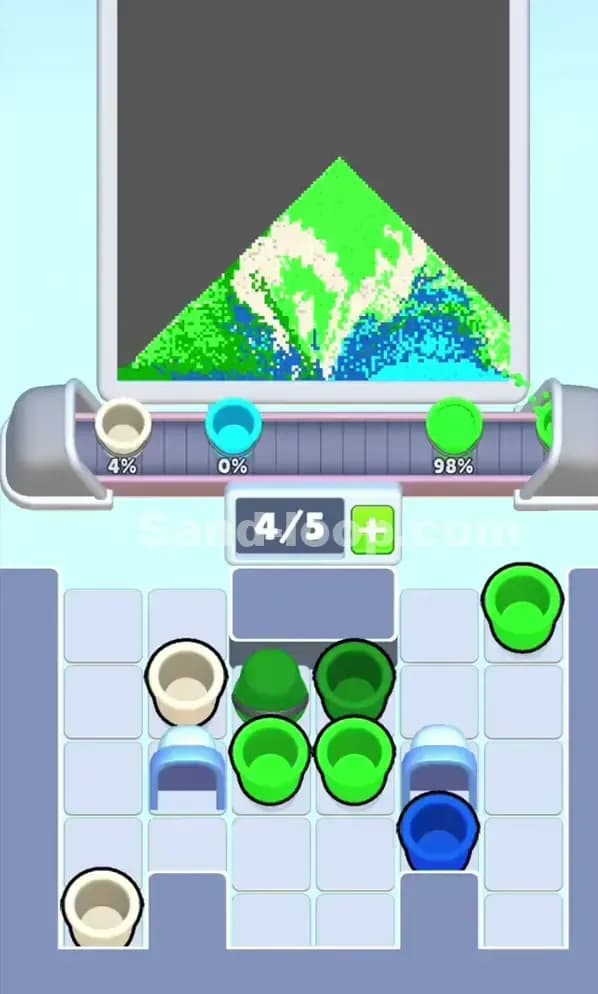
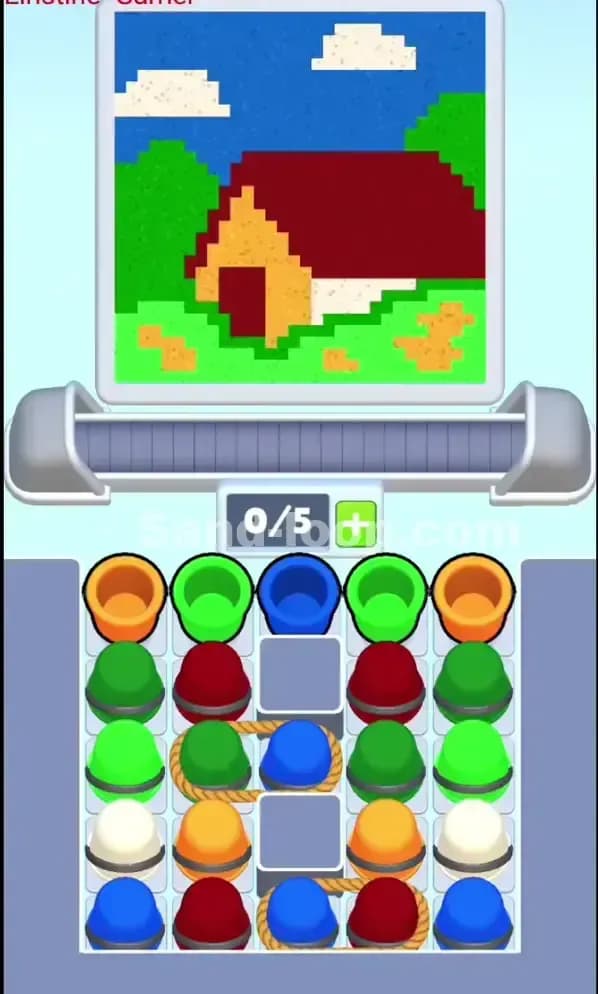
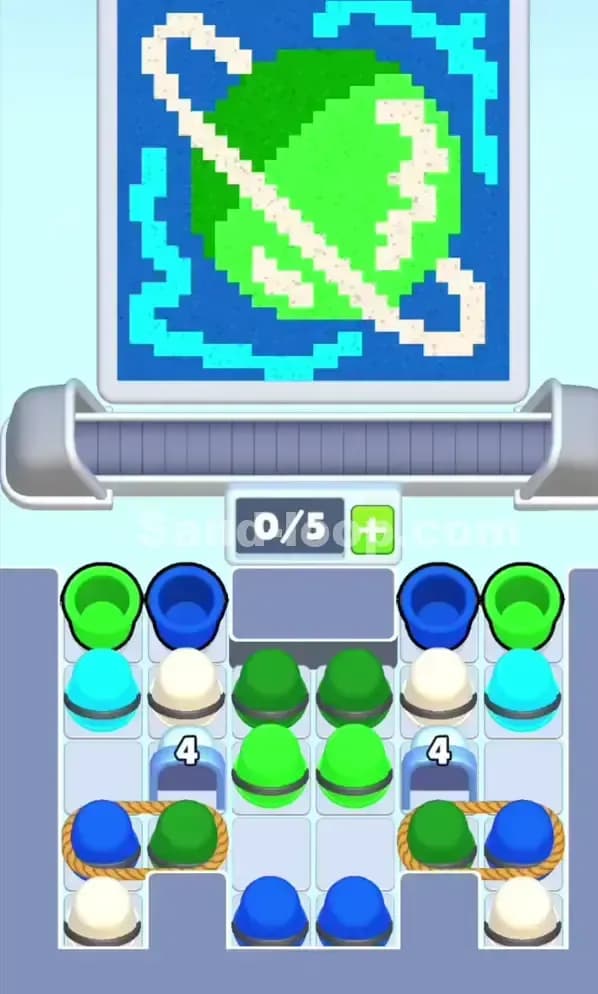
Sand Loop Level 56 throws a gorgeous but challenging canvas at you: a bright lime-green central orb framed by deep navy blue, cyan accents, and white highlight regions. The color progress meter sits at 0/6, meaning you've got six distinct color zones to fill in a very specific order. That green dominates the canvas, but the surrounding blue, cyan, and white sections aren't just decoration—they're essential progress gates. You can't skip to green-only; you have to balance all four colors or the level won't open up.

The Starting Setup: Tight Slot Economy

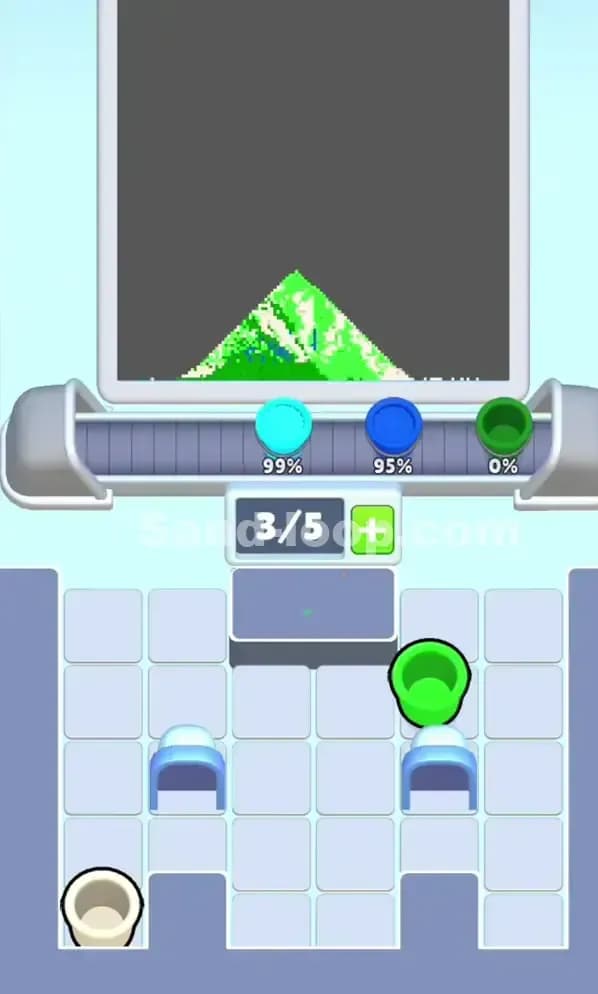
You're starting with a conveyor belt set to 6/6 capacity—every slot is full, and that's a problem waiting to happen. The supply tray below shows a mix of colors: green cups (multiple, stacked and partially blocked in the center), blue cups (positioned on the outer edges), cyan cups (flanking the sides), and white cups (buried deeper in the stack). The two green cups in the center stack are accessible, but they're covering other colors you'll need. You don't have the luxury of a free slot, which means your first move must create breathing room before the belt locks up.

The Win Condition

Fill the canvas so all four color progress zones (green, blue, cyan, white) reach their targets without overflow or waste. Sand Loop Level 56 is unforgiving about overfilling any single color—if you dump too much green too early, you'll lock yourself out of the blue and cyan regions, and recovery becomes almost impossible. The real test is sequencing: which color goes first, how many cups of each, and when to leave the conveyor empty to avoid jamming.


Why Sand Loop 56 Feels Hard (The Actual Bottleneck)

The Core Problem: Starting at 6/6 Capacity

You've got zero margin for error. A full belt means every tap triggers a pour immediately—there's no buffer time to replan. Most players panic and start pouring greens because they're visible, but that's a trap. Sand Loop Level 56 punishes greed. You need to shrink the belt load first, which feels counterintuitive when you're staring at a big empty canvas.

Three Classic Traps

Trap One: Greens Are a Decoy. Yes, green is huge on the canvas, but it's not the bottleneck color—it's the filler. Blue, cyan, and white are your gatekeepers. If you load green first, you'll overshoot and starve the precision zones. I choked this timing three times before I realized the order was backwards from what the canvas suggested.

Trap Two: The Stacked-Center Cups Block Everything. Those two green cups in the middle are sitting on top of colors you actually need. Every time you load green, you're delaying access to blue and cyan. The puzzle wants you to unblock methodically, but beginners just keep cycling greens because they're on top.

Trap Three: Continuous Pouring Ruins Precision. Sand Loop Level 56 requires discrete, planned pours—not holding down the button. Miss a single timing window and you'll overfill one color while another falls behind. The rhythm sounds easy but it's tighter than it looks.

Why It Feels Deceptively Easy

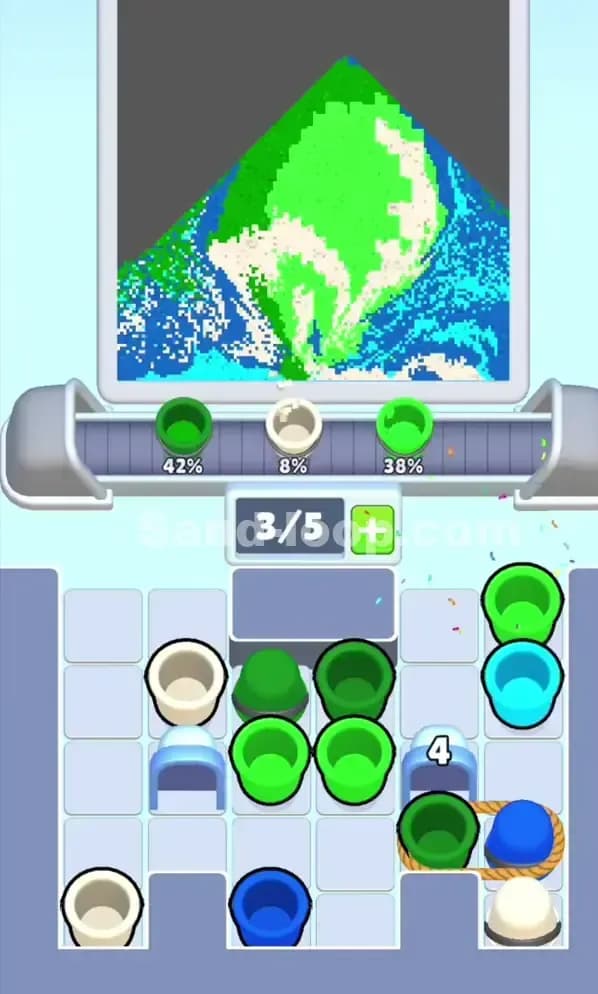
The canvas looks straightforward—just four colors, no weird shapes, no micro-zones. But the constraint is invisible: you can't see the progress meters until you start filling. By then, if you've locked green at 3/6 too early, you're stuck. The level doesn't punish mistakes loudly; it just makes winning impossible. That's what makes Sand Loop 56 so frustrating—you won't know you've lost until the last cup is gone.


Step-by-Step Walkthrough to Beat Sand Loop Level 56

Opening Rhythm: Create a Gap First

Before you tap anything, identify your first three moves. The conveyor is at 6/6, so your initial goal is to drop to 4/6 or 5/6 within the first minute. Here's the exact sequence:

  1. Tap to advance the belt. This pushes the first cup under the pour, and a new slot opens at the back of the tray. Don't pour yet—just let it move.
  2. Immediately load a cyan cup into the new back slot. Cyan is critical for precision, and it's currently buried. By loading it early, you ensure it cycles through within the next 6–8 actions.
  3. On the second pour window, tap and load a white cup. Again, don't pour—just advance and fill the new slot.

After these three actions, your belt should be at 5/6 or 4/6, and you've queued two scarce colors. This costs you nothing on the progress meters because you haven't poured a single sand grain. You've just repositioned the puzzle.

Unblocking Plan: Free the Key Colors Without Jamming

Now the central green stack is in its second or third belt position. Here's where you decide: do you pour green into the canvas, or do you advance it past the pour zone and then load blue underneath?

The smart play in Sand Loop Level 56 is to advance the greens past the pour without tapping—just let the belt move. As the greens exit the pour zone, you immediately load blue cups into the newly freed slots. This flips your tray's priority: blue and cyan are now in the upcoming queue, green is locked into the mid-belt pipeline.

Specific timing: Watch for the moment one green cup exits the pour zone. Immediately load a blue cup into that freed slot. Repeat for the second green. After two blues are loaded, start pacing your pours: one cyan, one blue, one white, then one green. Don't do two greens in a row—that's when overshoot happens.

Mid-Game Control: The Pace and Gap Strategy

Once you've unblocked the tray (roughly 20–30 seconds in), you're managing three meters simultaneously:

  • Blue: target 1–2 pours.
  • Cyan: target 1–2 pours.
  • White: target 1–2 pours.
  • Green: target 2–3 pours (the balance).

The trick is to enforce gaps: after every pour, let the belt advance one full cycle without tapping. This prevents the "continuous feed" disaster and gives you time to read the progress meters. You'll notice cyan and white climb faster than you expect—they're smaller zones. Tap for blue or white, wait for the belt to reset, then tap again. This rhythm feels slow, but it's how you avoid locking yourself out.

Here's a concrete example: Meter reads Blue 0/1, Cyan 0/1, White 0/1, Green 0/3.

  • Tap 1: Advance belt, load blue.
  • Tap 2: Pour white (now White 1/1 ✓ complete).
  • Tap 3: Advance, load cyan.
  • Tap 4: Pour cyan (now Cyan 1/1 ✓ complete).
  • Tap 5: Advance, load blue.
  • Tap 6: Pour blue (now Blue 1/1 ✓ complete).
  • Tap 7–9: Pour three greens spaced out (Green 3/3 ✓ complete).

That sequence took 9 taps and no waste. Every pour hit a target. No overshoot.

End-Game Precision: The Last 10–20%

When you're down to the final 1–2 pours, the belt is nearly empty and your margin is razor-thin. This is where you slow down even more. If green is 2/3 and everything else is full, you have exactly one more action: pour the last green, and you're done. But if you miscounted and green is actually at 2/3 while white is still at 0/1, you have a problem.

Prevention: In the last third of the level, take a hard pause between every pour. Read the meters. Confirm which color is still short. Load that color and only that color onto the belt. Advance it through a full cycle so you see it at the pour point. Then tap. This paranoia saves runs.

If you're on your final pour and you realize you've filled green past the target (say, 4/3), you've already lost—the level won't register completion. But this almost never happens if you use the gap strategy above.

If You Mess Up: Quick Recovery Tactics

Scenario A: You overfilled green early (Green 2/3, everything else 0/1).

  • Don't panic. Let the remaining greens cycle past the pour without tapping. Focus purely on filling blue, cyan, and white. You'll finish, but it'll feel tight.

Scenario B: You have 1 slot left and both blue and white are pending.

  • You can't load both. Load blue, advance it to the pour point, tap it, then load white. You'll need 2 more belt cycles, but it's doable.

Scenario C: The belt jammed because you filled it carelessly.

  • The game won't let you advance until you pour something. Identify the safest color to pour (the one closest to its target without going over), tap, and reset the belt. Then resume the gap strategy.

Why This Strategy Works in Sand Loop 56

Conveyor Lead Time + Slot Economy

Sand Loop Level 56's clock ticks twice: once when you tap (pour decision), and again when the cup reaches the pour zone (result). The gap strategy exploits this lag. By advancing the belt without pouring, you're "pre-positioning" colors. When cyan is six cups away, you don't need to pour yet; you just need to know it's coming. This mental prep prevents the panic-tap that ruins precision levels.

The 6/6 starting point is a feature, not a bug. A full belt forces you to think ahead. If you had infinite slots, you'd just load everything at once and pour carelessly. The constraint teaches you timing.

Waste Prevention and the "Overfill Lockout" Problem

Sand Loop Level 56 doesn't have an "undo" button—pouring too much green kills your run permanently. The ordered-pace method (blue, cyan, white, green, repeat) distributes pours evenly so no single color ever sprints ahead. It's mathematically safe. Even if you miscount slightly, you'll still fit four pours into a 4-target level without overflow.

Consistency Under Pressure

If this level has a move limit (some versions do), this strategy finishes in 9–12 taps max. It's predictable and repeatable. Once you nail it once, you'll replicate it every run. That's how you avoid the frustration of Sand Loop 56: consistency, not lucky timing.


Extra Tips and Adaptations for Levels Like Sand Loop 56

Six Specific Mistakes and Fixes

  1. "I tapped the belt five times in a row without looking at the meters."

    • Fix: Hard pause after every pour. Read the screen. Identify the next color you need. Only then tap again.
  2. "I loaded green on top of blue, so blue never appeared."

    • Fix: Watch the tray stack height. If blue is buried under green, advance without pouring until green exits the pour zone. Then load blue into the freed slot.
  3. "I poured white three times by accident."

    • Fix: Confirm the cup color is in the pour zone before you tap. Trace with your eyes: cup loaded → belt advances → cup reaches pour → tap. Don't auto-tap.
  4. "The belt is full and I can't load the color I need."

    • Fix: Advance without pouring (let cups cycle through) until a slot opens, then load immediately. This is what the opening rhythm prevents.
  5. "I finished green but blue and cyan are both still at 0."

    • Fix: You loaded greens too greedily. Next attempt: load blue and cyan first, before any green. Let them cycle through 1–2 pours, then load greens for the bulk.
  6. "The final pour was green, but the meter showed green was already at 3."

    • Fix: Count your pours aloud: "One green, two green, three green. Done. No more greens." Use your voice to lock in the count.

Boosters: When to Use Them (And When to Ignore Them)

If your version of Sand Loop 56 offers an Extra Slot booster, skip it early attempts. The puzzle is designed for 6/6 belt management; the extra slot feels like cheating and prevents you from learning the real skill.

However, if you've tried 5+ times and hit a wall, Extra Slot (to 7/6 or 8/6) removes the "belt full" deadlock and gives you flexibility on mid-game loads. Use it as a training-wheel, not a permanent crutch.

A Slower Belt booster is actually useful here because it gives you more real time between pours. If you find yourself tapping too fast and losing track, one Slower Belt run is worth it to practice the rhythm without rushing.

Avoid Undo unless you're truly stuck. Sand Loop Level 56 is solvable without it.

Final Encouragement

Sand Loop 56 is a "tight execution" level, not an impossible puzzle. You're not solving an unsolvable equation; you're practicing a rhythm. The first clear will feel hard. The second clear will click. The third clear you'll do blindfolded. Once you internalize the color sequence and the gap pacing, Sand Loop Level 56 becomes one of your reliable wins.

If you're still stuck after 10 attempts, visit sand-loop.com for video walkthroughs—seeing the belt rhythm in motion often clarifies what text alone can't explain. You've got this. Now go clear that beautiful green canvas.