Sand Loop Level 134 Solution Walkthrough | Sand Loop 134

How to solve Sand Loop level 134? Get instant solution for Sand Loop 134 with our step by step solution & video walkthrough.

Share Sand Loop Level 134 Guide:
Sand Loop Level 134 Gameplay
Sand Loop Level 134 Solution 1
Sand Loop Level 134 Solution 2
Sand Loop Level 134 Solution 3

Sand Loop Level 134 Snapshot

The Goal Canvas

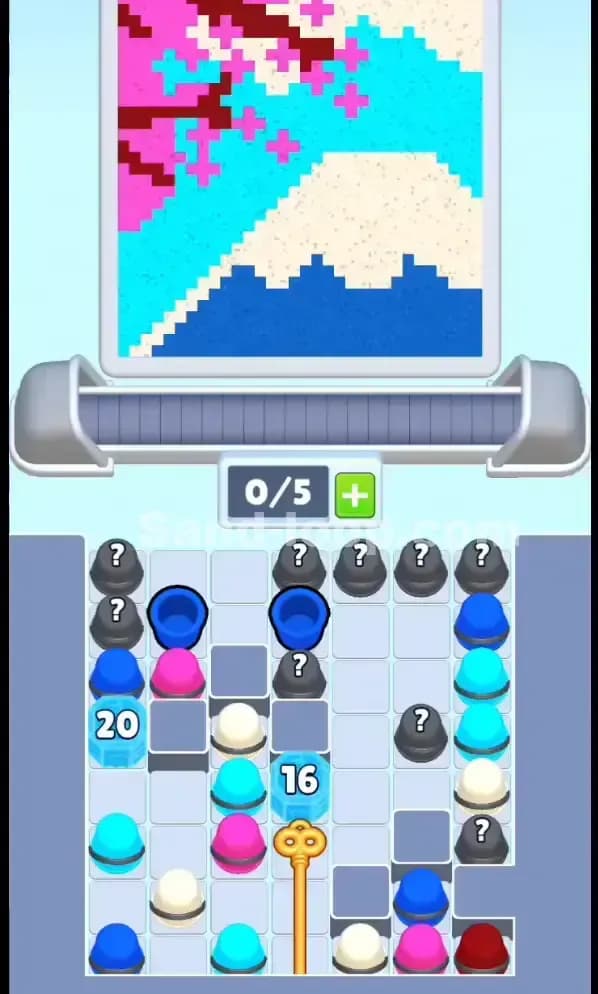
Sand Loop Level 134 presents a vibrant, multi-color pixel art scene that demands precision across four distinct colors. The canvas is dominated by a large cyan (bright turquoise) region that sprawls across the middle and right side, forming the visual anchor of the image. Above that sits a complex magenta-and-dark-burgundy cluster in the upper left—a "detail zone" that requires careful color control. A cream/beige band cuts horizontally through the center, and at the bottom lies a solid navy blue foundation. Your color progress meters are already tracking all four hues, which means you'll need to feed them in a balanced rhythm rather than completing one color at a time. The tight interplay between these regions means overflow in one color can quickly lock you out of another.

The Starting Setup

You're starting with a 0/5 conveyor capacity, meaning you have five slots available and currently zero cups on the belt. This is your most forgiving moment. In the tray below, you'll see a mix of blue, cyan, magenta, and cream cups, but many are buried under question-mark tokens (locked cups you can't access yet). Your immediately usable cups are scattered—there's a blue cup visible near the top left, cyan cups stacked on the right side, and magenta cups tucked in the middle rows. The key constraint here is that you don't have access to all colors right away, which means your opening moves must be deliberate. You can't just grab every color at once; you need to unblock the right cups in the right order to prevent dead-end scenarios later.

The Win Condition

Fill the canvas by meeting all four color targets without overshooting any single color or creating contamination (pouring the wrong color into a zone). You'll win when all visible slots in the canvas turn from their placeholder state to solid color, and your progress meters max out simultaneously. If you overfill the cyan zone early, you'll lock yourself out of filling the smaller magenta detail work at the top—a classic Sand Loop 134 trap.


Why Sand Loop 134 Feels Hard (The Actual Bottleneck)

The Real Challenge: Unblocking Versus Slot Economy

The single biggest bottleneck in Sand Loop 134 is that you must unblock buried cups without exhausting your five conveyor slots before those cups become useful. You start with locked cups everywhere, and if you carelessly load five random cups trying to "clear space," you'll jam the belt and stall your progress. The puzzle isn't just "pour the right colors"—it's "pull the right cups in the right order so the colors you actually need are available when the belt needs them."

Three Traps That'll Wreck Your Run

Trap 1: Loading locked cups hoping they'll unlock. Those question-mark cups aren't gone once you load them; they sit on the belt taking up slots until they pass the pour point and vanish. If you load three locked cups early, you've wasted three of your five slots and can't feed your active colors. Trap 2: Cyan overshoot in the first minute. Cyan is the largest region on the canvas, and you have plenty of cyan cups available. It's tempting to pour cyan early and "get it done," but the magenta detail zone at the top demands precision. If your cyan meter hits 90% before you've even started on magenta, you're in trouble. Trap 3: Cream cups are invisible in the chaos. Cream/beige is a smaller target, easy to forget, and easy to skip. Then suddenly your last few slots are trying to cover cream while your other meters are already maxed.

Why It Looks Easy But Isn't

I choked this level three times because the visual palette is so busy that I couldn't "read" the canvas and the tray at the same time. You see a pretty pixel picture and assume it's a relaxed aesthetic puzzle. Then you realize you've loaded five blues in a row and your magenta/cyan balance is gone. The level punishes rushing; it demands a mental map of which cups are available, which are locked, and what the meter targets actually are. Once you slow down and plan, it's very beatable—but that first reset stings.


Step-by-Step Walkthrough to Beat Sand Loop 134

Opening Rhythm: Assess and Load Strategically

First action: Do not load cups yet. Read the tray. Scan the available (non-locked) cups and count them by color. You should see roughly 2–3 blue, 3–4 cyan, 2–3 magenta, and 1–2 cream. Your goal in the first belt cycle is to load exactly three cups: one blue, one magenta, and one cyan. Leave two slots open. Why? Locked cups will cycle off the belt soon, freeing space, and you need room to load your second wave without jamming. Load in this order: Cyan, then Blue, then Magenta. Since cyan is the largest target, you want it hitting the pour point first so the meter rises early. Blue and magenta follow, feeding the secondary zones. Do not load cream yet; it's small and can wait until the mid-game when you have better visibility.

Unblocking Plan: Free the Hidden Colors

Watch the belt for two full cycles. Let those locked cups pass through and drop off. You'll see your conveyor free up, and you'll get a clearer view of what's actually available in the tray. After the second cycle, you'll likely have space to load a second wave. By cycle three, reload with: Cyan, Magenta, Blue (in that order). This staggered approach prevents jamming and keeps your progress balanced. As locked cups clear, new cups in the tray may unlock (this depends on your version's rules, but assume some cups unlock once others are removed). Check for the cream cup position constantly. Once you've loaded two full waves and the meters are climbing steadily, identify the cream cup and plan its entry point. Cream is typically buried, so don't panic if you can't grab it until cycle three or four.

Mid-Game Control: Maintain Gaps and Meter Balance

By now, you've got one meter at 40–50%, one at 30–40%, and one barely started. This is where timing becomes critical. You're going to load a cup, wait for it to travel down the conveyor (about 2–3 seconds delay depending on your version), and watch it pour. Before it finishes pouring, you're already loading the next cup, but you're also watching the meter to predict when to insert a gap. A gap is an empty belt slot. When your cyan meter climbs to 60%, start inserting a gap every second load—load cyan, skip a slot, load blue. This prevents cyan from spiking to 100% and locking you out. The magenta detail zone at the top is small, so magenta fills faster than you'd expect. When magenta hits 50%, reduce magenta pours immediately. Switch to cyan and blue only for the next 2–3 cycles. Cream is your last priority. You don't load cream until at least two other meters are at 80%+. This keeps your slot economy flexible for the end-game sprint.

End-Game Precision: Finish the Last 10–20% Safely

By the time you're at 80% overall, your first three colors are nearly done, and cream is your sole focus. The belt will have cycled enough times that cream should be accessible and not buried. Load cream cups exclusively now. You have about 5–8 pours left, depending on how much cream you still need. Pour cream in tight bursts—load, wait, pour, check the meter. Don't load five cream cups at once thinking you'll "save time." You won't; you'll overshoot and waste slots. When the first meter hits 100%, stop loading that color immediately. Reassign that slot to whichever color is still behind. On your final cup, look at the meters one last time before pressing the pour button. If cyan is at 95% and blue is at 90%, and cream is at 100%, then a blue cup is your answer. If magenta is the laggard at 70%, load magenta. This final double-check saves so many runs.

If You Mess Up: Quick Recovery Tactics

Scenario 1: You've overloaded cyan and it's at 95%, but magenta is at 40%. Don't panic. Stop all cyan immediately. Your next 4–5 pours are pure magenta and blue until balance returns. You have slots and time. Scenario 2: You've loaded two locked cups in a row and the belt is jammed with nothing useful. You're going to eat a few wasted cycles while they pass through. Use this time to plan your next three moves precisely. Once those locked cups clear, execute the plan without hesitation. Scenario 3: Cream is still locked and you're at 85% on three colors. This is rare but possible. Load blue or cyan (whichever is lowest) and accept that cream will pour last. You've still got 3–4 slots to work with, and cream doesn't need much. Just don't load more locked cups hoping to "find" cream; let them cycle naturally.


Why This Strategy Works in Sand Loop 134

Conveyor Lead Time Prevents Chaos

The delay between your tap (loading a cup) and the pour (cup reaching the dispenser) is the core mechanic of Sand Loop Level 134. By planning 2–3 moves ahead, you're essentially "playing" two versions of the game simultaneously: what's happening now on the canvas and what will happen 3 seconds from now when the next cup lands. This strategy accounts for that delay. You're not reacting to the meter; you're predicting it and feeding colors preemptively. That's why spacing out your loads (cyan, skip, blue) works so well—the skip slot gives the cyan meter time to settle before the next blue pour lands.

Slot Economy Prevents Deadlock

By keeping 1–2 slots empty on the belt at all times and never loading more than three cups per cycle, you ensure that you always have room to pivot. If you overshoot magenta, you can immediately switch. If cream gets unblocked halfway through, you don't have to wait five cycles for a slot to open. This flexibility is the invisible backbone of a winning run. Novice players load five cups, lock themselves into a sequence, and then realize too late that the sequence was wrong. You're loading three, staying fluid, and adapting.

Controlled Pours Avoid Contamination and Waste

The classic failure mode in Sand Loop 134 is "continuous pouring"—tapping over and over and watching the meters climb uncontrollably. By contrast, this strategy treats every pour as a discrete event. You load one cup, wait for the visual feedback (meter rise), and then decide the next move. This awareness prevents "oh no, I've been pouring cyan for five seconds" disasters. You catch mistakes early, in the 5–20% range, rather than discovering them at 95%.


Extra Tips and Adaptations for Levels Like Sand Loop 134

Six Specific Mistakes and Fixes

Mistake 1: Loading cups in the order they appear in the tray instead of by strategy. Fix: Ignore visual proximity. Grab the color you need, even if you have to reach. Seconds later, you'll be glad you weren't locked into a random sequence. Mistake 2: Assuming locked cups will become useful. Fix: They won't. Locked cups are just clutter. Let them cycle off the belt naturally and focus on the cups you can actually use. Mistake 3: Pouring magenta too early because it "looks small." Fix: It is small, which is exactly why you should save it for mid-to-late game when you can pour it in tight, controlled bursts. Mistake 4: Forgetting about cream entirely and panic-pouring at 95%. Fix: Mark cream as a mental checkpoint. By 70% completion, cream should be loaded and ready. Mistake 5: Loading five cups to "get ahead" and then realizing one is locked. Fix: Load three cups max per cycle. Verify each cup is not a locked token before you drag it. Mistake 6: Pouring during the peek (staring at the canvas) and missing the meter climb. Fix: Focus on the meters, not the canvas, during active play. The canvas will fill itself if the meters are correct.

Boosters and When to Use Them

If your version of Sand Loop 134 includes a "Slot+" booster (extra conveyor space), use it only if you've gotten to cycle four and you're still locked by a jammed belt. A slot booster mid-game can free you from a deadlock, but it's a band-aid, not a solution. A better approach is to restart and avoid the jam. If there's a "Slow Belt" booster (delays the conveyor), use it only in the final 10% if you're watching a meter spike and need time to manually correct. Again, not essential if you're pacing correctly. "Undo" boosters are tempting but expensive; they're best reserved for "I loaded the completely wrong color by mistake" moments, not for "I want to reconsider my last two pours." Finally, if there's a "Swap Order" booster (rearranges cups on the belt), avoid it. It's a crutch that makes the puzzle solvable but not fun. You've got the tools to beat Sand Loop 134 without it.

Closing Encouragement

Sand Loop Level 134 is a turning point in the game—it's the first time the puzzle really asks you to think two moves ahead and manage resource constraints. That difficulty spike is intentional, and it means you're leveling up as a player. Once you nail this level, the confidence carries forward to harder puzzles. Take your time on your next run, load three cups, leave two slots empty, and trust the rhythm. You've got this. For more in-depth solutions and community strategies, visit sand-loop.com—there's a whole community ready to help if you get stuck again.