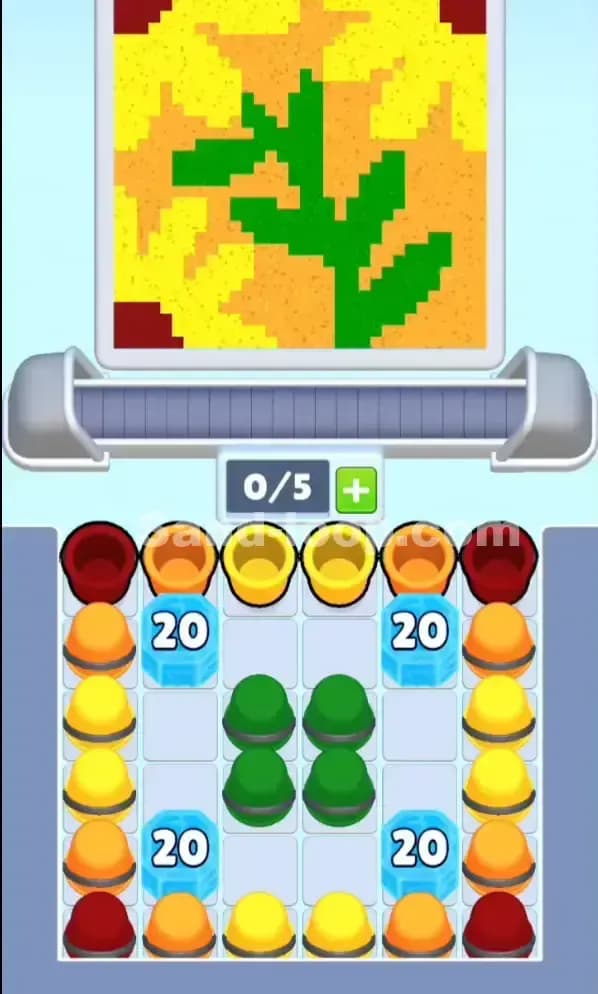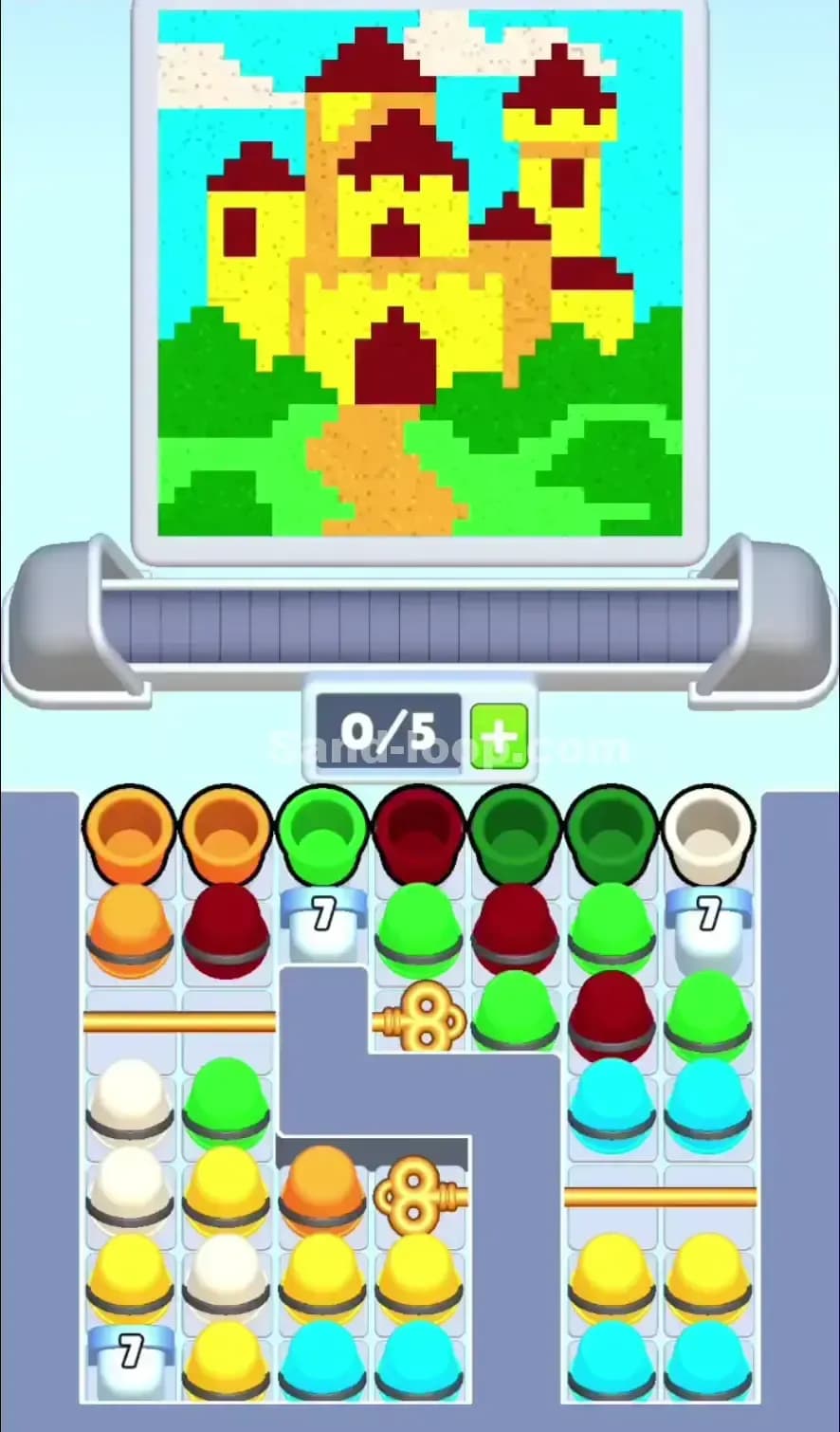
Sand Loop Level 141 Solution Walkthrough | Sand Loop 141
How to solve Sand Loop level 141? Get instant solution for Sand Loop 141 with our step by step solution & video walkthrough.



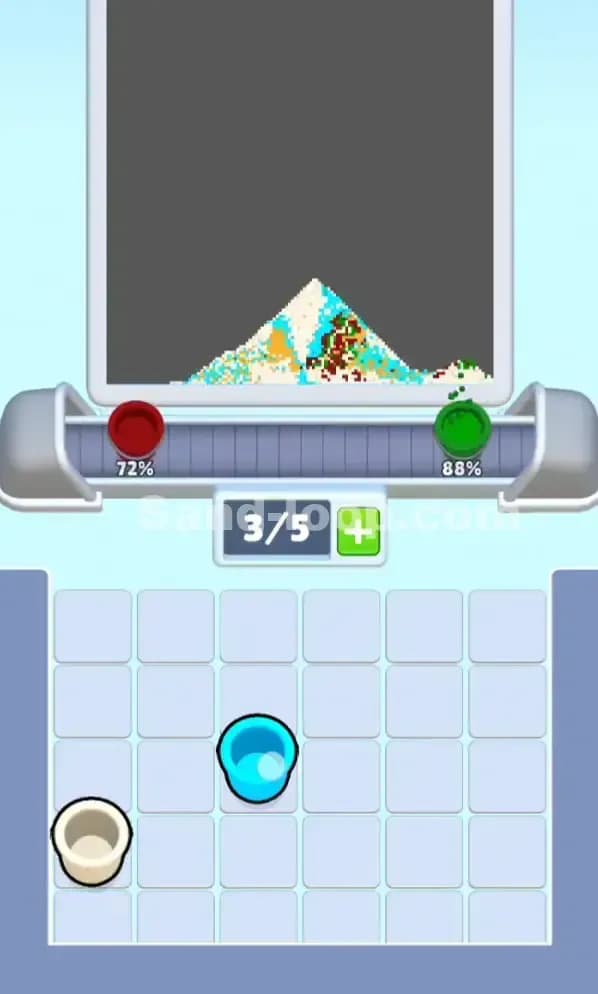
Sand Loop Level 141 Snapshot
The Canvas and Your Mission
Sand Loop Level 141 presents a charming pixel-art landscape: a cream-colored sky with green foliage at the top, a dark red tree trunk cutting vertically through the middle, cyan water in the lower half, and an orange/tan shoreline. The beauty here is deceptive—you're not just filling random space. The game tracks four dominant colors (green, cyan, orange/tan, and dark red), and each has a progress meter you must satisfy without overshooting. The canvas is large enough that one careless color pour early on can lock you out of victory later. This is why Sand Loop Level 141 demands precision, not just speed.
Starting Setup and Slot Economy
You're working with a 6/7 conveyor capacity, meaning you can load up to six cups at once before the system jams. The supply tray below is stacked strategically: orange and green cups are accessible at the top, but cyan and dark red cups sit deeper in the columns, requiring you to clear other colors first. The immediate challenge isn't pouring—it's unblocking. You'll notice the tray shows 20 and 25 quantity badges on certain columns, signaling which colors are abundant and which are scarce. In Sand Loop Level 141, orange and cyan are your workhorse colors; green and dark red are precision finishers.
Win Condition
Fill the target colors to their exact thresholds without overflow or waste. One misplaced pour, and you're burning moves. The level ends when all four color meters reach full and no empty cream-colored gaps remain in the canvas.
Why Sand Loop 141 Feels Hard (The Actual Bottleneck)
The Real Problem: Unblocking Dark Red and Cyan
You'd think the bottleneck is the conveyor speed or the cup capacity, but it isn't. In Sand Loop Level 141, the true puzzle is access. Dark red and cyan cups are buried under layers of green and orange in the supply tray. If you greedily load six green or orange cups onto the belt early, you'll jam your slots and find yourself unable to fetch dark red when the canvas desperately needs it in the final stages. This forced waiting is where most runs die.
Classic Trap #1: The Green Overload
Green is plentiful and tempting. You can grab green cups almost automatically, and the first 30% of the canvas does need green. But if you pour green continuously without restraint, you'll overfill the forest area and suddenly have nowhere to place that critical dark red tree trunk. I choked the timing here twice before realizing that leaving gaps in the pour schedule is actually a feature, not a failure.
Classic Trap #2: Cyan Timing Mismatch
Cyan cups are deep in the tray. By the time you've freed enough cyan to pour, the conveyor delay means your pour hits the canvas two or three seconds after you tap. If you miscalculate and load four cyan cups, three will hit the water area correctly, but the fourth will arrive after you've already moved on—wasting a slot and drenching the shore in cyan when you need orange.
Classic Trap #3: Slot Deadlock
This is the silent killer of Sand Loop Level 141. You load six cups, but none of them are the color you need right now. The system won't let you tap new cups until one leaves the belt. You watch helplessly as the wrong color pours while a perfectly good dark red sits trapped in the tray below. Many players panic and restart; the real fix is simpler: maintain 1–2 open slots at all times.
Why It Feels Hard
Sand Loop Level 141 looks straightforward—just match colors. But the puzzle is really about sequencing and restraint. You're not racing; you're choreographing. Every decision ripples forward three to five seconds thanks to conveyor lag. That's humbling, and honestly, it's why this level sits at 141 instead of 100.
Step-by-Step Walkthrough to Beat Sand Loop Level 141
Opening Rhythm: Load Smart, Leave Gaps
Start by loading only three cups: one orange (from the top-right column), one green (from the top-left), and one cyan (you'll need to clear one green first to expose it). Yes, three cups seems conservative, but you're not trying to fill the belt; you're trying to control what pours and when. Tap the sand dispenser and let these three cycle onto the belt. The orange will hit first (around 2 seconds), the green around 3 seconds, and the cyan around 4 seconds. This staggered arrival lets you observe how the canvas responds without committing four pours to the same color.
While those three are on the belt, do not load a fourth cup immediately. Use those 4–5 seconds to analyze the progress meters. If orange is climbing slower than you expected, you have breathing room. If cyan jumped surprisingly fast, you now know the next cyan pour needs to wait. Keep 2–3 open slots to preserve your flexibility. This is the golden rule of Sand Loop Level 141: idle slots are not wasted capacity—they're your control lever.
Unblocking Plan: Free Dark Red and Cyan Without Jamming
Around the 20-second mark, you'll have cycled six or seven pours and the meter should show roughly 1/4 of the canvas filled. Now it's time to deliberately unblock the buried colors. Load one orange, one green, one dark red (tap the second row of the center-left column), and two cyan cups from the now-exposed rows. Leave one slot open. Pour twice—enough to move those cups forward on the belt. As the first wave clears the belt (around 10 seconds), immediately load the next priority: if dark red is still climbing, load only green and cyan. If cyan is below target, load two cyan plus one dark red.
The key insight: don't load a new cup the instant the slot opens. Pause for a half-second. Look at the progress bars. Decide if you need that color or if you're just filling a slot out of habit. In Sand Loop Level 141, every cup is a commitment. Treat them like moves in a puzzle, not tokens to spend mindlessly.
By the 40-second mark (roughly halfway through), the tray should show no blocks: all four colors should be easily reachable from the top two rows. If dark red is still buried, you went too heavy on green early. Recover by loading only dark red and cyan for the next two cycles—no green, no orange. You'll "waste" two pours on colors you're already close on, but you'll unblock the tree.
Mid-Game Control: Cycling, Gaps, and Meter Awareness
This is where Sand Loop Level 141 tests your discipline. Between 50–70 seconds, you're in the sweet spot: all colors are unlocked, the canvas is half-full, and you can see the final composition taking shape. Load strategically: check the color with the lowest progress bar and dedicate two pours to it. If green is at 60% and dark red is at 40%, load one green, one dark red, leave a gap, then load two dark red, one green. This rhythm prevents any single color from spiking too early.
Avoid the trap of "continuous pouring." Tap once every 4–5 seconds. It feels slow, but it gives you reaction time. If cyan suddenly jumps to 85%, you catch it before loading another cyan and overshooting. The conveyor belt will run—you don't need to feed it constantly. Sand Loop Level 141 rewards patience.
Also, watch for the "pile-up" effect: if you load six cups and the first three haven't cleared the pour zone yet, you're creating a backlog. The belt moves at fixed speed; you can't speed it up by loading more cups. In fact, loading too many too fast guarantees one of them will pour at the wrong canvas location. Stick to 3–4 cups per cycle.
End-Game Precision: The Final 20%
At around 70 seconds, you'll have 80% of the canvas filled. Margins are razor-thin. At this stage, load one cup at a time, wait for it to pour, check the meter, then decide on the next cup. Yes, it's methodical, but it's the only way to avoid overshooting. If you need orange to hit 90% and it's currently at 85%, load one orange cup. Pour it. Verify the meter jumped 5%. Load another only if you're still below 90%.
Dark red and cyan are the hardest to meter in Sand Loop Level 141 because their sections (tree trunk and water) are visually concentrated. One extra pour of dark red can overfill the trunk and lock you out of the final cream-colored pixels. Load dark red in single cups. Cyan can handle slightly more tolerance because the water area is large, but still—pairs only, with gaps.
For the last few pours (the final 5% of pixels), switch to single cups exclusively. This is tedious, but one overzealous load will waste a move and potentially end your run.
If You Mess Up: Recovery Tactics
You loaded three cyan cups and cyan just hit 95%—one more would be catastrophic. Stop loading cyan immediately. Fill the remaining slots with orange, green, or cream cups (cream cups don't add color, they just fill space—use them if available). The next pour will be cyan, and it will overfill, but by then you'll have loaded an orange cup that will pour after, giving you a chance to rebalance.
Alternatively, if you have boosters active (or can afford one), an "undo last pour" will let you reject that cyan disaster and re-sequence. But in standard Sand Loop Level 141, you're stuck—just minimize the damage and prepare the next cycle to over-correct.
Why This Strategy Works in Sand Loop 141
Conveyor Lead Time and Slot Economy
The delayed pour is the core mechanic. By loading cups slowly (3–4 per cycle instead of 6), you let the earliest cups finish pouring before you commit to new ones. This way, you see the meter move, adapt, and load the next color based on actual feedback, not prediction. In Sand Loop Level 141, a one-second delay in loading saves you from cascading overshoot.
Keeping 1–2 slots open is not inefficiency—it's control. An open slot means you can load the exact color you need in the moment, not 5 seconds ago when you guessed wrong. The conveyor belt is a pipeline; if the pipeline is always full, you have no choice in what flows out. If it has room, you steer.
Avoiding the Background Overfill Trap
Green and orange are abundant and cover large canvas areas. The temptation is to pour them aggressively to "clear" them early. But Sand Loop Level 141's composition shows that green and orange aren't the final layer—dark red and cyan create detail on top of them. If you overfill green by 15% in the first 40 seconds, you've stolen pixels that dark red needs. By loading slowly and leaving gaps, you force yourself to pour each color in smaller chunks. Ten pours of one green each is safer than three pours of three green each, even if the total is the same, because you'll see the meter climb and stop sooner.
Consistent Runs
This strategy doesn't depend on perfect timing or luck—it depends on observation and restraint. Even if you pause for an extra second between loads, or misjudge a pour by one unit, you have buffer room because you haven't crammed six cups into the belt. Most players who beat Sand Loop Level 141 in one attempt (or within three tries) use this methodical pacing. The time-pressure players feel is artificial; the game rewards slowness.
Extra Tips and Adaptations for Levels Like Sand Loop 141
Mistake #1: Loading All Orange First
Fix: Orange is tempting because it's on the top shelf, but resist. Load one orange, one green, one cyan in your opening cycle. Diversity prevents regret.
Mistake #2: Ignoring the Progress Bars
Fix: Glance at the four color meters every 10 seconds. If one color is at 30% and the others at 60%, that's your signal: load more of the 30% color. Don't assume the tray's abundance matches the canvas's need.
Mistake #3: Jamming the Belt with Six Cups Immediately
Fix: Load three, pour, load three more. Splitting into waves gives you checkpoints.
Mistake #4: Panicking and Restarting After One Overfill
Fix: One overfilled color rarely ends a run. Load the opposite or neutral colors for the next 2–3 cycles and rebalance. Sand Loop Level 141 often survives a single mistake if you correct course.
Mistake #5: Forgetting Conveyor Lag
Fix: The cup you load now won't pour for 2–4 seconds. When you load, mentally note "this dark red will hit the canvas when the meter is around X%." Plan ahead, not reactively.
Mistake #6: Leaving Slots Open but Forgetting to Use Them
Fix: An open slot is only useful if you fill it with intention. Every load should be deliberate—"I'm loading this cyan because the meter is at 45%," not "because there's space."
Boosters for Sand Loop Level 141
If the level includes a "Extra Slot" booster, it's worth activating if you find yourself deadlocked (all cups loaded, nothing the canvas needs in the pour queue). However, in standard play, you shouldn't need it—this strategy keeps you unlocked naturally.
A "Slow Belt" booster is occasionally useful in the final 10% if you keep miscounting the delay, but it's not essential. Learn to count the 3–4 second delay instead; it's faster than using a booster.
An "Undo Last Pour" booster is your safety net for the catastrophic overshoot. If you accidentally load cyan and it hits 99% when you need it at 85%, this booster is worth spending currency on to recover.
Closing Thought
Sand Loop Level 141 isn't hard because it's complex—it's hard because it's patient. The game asks you to resist the urge to speed-run and instead trust a slower rhythm. Once you internalize the conveyor lag and respect the slot economy, the level shifts from frustrating to manageable. Most players who retry two or three times beat it without boosters. You've got this.
For more strategies and community solutions on levels like Sand Loop 141, head over to sand-loop.com—there's a treasure trove of walkthroughs, tips, and replay clips from players who've cracked every level from 1 to 150+. Happy pouring!