Sand Loop Level 151 Solution Walkthrough | Sand Loop 151

How to solve Sand Loop level 151? Get instant solution for Sand Loop 151 with our step by step solution & video walkthrough.

Share Sand Loop Level 151 Guide:
Sand Loop Level 151 Gameplay
Sand Loop Level 151 Solution 1
Sand Loop Level 151 Solution 2
Sand Loop Level 151 Solution 3

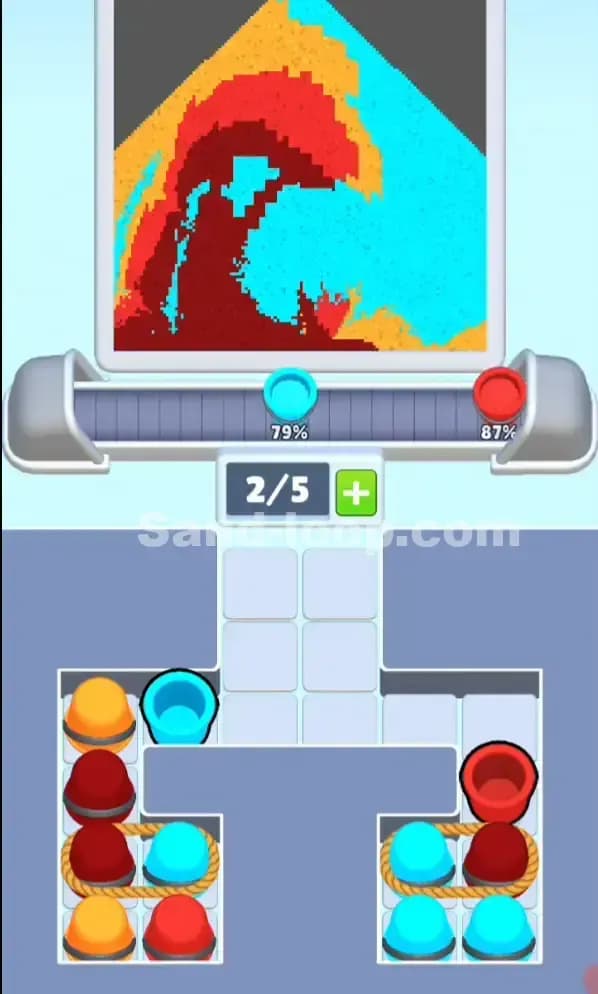
Sand Loop Level 151 Snapshot

The Canvas: A Complex Multi-Color Pattern

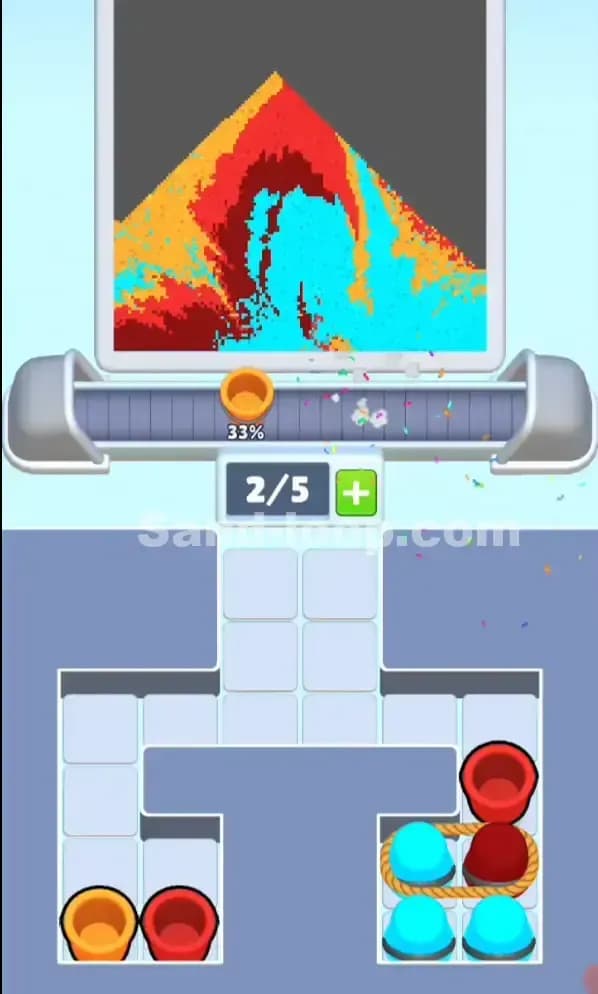
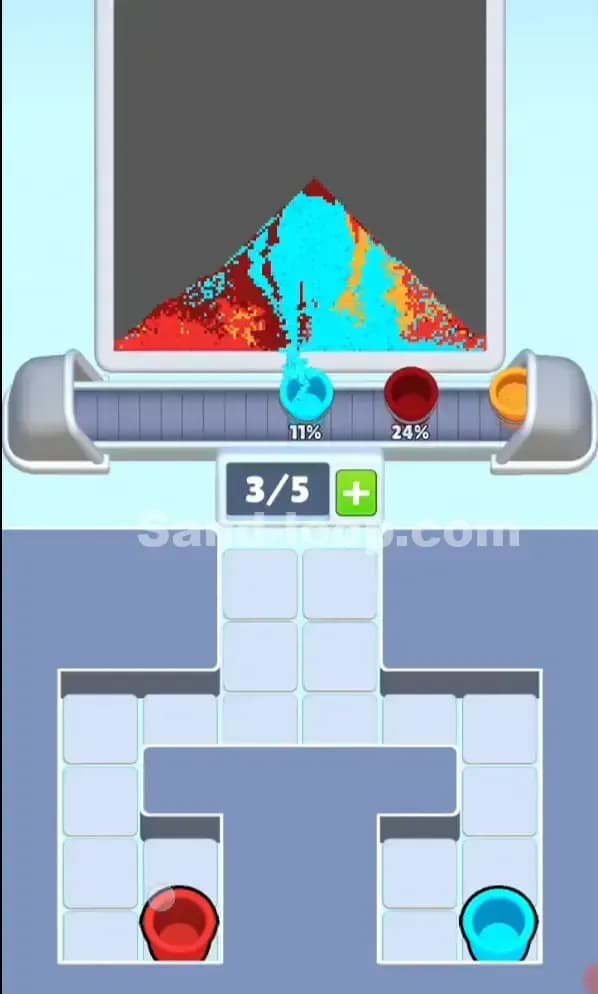
Sand Loop Level 151 presents a striking pixelated image dominated by four distinct colors: cyan (bright blue), dark red, bright red, and golden yellow. The canvas is split into overlapping regions—the top-left features a large dark red shape with cyan cutouts, the top-right shows vibrant cyan, and the middle-right and bottom sections layer in bright red and yellow accents. This isn't a simple "fill one color, then move on" puzzle; you're managing precise color distribution across four competing progress bars. The color targets are staggered, meaning you can't just pour one color until it's done and forget it—you'll need to weave between them strategically.

Your Starting Tray: A Locked-In Setup

You begin Sand Loop 151 with a conveyor capacity of 0/5, meaning all five slots are empty. The supply tray below shows a dense arrangement of stacked cups: two dark red cups at the top center (your most immediate grab), flanked by orange and cyan cups on the outer edges, with more dark red, cyan, and red cups buried underneath in a staggered pattern. The key insight here is that the dark red cups are accessible right away, but cyan and bright red cups are partially blocked—you'll need to unblock them at precisely the right moment to avoid jamming your conveyor belt.

The Win Condition

You must fill the canvas by pouring sand into cups on the moving conveyor belt, timing your pours so that each cup reaches the pour point when you tap. The level ends when all four color progress bars are satisfied without overflow, waste, or contamination. Keep your slot economy lean (aim for 1–2 free slots at all times), and you'll avoid the deadlock that claims most attempts.


Why Sand Loop 151 Feels Hard (The Actual Bottleneck)

The Four-Color Juggling Act

The single biggest challenge in Sand Loop 151 is that you can't prioritize one color cleanly—all four colors have significant canvas presence, so their progress meters will rise at roughly equal speed if you pour evenly. This creates a "whack-a-mole" pressure: you'll tap dark red, then switch to cyan before dark red overfills, then flip to yellow or bright red, and cycle back. One mistimed switch, and a single color spikes to overfill while the others lag. I choked the timing here twice before realizing I was pouring too greedily into dark red early on.

Two Silent Traps

First, the dark red cups in your tray look like the obvious first choice because they're on top—and they are the right first choice—but grabbing both immediately locks you into pouring dark red twice in a row, which will almost certainly overfill it before you've opened up your cyan or yellow options. Second, the staggered tray arrangement means that pulling a cup from the left or right outer positions can shift the internal stacks, accidentally unblocking cups you didn't want to use yet. Plan your tray extraction order, or you'll find yourself with unwanted cups on the conveyor while others remain stuck.

Why It "Looks Easy But Isn't"

Sand Loop Level 151 shows a clean, graphic image with four chunky colors—at first glance, you think, "I'll just pour each color a few times and I'm done." In reality, the timing of which cup reaches the pour point when you tap, combined with the four competing color meters, creates a rhythm-game difficulty that trips up players who rush. The conveyor lead time (your tap happens now, but the cup pours later) compounds this if you're not thinking ahead.


Step-by-Step Walkthrough to Beat Sand Loop 151

Opening Rhythm: Load Smart, Not Fast

Your first move is to grab one of the two dark red cups sitting on top of the tray—just one, not both. Load it into slot 1 of the conveyor. Wait for it to slide toward the pour point, then tap to fill it. Don't immediately load the second dark red cup. Instead, grab a cyan cup from the outer left position—this will be your second pour. The staggered tray layout means you can now access a bright red or yellow cup without jamming. By alternating dark red → cyan, you're spreading the load across two major color zones on your canvas and keeping your meter reads balanced. Maintain 2–3 free slots on the conveyor at all times; this prevents deadlock and gives you flexibility to swap priorities if a color threatens to overfill.

Unblocking Plan: Sequenced Extraction

Once you've poured dark red once and cyan once, the tray has shifted slightly. You'll notice the bright red cups are now more accessible from the right side, and the yellow cups are emerging from the inner-left position. Don't grab two of the same color in a row—you're not trying to "clear" a color, you're trying to keep all four progressing evenly. Your second dark red cup should come out after you've done cyan and at least one yellow or red pour. This sequenced approach ensures you never accidentally load a blocked cup and it also delays the heavy colors (dark red and bright red) so that the lighter accents (cyan and yellow) can catch up on the canvas. The fewer blocked/stacked cups in your way, the easier it is to maintain rhythm later.

Mid-Game Control: The Cycling Cadence

By the time you've done 5–8 pours (roughly halfway), your canvas is roughly 40–50% filled, and all four color bars are climbing. Now's when the rhythm matters most. You'll be cycling through: dark red → cyan → bright red → yellow, and then repeating. Each color gets poured once per four-cup cycle. Watch your progress bars closely; if dark red creeps faster than the others, skip it for one cycle and do cyan twice. If yellow lags, grab a yellow cup earlier in the sequence. This mid-game phase is also when the tray becomes more fluid—fewer cups are stacked, so grabbing your next color is faster and you have more control. Resist the urge to pour "just one more" of your favorite color; discipline here saves failed attempts later.

End-Game Precision: The Final 10–20%

As you approach the finish line, your conveyor rhythm is probably second nature—but now you need to read the progress bars like a fuel gauge. If dark red is at 80% and the others are at 70%, stop pouring dark red entirely until the others catch up. The end-game is about precision, not speed. You might spend 4–5 cycles pouring only cyan, yellow, and bright red to level out the canvas. Don't panic if it feels slow; you're avoiding the overfill trap. Once all four colors are within 5–10% of each other, you can do one final balanced cycle to cap them all simultaneously. The level ends the instant all progress meters hit 100%, and there's no "almost" in Sand Loop 151—overfill by even one pixel and you'll restart.

If You Mess Up: Recovery Tactics

If you accidentally loaded two dark reds in a row and dark red is now at 90% while cyan lags at 60%, don't panic—you have options. First, immediately pivot to only cyan, red, and yellow pours for the next 6–8 cycles. Dark red will stay locked at 90% while the others climb. The catch is that your tray now has mostly dark red cups remaining, so you'll burn through several "skip dark red" decisions before those cups rotate back out. If you've truly painted yourself into a corner (e.g., dark red at 100%, cyan at 40%, and all remaining cups are dark red), restart—it's faster than trying to thread an impossible needle. The lesson: if a color spikes above 85% and one other color is below 55%, your current run is likely unsalvageable, so reset early and save time.


Why This Strategy Works in Sand Loop 151

Conveyor Lead Time + Slot Economy = Prevention

By maintaining 2–3 free slots and loading cups in a four-color sequence rather than grinding one color at a time, you're working with the conveyor's delayed timing. Your tap happens now, but the pour happens 1–2 seconds later—so planning four cups ahead (dark red, cyan, red, yellow, repeat) means you're always "one decision ahead" of the pour point. You never panic-tap because you know exactly which colors are coming next. The free slots act as a buffer: if you realize mid-sequence that a color is rising too fast, you can skip one cup and re-plan your next four without jamming the belt. Tight slot economy (5/5 full at all times) leaves you zero flexibility and zero margin for error.

Waste Prevention Through Rhythm

Sand Loop Level 151 punishes sloppy pouring because overflow and contamination (wrong color bleeding into the wrong region) are instant game-overs. By cycling through colors evenly rather than binge-pouring one color, you're distributing the canvas fill smoothly and reading the progress bars honestly. There's no "I'll hammer dark red now and catch up with cyan later"—that's a guaranteed overfill. Instead, you're treating all four colors as equals throughout the run, so your final fill is balanced and clean. Waste also comes from grabbing the wrong cup by accident; the sequenced tray extraction plan minimizes this by always pulling from accessible, unblocked positions.

Consistency Across Runs

If Sand Loop Level 151 has move limits or attempt limits in your version, this strategy is repeatable because it doesn't rely on "lucky timing" or fast reflexes. You follow the same sequence (dark red → cyan → red → yellow, repeat), read the same progress bar cues (if one color is 10% ahead, adjust next cycle), and finish with the same balanced fill each time. You'll beat it within 2–3 attempts once the rhythm clicks, because you're solving the puzzle correctly, not hoping to fluke it.


Extra Tips and Adaptations for Levels Like Sand Loop 151

Six Mistakes and How to Fix Them

  1. Grabbing both dark reds at once: You'll overfill dark red before cyan is even halfway. Fix: Load one dark red, then immediately pivot to cyan or yellow. Come back to the second dark red only after one full cycle.

  2. Pulling cups from blocked positions: This shifts your tray in unexpected ways and can unlock cups you didn't want yet. Fix: Always grab from the outer edge or a clearly accessible cup. If a cup looks stacked under another, skip it this cycle.

  3. Pouring too fast early on: You rush through your first 5 cups and suddenly dark red is at 70% while cyan is at 30%. Fix: Slow down. A 4-cup cycle takes maybe 20–30 seconds; there's no timer pressure in Sand Loop Level 151, so breathe and read the bars.

  4. Ignoring the progress bars until they're critical: You get hypnotized by the conveyor belt and forget to glance at the canvas. Fix: After every two pours, check the canvas bars. If one color is visibly ahead, make a mental note to skip it next cycle.

  5. Panicking when one color hits 80%: It's not too late—you have room for 20% more. Fix: Switch to other colors for 3–4 cycles and let that high color cool down. You can almost always recover from 80% by being disciplined for a few rounds.

  6. Restarting too late: If dark red is at 95% and cyan is at 40%, with 10 cups remaining and 8 of them are dark red, you're done. Fix: Restart immediately rather than spending 2 minutes trying to escape. A fresh attempt is faster than a slow crawl to failure.

Booster Guidance (If Available)

If your version of Sand Loop 151 includes boosters, the "Extra Slots" booster is only useful if you're struggling with tray access (i.e., you feel forced to load cups you don't want). The "Slow Conveyor" booster is not recommended—it doesn't solve the color-balance problem, it just makes it slower. The "Undo Move" or "Rewind" booster is valuable insurance if you've nailed 90% of the run and made one wrong tap at the end; it lets you reset just that tap rather than the entire attempt. Use it sparingly and only when you're very close to victory.

Closing Encouragement

Sand Loop Level 151 is harder than it looks because it demands attention to four colors at once, but it's absolutely beatable with a calm head and a repeatable rhythm. Once you've done 2–3 successful runs, the pattern becomes automatic and you'll breeze through similar levels afterward. If you need additional strategy breakdowns or video walkthroughs for this level and others, check out sand-loop.com for more detailed solutions. You've got this—just remember: balanced, steady, and don't overfill. Good luck!