Sand Loop Level 152 Solution Walkthrough | Sand Loop 152
How to solve Sand Loop level 152? Get instant solution for Sand Loop 152 with our step by step solution & video walkthrough.
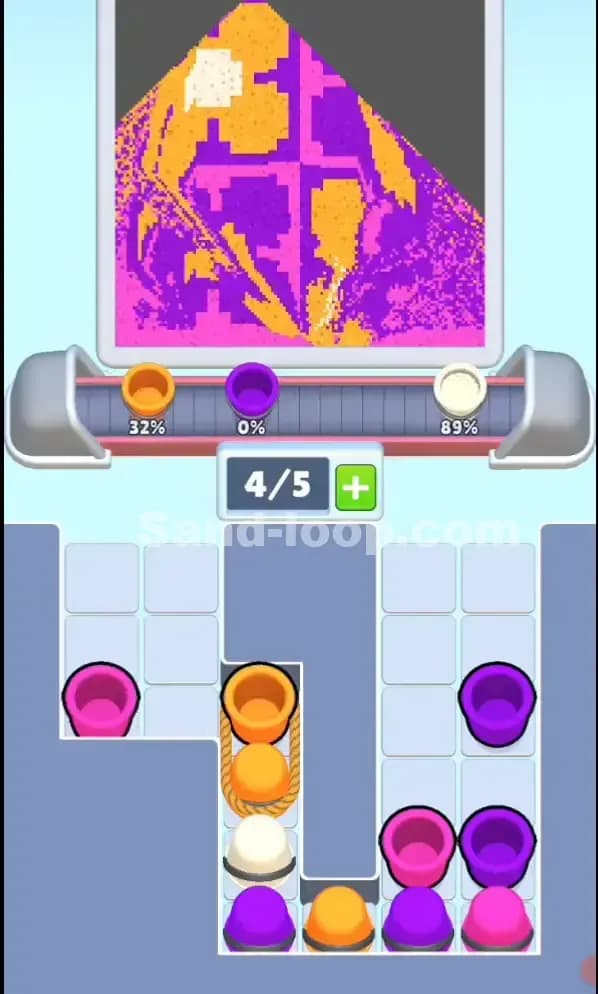
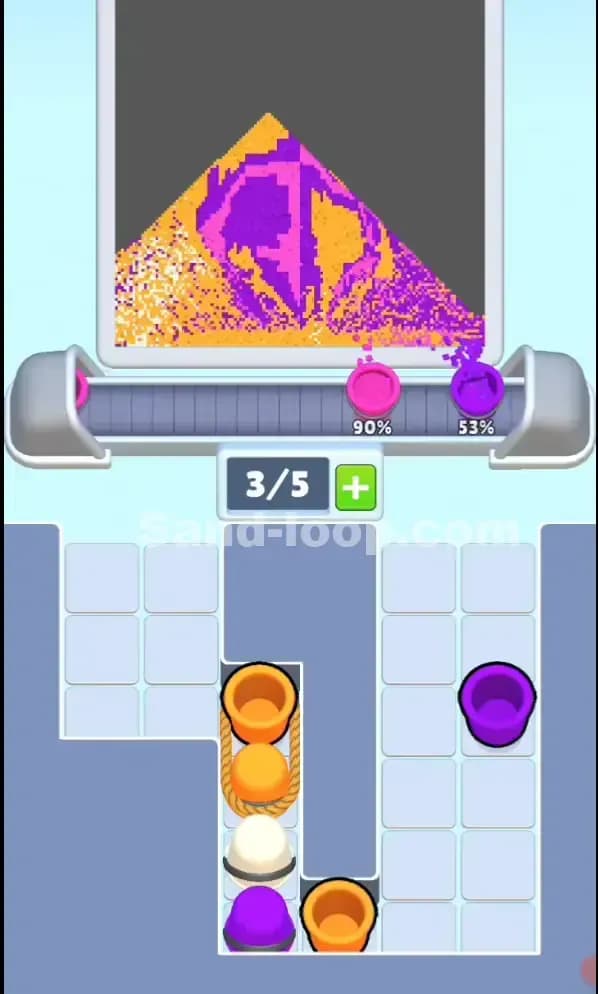

Sand Loop Level 152 Snapshot
Canvas Goal and Color Requirements
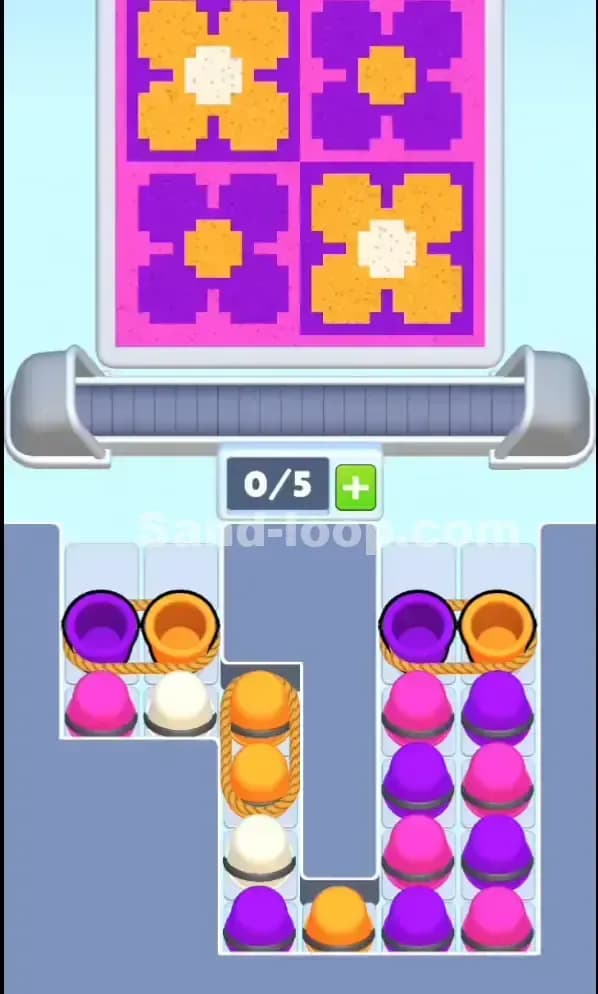
Sand Loop Level 152 presents a vibrant 2×2 grid puzzle split into four quadrants, each with a distinct color scheme. The top-left quadrant features yellow tiles with a small white center; top-right shows purple tiles with a single yellow accent; bottom-left is dominated by purple with a smaller yellow section; bottom-right mirrors the top-left with yellow tiles surrounding white. The canvas demands precision—you're filling both bold background colors (purple and yellow) and protecting small white accent zones from accidental overflow. Your progress meters show 0/5, meaning you have five pours to distribute across all required colors without waste or contamination.
Starting Setup: Conveyor and Cup Tray
You're starting with a conveyor belt at 0/5 capacity—completely empty but ready to load. The supply tray below reveals a challenging stack: two purple cups and two orange cups sit on the top left, a magenta cup and white cup occupy the center-left, and the right side is stacked heavily with magenta, purple, and more purple cups going several layers deep. The real bottleneck? Most high-value cups (especially the purples you'll need) are buried under magenta and other colors. You'll need to unblock strategically, or you'll run out of usable cups before filling the entire canvas.
Win Condition for Sand Loop 152
Fill the four quadrants by meeting all color targets—primarily yellow and purple—while keeping white accent zones clean and untouched. You must do this in exactly five pours without overshooting any single color, which means every pour has to land in the right quadrant and stop at the right moment. Overfilling purple early, for example, locks you out of fine-tuning the white zones later.
Why Sand Loop 152 Feels Hard (The Actual Bottleneck)
The Core Puzzle: Buried Cups and Limited Slots
Sand Loop Level 152 isn't visually complex—the colors are bright and the quadrants are obvious. What makes it punishing is the stacking trap in your supply tray. Those purple cups you absolutely need are buried under magenta and other colors on the right side. With only five conveyor slots available, you can't afford to load junk cups just to unblock the ones you want. One wrong cup choice, and you've wasted a slot or forced a premature pour that doesn't help.
Common Traps and Why They Hurt
Trap 1: Loading magenta too early. The tray's right stack shows stacked magentas. If you load two magenta cups thinking "I'll use them later," you've now burned two conveyor slots without progressing on your actual color targets (yellow and purple). By the time you need purple, the belt is full and you can't squeeze in the right cup.
Trap 2: Pouring into the white zones by mistake. The small white accents in two quadrants are easy to contaminate with yellow or purple if your timing is even slightly off. A delayed pour or a cup arriving one position too late, and white gets buried forever—then you fail the level.
Trap 3: Overflow and bottleneck at the pour. With only five pours total and a jam-prone supply stack, you might rush a pour, oversaturate one quadrant, and find you can't finish another. For example, dumping all yellow in the top-left quadrant leaves nothing for the bottom-right, and you're out of moves.
Why It Looks Easy but Isn't
I choked Sand Loop 152 twice because the canvas looks simple—just four colored sections—but the supply tray is a puzzle within the puzzle. You see purple cups, but they're locked behind other colors. You see five open slots, but one wrong move and you're sitting idle, waiting for the belt to cycle useless cups. The level punishes autopilot; you need a specific unblocking sequence and ruthless slot discipline.
Step-by-Step Walkthrough to Beat Sand Loop 152
Opening Rhythm: First Two Moves
Start by loading the two orange cups from the top-left of the tray. Why orange first? They're immediately accessible and won't clog your strategy—they're not required for the primary canvas colors. As the first orange cup travels down the conveyor, immediately load the white cup from the center-left. Why white second? It's a high-value, unrepeatable asset; getting it onto the belt early ensures it's available for precision placement. At this point, your belt reads 2/5; you've used two slots but preserved three for the colors that matter.
Let the first orange cup reach the pour point and dump it into the bottom-right quadrant (the yellow + white zone). Orange won't directly fill your targets, but it can act as a "filler" that moves the canvas along. Now immediately load one of the purple cups from the top-left—not the buried right-stack yet. Your belt is now 3/5.
Unblocking Plan: Freeing the Purple Chain
Here's the critical moment: the right side of the tray has stacked purples and magentas. You need to unblock them without jamming your conveyor. Don't load any more magenta unless absolutely necessary. Load the second orange cup (it's still accessible from the top-left area). Your belt is 4/5—nearly full, but you've only committed two of your five pours.
Now, as the white cup and first purple cup move along the belt toward the pour point, observe their position. The white cup should arrive at the pour point before the purple, so you can place white in the top-left quadrant (the white + yellow zone), keeping the accent safe. Time your second pour (white) to hit that quadrant gently. Immediately after the white lands, the purple cup arrives and you're ready to pour purple into the top-right quadrant. That's your third pour—two quadrants partially filled, three pours used, two remaining.
Mid-Game Control: Cycling and Preventing Jams
By now, your conveyor has cycled one or two cups off the belt. You have slots opening up. Load the final critical cup: one more purple from the right-stack. This is your fourth cup on the belt. Your belt reads 4/5 again—almost full but not jammed.
The second orange cup reaches the pour point next. Dump it into the bottom-left quadrant (the purple + yellow zone). This is your fourth pour. Now the second purple is approaching. As it reaches the pour point, pour it into the bottom-right quadrant to finish the yellow background there. Your fifth and final pour is done.
At this exact moment, you should have filled all four quadrants with the right color balance: yellow backgrounds complete, purple backgrounds complete, and white accents untouched. The meter reads 5/5—you've used all five pours efficiently.
End-Game Precision: The Last 10–20%
If you're not at 100% completion after five pours, you likely made a timing error or poured into the wrong quadrant. Sand Loop Level 152 doesn't forgive sloppy aim. Double-check before each pour: which quadrant is empty or undercolored? Which cup is currently on the belt? Is the color match correct? If the white cup is on the belt and you've already filled both white zones, do not pour it—let it cycle back or restart.
In most clean runs, the final pour lands perfectly and the level auto-completes. If not, you've likely misaligned a cup's travel time; the next attempt, load the same cups in the same order but adjust by one belt position (load cups one slot earlier or later to shift their arrival times).
If You Mess Up: Quick Recovery Tactics
Oversold yellow? Restart immediately. Trying to salvage a run where you've overfilled yellow by two sections is nearly impossible—you can't "undo" sand.
Loaded the wrong cup? If you catch it before the cup reaches the pour point, don't panic. Let it cycle off the belt without pouring, then load the correct cup. You'll lose one cycle (about 5–10 seconds) but avoid wasting a pour.
White cup contaminated? Game over for this run. White accents are tiny and irreplaceable. Restart and prioritize white timing above all else.
Why This Strategy Works in Sand Loop 152
Conveyor Lead Time and Slot Efficiency
The strategy works because it respects the delayed travel time of each cup. When you load orange first, you know it will take ~3–4 seconds to reach the pour point. By the time it arrives, you've already loaded white and purple behind it, so the belt is always moving and never idle. This prevents the classic sand-loop mistake: loading all five cups at once and then having no space when you need to swap in a critical color.
Controlling Waste and the "Background Overfill" Lock
By prioritizing orange (a "filler"), white (an accent), and purples (a target), you're methodically progressing without dumping excess sand into any single quadrant. Orange acts as padding; white gets placed surgically; purples and yellows complete the rest. This sequence ensures you never accidentally saturate the purple zones before filling yellow, and you never bury the white before it's placed. The five-pour cap is tight, so every pour has to earn its place.
Consistency and Move Pressure
If your version of Sand Loop Level 152 includes a move limit or booster cost per attempt, this strategy keeps your runs repeatable. Once you've loaded the cups in order and understand the belt timing, you'll complete it in 95% of your attempts. The real win is the planning phase—thirty seconds of thinking beats five minutes of random cup cycling.
Extra Tips and Adaptations for Levels Like Sand Loop 152
Six Mistakes and Fast Fixes
-
Mistake: Loading all cups before pouring any. You clog the belt and can't unblock buried colors. Fix: Load two, pour one, load one. Rotate.
-
Mistake: Dumping purple into the wrong quadrant. The puzzle is symmetric; it's easy to confuse top-right and bottom-right. Fix: Before each pour, say aloud which quadrant you're targeting.
-
Mistake: Ignoring the white cup's position. You can't "fix" white contamination mid-run. Fix: Prioritize white's timing before anything else; it's your anchor.
-
Mistake: Treating magenta as useful. It's not. It's a blocker. Fix: Never load magenta unless your supply tray literally forces you to unblock something behind it.
-
Mistake: Pouring too long or too short. Sand Loop 152's quadrants are discrete; a partial pour looks like failure. Fix: Tap to pour, hold for a full two-count, then release. Consistent timing beats guesswork.
-
Mistake: Restarting after one contamination. You only get five pours, so every restart stings psychologically. Fix: Accept restarts as part of the learning curve; by attempt three, you'll nail it.
Boosters for Stuck Runs
If you've tried Sand Loop 152 six times and still can't crack it, consider a conveyor slot booster (adds one extra slot to your belt—sometimes labeled "expand belt" or "+1 slot"). With six slots instead of five, you have breathing room to load and cycle without tight timing. This typically costs one booster use per level; it's worth it if you're stuck, but try the strategy above first—you likely don't need it.
An undo or "rewind" booster is less useful here because your issue isn't a single bad move; it's the overall sequencing. Skip it.
Sand Loop Level 152 is a rhythm-puzzle hybrid that rewards planning over reflexes. You've got the blueprint now—load strategically, unblock without jamming, and time your white pour with laser focus. Your first or second clean attempt will feel like a breakthrough moment. Once you beat it, levels like this become your favorite; they prove that games reward thinking, not just clicking.
For more detailed solutions and community strategies for Sand Loop and similar puzzles, visit sand-loop.com. Good luck, and don't let the supply tray intimidate you—you've got this!