Sand Loop Level 31 Solution Walkthrough | Sand Loop 31

How to solve Sand Loop level 31? Get instant solution for Sand Loop 31 with our step by step solution & video walkthrough.
Share Sand Loop Level 31 Guide:
Sand Loop Level 31 Gameplay
Sand Loop Level 31 Solution 1

Sand Loop Level 31 Snapshot

The Canvas Goal

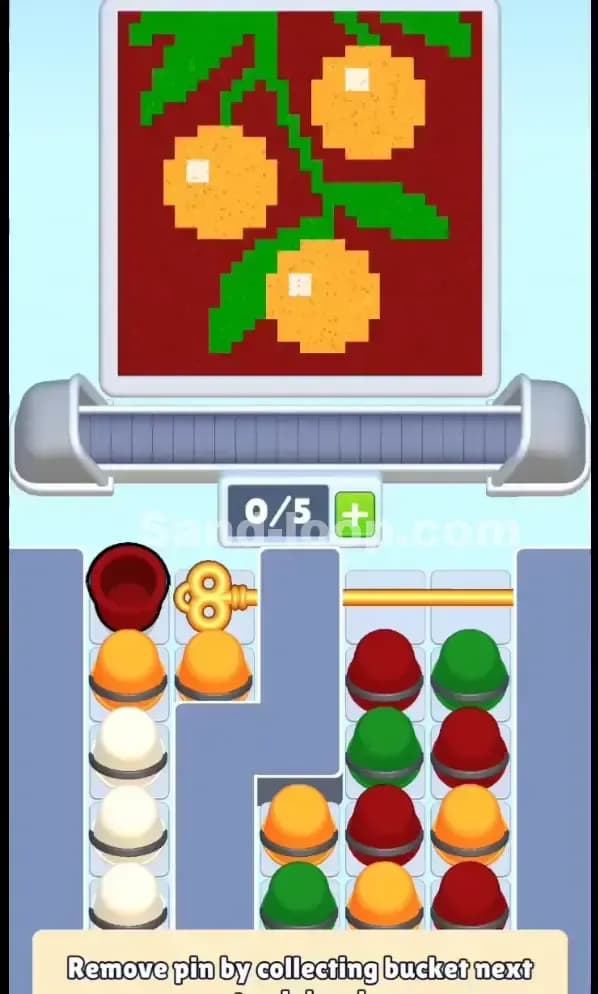
Sand Loop Level 31 presents a rich maroon or deep burgundy background with three golden-yellow circles scattered across it, each accented with a small white highlight. Between and around those yellow zones, you'll notice bright green angular shapes that form an irregular pattern—think jagged branches or lightning bolts cutting through the red. The color progress meters at the top show you're working with at least three target colors: yellow, green, and red (the background itself). The yellow circles are the "precision zones"—they're small, detailed, and require careful pouring. The green regions demand controlled bursts, and you'll need to fill the red background without overdoing it and locking yourself out of the finer details.

The Starting Setup

You're looking at a conveyor belt capacity of 0/5 slots—meaning the belt is completely empty when you start, which is actually freeing. Your supply tray below shows a mixed stack: you've got dark red cups at the bottom, orange and white cups in the middle column, and a scattered arrangement of red, green, and orange cups in the right columns. Critically, several cups are buried or blocked by others, so you can't immediately access every color. The yellow dispenser sits ready above the belt, but you won't pour until you've cycled the right cups into position.

The Win Condition

Fill the canvas by meeting the yellow, green, and red color targets without overfilling any single color. You must clear the canvas completely—no empty pixels, no accidental waste. The level's instruction ("Remove pin by collecting bucket next") hints that you're working toward a specific end-state that unlocks progression. Avoid contamination (wrong colors spilling into precision zones) and prevent slot deadlock by keeping 1–2 empty spaces on the conveyor as you work.


Why Sand Loop 31 Feels Hard (The Actual Bottleneck)

The Real Problem: Cup Stacking Vs. Precision Pours

The biggest trap in Sand Loop Level 31 is that your most useful cups are buried deep in the tray stacks. You can grab the top red and orange cups easily, but accessing the white cups (which often act as neutral buffers or precision tools) requires you to first clear the cups sitting on top of them. This creates a false sense of urgency—you might pour red too eagerly just to make room, only to realize you've already halfway filled the background and now you're locked out of doing clean yellow work. The conveyor belt's limited slots (5 total) means you can't just load everything at once and experiment; you have to commit to an order.

The Traps

First, the green zones are interwoven with the red background in a way that makes it easy to accidentally spill green over the red or vice versa if you're not timing your pours. One careless burst while the wrong cup is under the dispenser, and you've contaminated a zone. Second, yellow's precision requirement means you can't just dump a yellow cup and hope for the best—you need short, controlled taps, which demands you keep that yellow cup stationary under the pour for multiple small actions. If you load yellow too early and the belt keeps cycling, you'll miss your window or overfill. Third, the background creep: red is the dominant color, so it's tempting to load red cups first and "get the easy part done." But if you do that before unblocking green and white, you'll find yourself with a nearly full red background and no safe way to place the green details on top.

Why It Looks Easy But Isn't

I choked the timing here twice because the setup looks straightforward—three colors, a half-empty tray, a small canvas. But the stacking order in the tray is devious. You'll think you can grab a red cup, pour some background, load a green, and zip through. In reality, you end up cycling cups that do nothing for your immediate goal, filling your slots, and then panicking when the color you actually need is suddenly accessible but you have no room on the belt. It's a lesson in planning the full sequence before you tap.


Step-by-Step Walkthrough to Beat Sand Loop Level 31

Opening Rhythm: Load Smart, Not Fast

Start by loading two cups onto the conveyor belt—grab one orange cup from the left column and one red cup from the red stack. Don't load three or four cups right away; keep at least 3 slots free so you have flexibility. Tap the dispenser once or twice with the orange cup passing underneath. Orange is a good opening choice because it's a neutral mid-tone that won't catastrophically overfill any single zone, and it eases you into the rhythm. Watch where that orange goes on the canvas—it should blend into the background and yellow areas without standing out. Once the orange cup clears the belt, load a white cup (you'll need to unblock one by removing an orange or yellow above it first). White cups are precious; they act as precision buffers and help you make clean, small pours without over-committing to a color.

Unblocking Plan: Free the Green and Yellow Without Jamming

The green and yellow cups are your real payoff, but they're trapped. Here's the exact move: once your first two cups have cycled past the dispenser, load a yellow cup from the left stack. Don't pour yet—just let it ride the belt while you load a green cup from the right side. Now you have two key colors staged. The moment yellow passes under the dispenser, tap it once or twice to add a small amount of yellow to the top-left golden circle. Immediately after, stop pouring and let the cup roll off the belt. This keeps your yellow pour minimal and controlled. Next, rotate the green cup under the dispenser and do one quick tap to add green to the top-right jagged region. You're not trying to finish these zones yet; you're just starting them and establishing a rhythm. This approach unblocks those cups from the tray without forcing you to load five cups at once and jam your slots.

Mid-Game Control: Cycle, Gap, and Avoid Creep

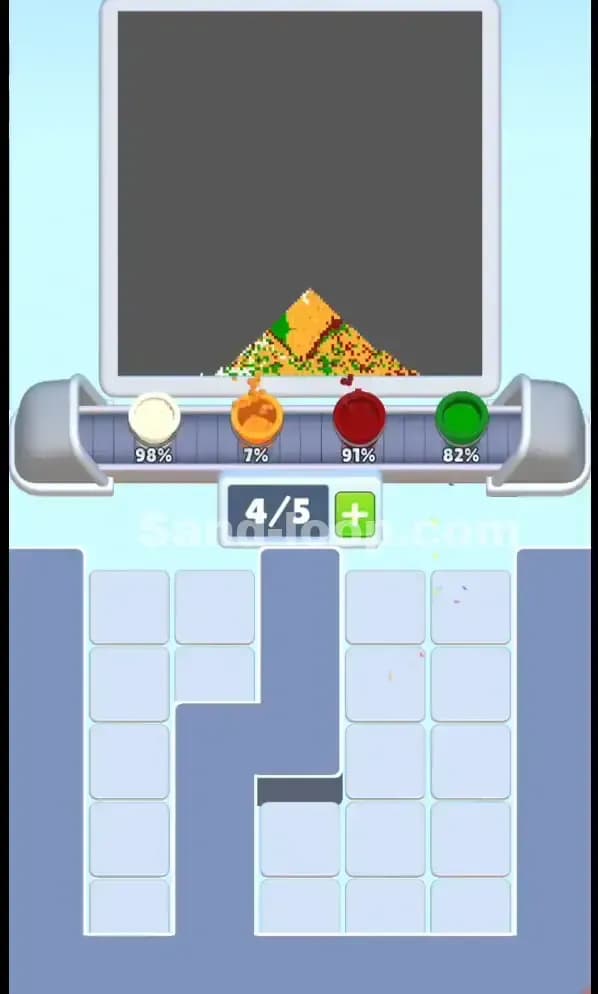
Now here's where most runs fall apart: once you've laid down some yellow and green, you need to circle back to red and fill the background without overflowing into the precision zones. Load two more red cups (from the bottom of the tray stack—they're easier to access now) and feed them to the dispenser in short bursts. The key is intention: each tap should move one color closer to completion. After a red cup, let an empty slot pass under the dispenser (just let the belt cycle without loading a new cup). This gap prevents the belt from getting congested and gives you a moment to eyeball the canvas and decide what's next. You should be roughly 30–40% done with red, 10–15% done with yellow and green, and still have 1–2 empty slots on the belt.

In the second half, load your remaining white and orange cups and use them as "touch-up" colors. A white cup under the dispenser gives you the option for ultra-fine precision work—tap once or twice on the yellow circles' highlights or on the green boundaries where they meet red. Orange can fill mid-tone gaps in the background. The entire time, keep asking yourself: "Do I have empty slots? Is the next color going to help or hurt?" If the answer is "hurt," load an empty slot and think.

End-Game Precision: The Last 10–20%

When you're down to the final 10–20% of completion, switch to single taps. Load one cup at a time, and for each cup, decide before it reaches the dispenser whether you need 1, 2, or 3 taps. Yellow highlights and green-red boundaries are your final focus. If you see a pixel of red peeking through a yellow zone, load yellow and give it one precise tap. If green is leaving red gaps, load green and be surgical. Don't try to finish two colors in one cup rotation—it doesn't work. Finish one color as much as possible, clear the cup, then load the next. This methodical approach prevents overshooting any single color and keeps your win condition (complete fill, no waste) achievable.

If You Mess Up: Quick Recovery Tactics

Overfilled red? Stop loading red immediately. Switch to yellow and green, and use them to cover the overfilled areas. If red has genuinely covered a yellow or green zone, you might be in an unrecoverable state—but usually, a couple of precise yellow or green pours can repair it. Loaded the wrong cup order? Let those cups cycle off the belt (don't pour) and re-stage your next batches. It costs you time, not your run. Contaminated a precision zone? Use the opposite color (if green spilled into yellow, load yellow and do a controlled tap nearby) to "mask" the contamination and redefine the boundary. This isn't ideal, but it's better than resetting.


Why This Strategy Works in Sand Loop 31

Conveyor Lead Time + Slot Economy

This strategy respects the delay between your tap and the cup's arrival under the dispenser. By planning two cups ahead (loading while one is active), you're never caught flat-footed waiting for the right color to cycle back. The 5-slot limit becomes an asset, not a prison—you're deliberately keeping 1–2 slots free, which means you're never deadlocked with a tray full of cups you can't load and a conveyor full of cups you've already used. The strategy also staggers your color inputs so that no single color dominates early. You're spreading your pours across the sequence, which naturally prevents overfill.

Controlled Waste and the "Background Overfill" Prevention

By using white and orange cups as mid-game "buffers," you're essentially rationing your aggressive colors (red, yellow, green). Red gets poured in bursts, not one giant deluge. Yellow and green are measured in single or double taps, not whole cups. This means you won't accidentally finish red at 60% canvas completion and spend the next 20 moves desperately trying to eke out yellow and green from a nearly full background. The small, intentional gaps in your belt cycles also give you moments to visually assess the canvas and stall if a color is climbing too fast. It's a form of pacing that turns a chaotic puzzle into a manageable rhythm.

Consistency and Repeatability

Because the strategy respects cup stacking order and doesn't demand perfect timing on your first attempt, you can repeat it successfully even if you're rusty. You're not relying on a 10-tap-perfect sequence or split-second reflexes. You're relying on a logical progression: unblock, stage, cycle, gap, precision. If you fail, the reason is clear (you loaded red too aggressively, you didn't manage your slots), and you can adjust on the next run without re-learning the whole strategy.


Extra Tips and Adaptations for Levels Like Sand Loop 31

Common Mistakes and Fixes

  1. Loading five cups at the start. You'll fill your slots and lose flexibility. Fix: load two, cycle them, assess, then load more.

  2. Pouring red continuously without stopping. You'll overshoot the background and paint yourself into a corner with no room for yellow or green details. Fix: alternate colors and use gaps. One red cup, one gap, one green cup, one gap.

  3. Forgetting white cups exist. They're your precision tools. Fix: unblock at least one white cup early and save it for the final 15% of the run, when you need sub-pixel accuracy.

  4. Underestimating the green-red boundary. The angular green shapes look simple but are actually tiny. One careless burst of red bleeds over the line and contaminates the green zone. Fix: zoom in mentally, slow down your taps near boundaries, and use small bursts.

  5. Rushing the yellow circles. They're small and detailed. If you load yellow and immediately dump a whole cup, you'll overfill them in seconds. Fix: tap once, assess, tap again. Treat yellow like you're filling a shot glass, not a bucket.

  6. Not unblocking cups in the right order. You might clear a white cup but in doing so, bury a green cup deeper. Fix: visualize the tray as a puzzle. Always remove cups that are blocking your next three intended pours, not just the immediate next pour.

Boosters (If Available)

If your version of Sand Loop Level 31 includes boosters, use Extra Slots only if you find yourself consistently unable to stage your next three cups without overflow. Use Slow Belt in the final 5% of the run when you're doing one-tap precision work and you keep overshooting because the cup cycles too fast. Avoid Undo Pours unless you've genuinely contaminated a precision zone; the move cost isn't usually worth it if you can just mask the mistake with another color.

A Final Encouragement

Sand Loop Level 31 is a skill-check level, and if you're struggling, it's because the puzzle is actually demanding, not because you're bad at the game. Take a breath, load two cups, and watch the rhythm. You'll feel it click once you stop treating the tray like a vending machine and start treating it like a chess board. Every cup has a reason to load, and every gap has a reason to exist. Master this level, and you'll sail through the rest of the campaign—or head over to sand-loop.com for more detailed guides and community solutions if you're still stuck. Good luck!