Sand Loop Level 34 Solution Walkthrough | Sand Loop 34
How to solve Sand Loop level 34? Get instant solution for Sand Loop 34 with our step by step solution & video walkthrough.
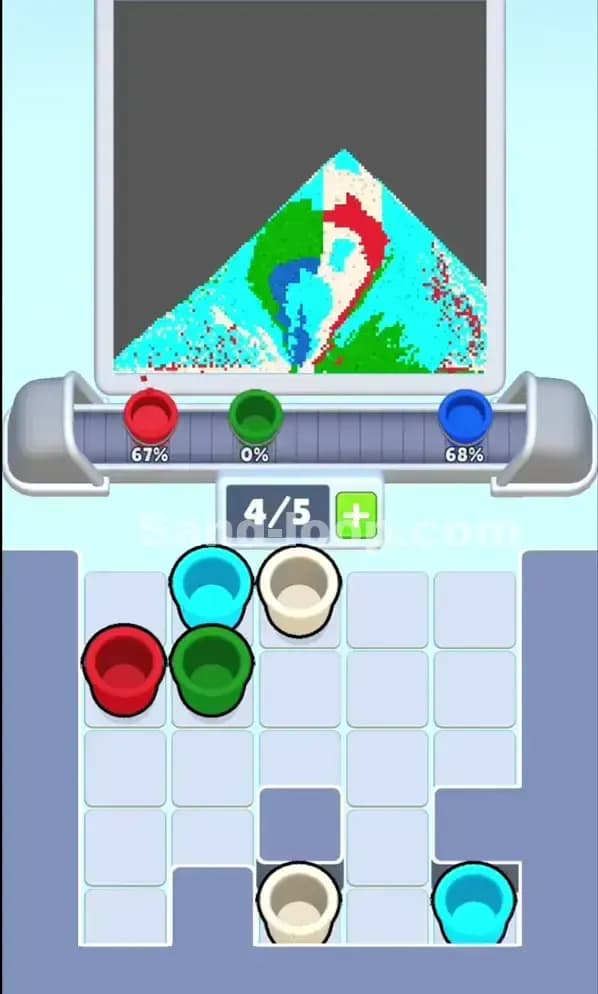
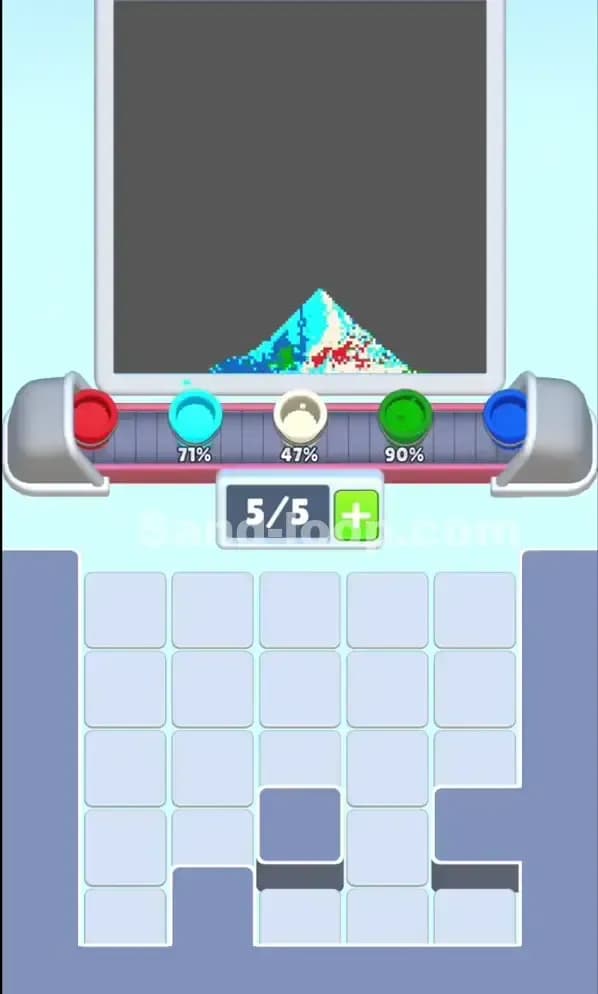
Sand Loop Level 34 Snapshot
The Canvas Goal
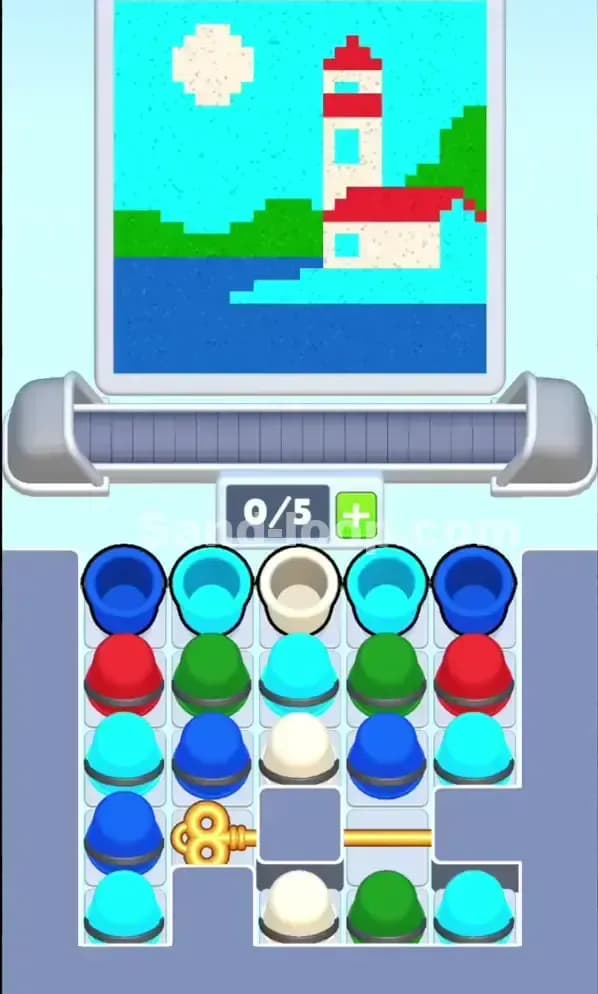
Sand Loop Level 34 drops you into a gorgeous pixel-art coastal scene: a cyan sky dominates the upper half, a red-and-white striped lighthouse anchors the center, green grassy cliffs frame the edges, and a deep navy-blue ocean fills the bottom third. You'll also spot a small cream-colored sun and some lighter beige accents around the lighthouse windows. The color progress meters at the bottom tell you exactly how much cyan, red, green, beige, and blue you need to fill to complete the picture. This level rewards precision—you can't just blob color everywhere and hope it sticks.
Starting Setup and Conveyor State
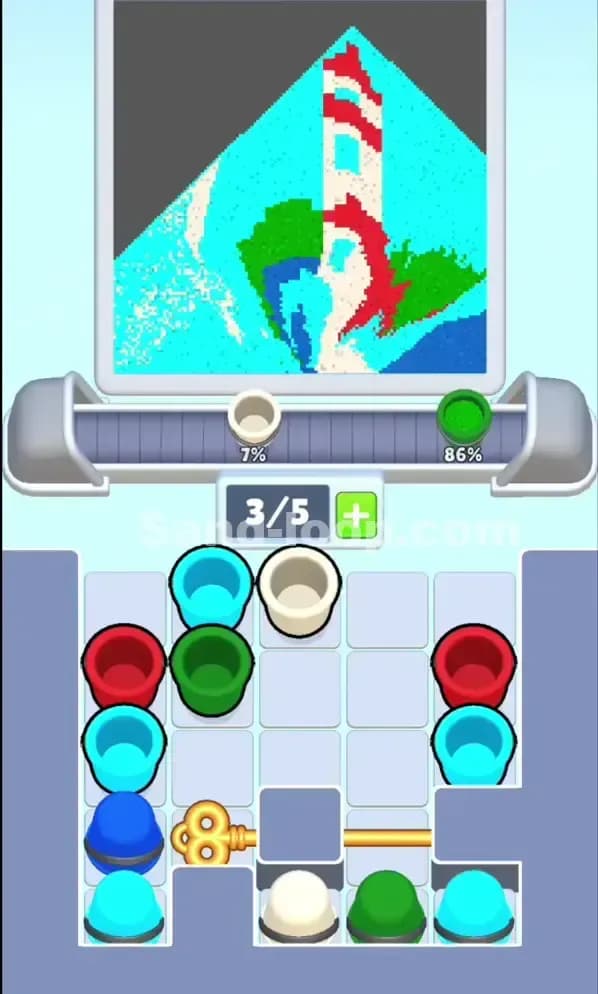
You're opening Sand Loop 34 with a 0/5 slot capacity, meaning the conveyor belt is completely empty and ready to receive cups. The tray below shows a mixed palette: you've got immediate access to blue and cyan cups in the front rows, but red, green, and beige are either stacked deeper or partially blocked by the positioning of larger cup piles. The conveyor itself is a standard horizontal belt—no tricks there—but the real puzzle is unblocking the right colors at the right moment without clogging your five available slots.
The Win Condition
Fill Sand Loop 34 by meeting every color target on the canvas (cyan, red, green, beige, and blue) without overflow, contamination, or wasteful pours. You must work around the slot economy, time your pours to match the conveyor's rhythm, and leave strategic gaps so the belt never locks up mid-level.
Why Sand Loop 34 Feels Hard (The Actual Bottleneck)
The Core Problem: Unblocking Red and Beige Without Jamming
Here's the trap: red and beige cups are not immediately available in the tray—they're either buried under blue/cyan stacks or wedged in positions that require you to clear other cups first. If you greedily load every accessible blue and cyan cup early, you'll fill your five slots, the belt will stall, and you won't be able to pull the red or beige cups you actually need. Sand Loop 34 punishes impatience.
Common Traps
Trap 1: Overloading blue too early. The navy ocean section is large, but it's not that large. If you spam blue cups without gaps, you'll overshoot blue before you've even loaded red, and then you're stuck watching the meter max out while holding cups you can't use.
Trap 2: Ignoring slot economy. Pushing five cups onto a full belt and waiting for even one to finish pouring takes precious seconds. You need to keep at least one, ideally two, slots free so you can flexibly swap in red or green when the tray finally releases them.
Trap 3: Pouring beige and cyan together by accident. Both are light colors and live in similar tray positions. One misclick and you're pouring the wrong cup into a region that doesn't match, wasting pours and contaminating your progress.
Why It Looks Easy But Isn't
I choked the timing here twice before I realized the issue: Sand Loop 34 looks straightforward because the canvas is visually clear and the cup colors are obvious. But the delayed pour mechanic (your tap now, cup reaches the dispenser several frames later) combined with the cramped tray layout means you're essentially solving a scheduling puzzle while managing a five-slot queue. It's not about color theory; it's about when you load what and when you leave gaps.
Step-by-Step Walkthrough to Beat Sand Loop 34
Opening Rhythm: Load Smart, Leave Gaps
Start by loading one cyan cup and one blue cup—don't load two of each immediately. Push them onto the belt in that order (cyan first, blue second). This accomplishes two things: it gets the two most abundant colors flowing, and it keeps your slot count at 2/5, leaving three empty slots for the colors you'll unblock next. As these two cups travel the conveyor and begin pouring, watch your color meters climb slightly. The moment the first cup (cyan) finishes and the slot frees up, load a second cyan cup—not immediately another blue. You want to keep cyan feeding steadily because the sky is the largest region.
Unblocking Plan: The Red and Green Liberation
After two cyan cups are on the belt, it's time to unblock red and green. Look at the tray: identify which red and green cups are closest to being accessible (fewest cups stacked on top of them). Load one red cup next. This signals the tray that you're ready to branch into secondary colors, and it starts you on the lighthouse roof. While that red cup travels, begin maneuvering the tray layout to expose green. The tray mechanics should let you shift or rotate stacks—take advantage of this to slide green cups forward. Once green is accessible, load one green cup. By now, your belt probably has 3–4 cups queued, and you're at around 3–4 slots. Perfect. This is controlled saturation.
Mid-Game Control: Maintain the Rhythm, Avoid Overshoot
From here on, the pattern is observe the color meters, respond with the right cup order. As cyan's meter climbs (it should be filling fast because the sky is huge), occasionally add a second blue cup to balance it—blue and cyan live next to each other visually, so slight overshoot in one won't ruin the balance as badly as, say, dumping five reds into the ocean section. Keep your slot count between 2/5 and 4/5. Never let it hit 5/5 and stay there; as soon as a cup finishes pouring and a slot opens, immediately load the next prioritized color.
Prioritize by meter progress: If cyan is at 70% and red is at 40%, load a red cup. If green is at 60% and blue is at 50%, load a blue cup. This reactive approach prevents the "one color maxed while others lag" disaster that locks you out.
Introducing Beige: The Final Precision Step
Beige is the trickiest because it's small and occupies specific regions (the lighthouse windows and sun). Do not load beige until you have solid control of the other four colors. Once cyan, red, green, and blue are all at 80%+ on their meters, carefully load one beige cup. Watch it travel the belt. As it reaches the dispenser, resist the urge to hold the pour button; instead, tap it once, watch the result on the canvas, and reassess. Beige meters often climb fast because the beige regions are small. One or two beige cups might be all you need. If beige overshoots, you've wasted a crucial slot.
End-Game Precision: The Final 10–20%
As all meters approach completion, slow down. Load one cup at a time, let it pour, observe the canvas update, and then decide the next cup. Your goal is to hit all five colors simultaneously (or within one cup of it) without any meter exceeding 100%. If you have one slot left and only cyan needs pouring, load a cyan cup and let it run through to completion. Sand Loop 34 is forgiving at the very end—the level wins as soon as all five targets are satisfied.
If You Mess Up: Quick Recovery
If you load a red cup by mistake and the blue meter was about to max out, don't panic. Let the red cup pour (you can't undo it), watch the canvas, and immediately adjust your next loads to compensate for the misstep. For example, if you accidentally overfill red, load extra cyan or green for the next two cups to balance the overall progress. The level doesn't fail you for a single overpour; it fails you only if you max out a meter and can't correct it in time. Stay calm, adjust, and keep moving.
Why This Strategy Works in Sand Loop 34
Conveyor Lead Time + Slot Economy
By maintaining 2–4 slots instead of cramming all five, you create "breathing room" on the belt. When you need to switch from cyan to red, you don't have to wait for a massive queue to clear; you can load the red cup into an available slot within two or three frames. This responsiveness is the secret to Sand Loop 34 not feeling like a grind. Respecting the conveyor rhythm—load, travel, pour, free up, load—keeps you synchronized instead of fighting against it.
Preventing the Overfill Lock
The classic failure mode in Sand Loop 34 is overshooting one color (usually blue or cyan, because they're accessible early) and then being unable to correct it. This strategy avoids that by prioritizing based on meter state. You're constantly checking, "Which color is slowest right now?" and feeding that color next. It's a feedback loop, not a script. By the time you're halfway through the level, you've already calibrated your sense of how many cups each color "needs," so the end-game feels less frantic.
Consistency Across Multiple Runs
If Sand Loop 34 has move or attempt pressure, this route shines because it's repeatable. The opening (cyan + blue, gap, cyan + red, gap, unblock green) is always the same. The mid-game rhythm (watch meters, load the slowest color) is predictable. You're not relying on luck or split-second reflexes; you're following a logical sequence. This means your first attempt and your fifth attempt will look almost identical, and your success rate climbs with each try.
Extra Tips and Adaptations for Levels Like Sand Loop 34
Six Specific Mistakes and Fixes
- Mistake: Loading all five cups immediately. Fix: Load three, observe, then add more.
- Mistake: Ignoring the tray layout and loading buried cups. Fix: Always check which cups are physically accessible before tapping the belt.
- Mistake: Pouring beige too early. Fix: Save beige for 80%+ completion on the other four colors.
- Mistake: Holding the pour button down continuously. Fix: Tap once, release, let the cup finish, then assess.
- Mistake: Not leaving gaps between cup types. Fix: Insert at least one empty slot between transitioning to a new color.
- Mistake: Panic-loading when a meter is rising fast. Fix: Take a breath, load a different color, and let the fast meter stabilize naturally.
Booster Considerations
If you have access to an Extra Slot booster, use it on your second or third attempt if you're struggling to manage the queue—Sand Loop 34 becomes much more forgiving with six slots instead of five. An Undo Last Pour booster is handy if you accidentally load beige too early or misclick a color, but it's not essential if you're following the strategy above. Avoid Speed Up Belt unless you're truly stuck on move pressure; the faster belt actually makes timing harder, not easier.
Final Encouragement
Sand Loop 34 is a confidence builder. The first time you beat it, you'll realize that the "hard" part was never the mechanics—it was the planning. Now that you know the unblocking sequence, the meter prioritization, and the slot economy, you can carry that logic to even trickier levels. Keep practicing, stay patient with the conveyor rhythm, and remember: every successful run of Sand Loop 34 makes the next one feel faster and easier.
For more solutions, strategies, and community tips, check out sand-loop.com. You've got this!