Sand Loop Level 36 Solution Walkthrough | Sand Loop 36
How to solve Sand Loop level 36? Get instant solution for Sand Loop 36 with our step by step solution & video walkthrough.

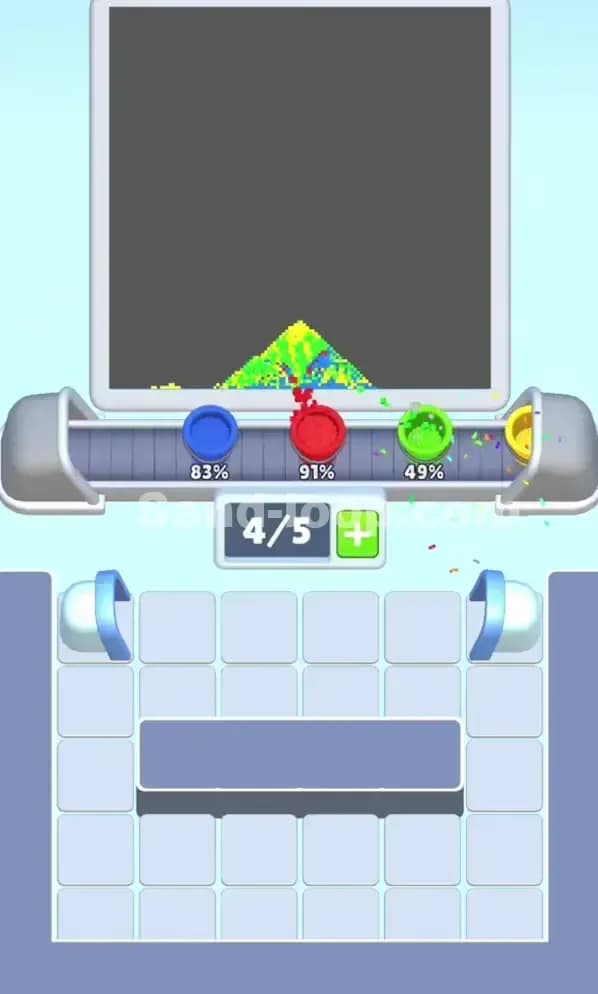
Sand Loop Level 36 Snapshot
The Goal Canvas and Color Requirements
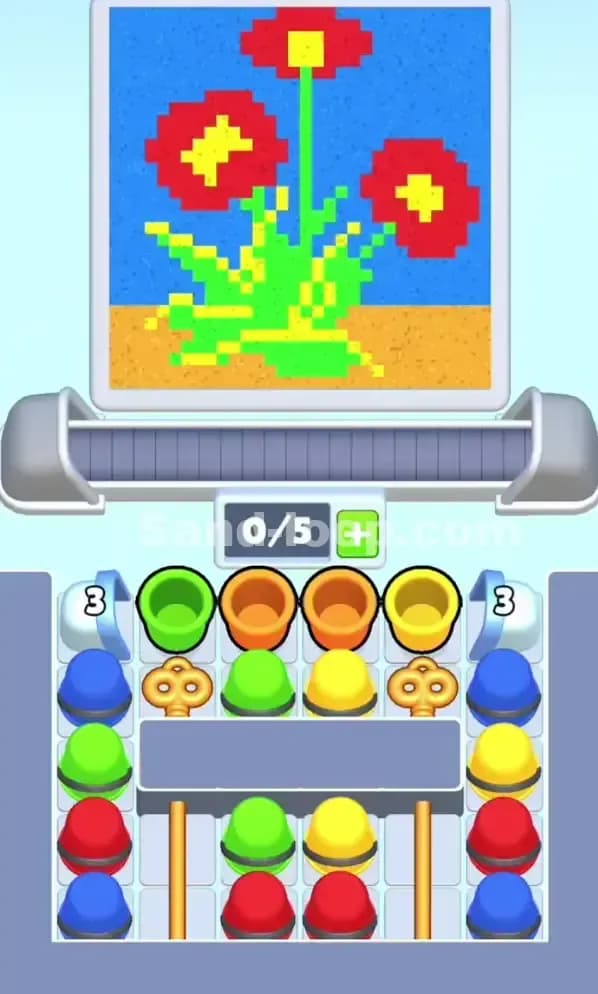
Sand Loop Level 36 presents a cheerful pixel-art flower scene dominated by a bright blue background, with three red flowers featuring yellow centers, a green stem, and a sandy tan base. The color progress meters at the top tell you exactly what's needed: you're looking at a balanced mix of blue (the sky), red (petals), yellow (flower centers and accents), and green (stem and foliage). The blue background is the largest area, so it'll consume most of your pours—but don't let that fool you into ignoring the smaller, precision regions like the yellow flower centers and green details. Those tight spots demand accuracy and timing.
Starting Setup and Cup Availability
You're starting with a conveyor capacity of 0/5, meaning zero cups are currently loaded on the belt. The supply tray below shows a mixed inventory: you've got green, orange, and yellow cups in the top row ready to grab, plus stacked cups behind them that are currently blocked. The real puzzle lies in that stack—buried beneath are blue, red, and more yellow cups you'll absolutely need later. The orange cups are interesting; they're immediately available but won't help you fill any of the color targets, so resist the temptation to load them early just because they're convenient.
The Win Condition
Fill the entire canvas by matching all color progress meters without overfilling any region. The key constraint here is that your conveyor only holds five cups at a time, and you've got limited pours per cup. One wrong sequence, and you'll either jam your belt with useless colors or accidentally oversaturate blue before you've had a chance to place your reds and yellows. The win feels satisfying once you crack the timing, but it absolutely requires discipline.
Why Sand Loop 36 Feels Hard (The Actual Bottleneck)
The Real Problem: Blocked Colors and Belt Congestion
The biggest bottleneck in Sand Loop 36 isn't the pouring itself—it's that you can't access your red and blue cups without first clearing the stacked inventory. Those red cups buried in the tray are essential for the three flower petals, and your blue cups (needed for the massive background) are similarly trapped. If you don't plan your unblocking sequence correctly, you'll find yourself forced to load orange or other filler cups just to keep the belt moving, and before you know it, your five slots are full of useless colors while the cups you actually need are still locked away.
Three Classic Traps on Sand Loop 36
Trap One: The Orange Cup Temptation. Those orange cups are right there, accessible, begging you to load them. Don't. They won't fill any progress meter, and loading them wastes precious belt slots that should be reserved for blue, red, yellow, and green. I've seen players burn two or three attempts just cycling orange cups through the conveyor before realizing they've shot themselves in the foot.
Trap Two: Overfilling Blue Too Early. The blue background looks huge, and it is, but it's easy to get greedy with blue pours. If you max out the blue meter before you've even started on red and green, you'll lock yourself out of completing the flower details—the game won't let you finish the level with incomplete precision regions, no matter how full the background is.
Trap Three: Forgetting the Delayed Timing. Your tap registers instantly, but the cup doesn't reach the pour point for another beat or two. This delay trips up new players constantly. You tap to pour green, think you're done with green, then suddenly your cup arrives and dumps green all over a region you've already filled. Plan your taps like you're leading a moving target.
Why It Looks Easy but Isn't
Sand Loop 36 looks deceptively simple at first glance—just a cute flower picture with straightforward color zones. But the constraint of five belt slots, combined with blocked cups in your tray and precise color targets, creates a puzzle that punishes sloppy sequencing. I choked the timing on this one twice before I sat down and actually mapped out which cups to load in which order. The level is teaching you that Sand Loop is as much about logistics and foresight as it is about reflexes.
Step-by-Step Walkthrough to Beat Sand Loop 36
Opening Rhythm: Your First Five Cups
Start by loading a green cup, then a yellow cup, then another yellow cup, then a blue cup, and finally another green cup. This sequence gets your two most flexible colors (yellow and green) onto the belt first, while blue is queued up behind them for the bulk fill. Yes, you're deliberately skipping orange and other distractions. Your conveyor is now at 5/5, full and intentional. Don't load a sixth cup yet.
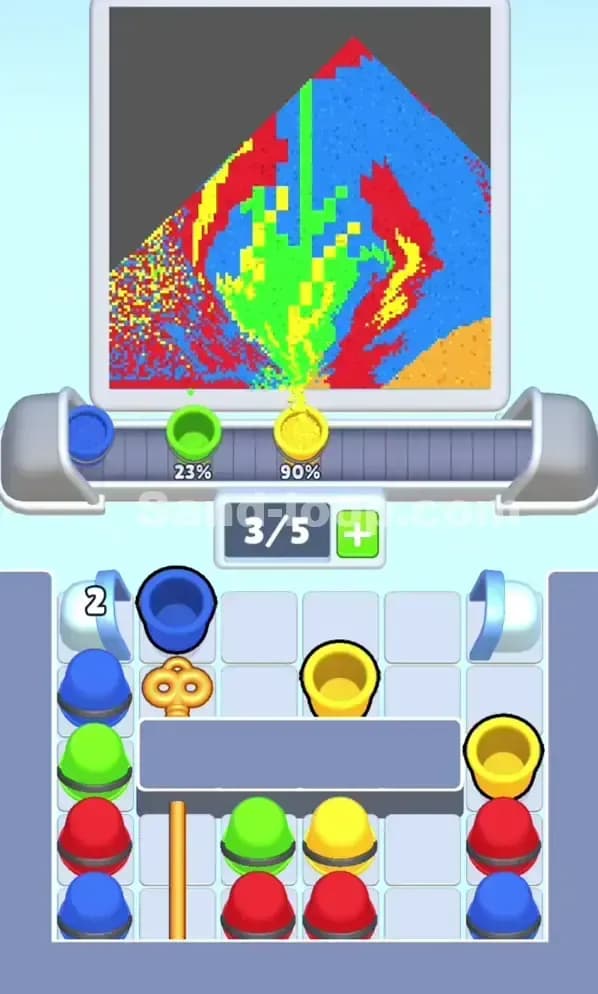
As this first wave moves through the pour point, tap green first (watch it fill the lower stem), then tap yellow (top flower centers), then tap yellow again (the side flowers), then tap blue (background), then tap green once more (the right stem detail). You're being surgical here—one tap per cup, no continuous pouring. This deliberate rhythm keeps you in control and prevents the dreaded "oops, I poured too much" moment.
Unblocking Plan: Free Your Reds and Blues
Once those first five cups have cycled through, your tray opens up, and now you can grab a red cup. Load it. Then load another red, then another red—you need three reds for those three flower petals, and they're all sitting right there now that you've cleared space. Behind the reds, you'll spot more blue cups. Load one blue. Keep one empty slot open on the conveyor. This gives you room to adjust if you spot an error or need to shuffle the queue.
The unblocking sequence works because it respects the reality of your tray: you can only access what's on top or on the sides. By pulling green and yellow first, you naturally expose red. By pulling red next, you expose the deeper blue cups. It's not random—it's following the physical stack.
Mid-Game Control: Cycling and Gap Management
As your second wave moves across the conveyor, you're now facing a new decision: how many times should you pour each color? Here's the rule I use: green and yellow get 2–3 taps each (they're smaller regions), red gets exactly 1 tap per cup (three petals, three cups), and blue gets multiple taps per cup (it's the biggest area). But don't load all your blue at once. Spread it across your remaining conveyor slots so you can pace the background fill and leave room for mid-game adjustments.
Maintain at least one empty slot on the conveyor at all times during this phase. Why? Because it gives you a pause point. If you notice a color meter climbing too fast, you can let the belt sit for a moment, reassess, and decide whether to load another cup or call a halt. Without that breathing room, you're locked into pouring whatever's queued, and mistakes compound.
Watch your color progress meters constantly. They're your truth meter. If blue is at 90% and you've still got three blue cups loaded, you're going to overshoot—either unload one of those cups (if the game allows it) or accept that you're about to hit a wall. Ideally, you'll have already seen this coming and prevented it by not loading that third blue in the first place.
End-Game Precision: The Final 10–20%
When you're down to the last gaps in your image—those final yellow slivers, the last red petal details, the last green foliage—you're in "single-tap territory." Load one yellow cup, tap it once, let it cycle. Load one more yellow if needed. Load a red cup, tap once, watch. This isn't the time for aggression. One accidental extra pour here nukes your progress.
If you've planned well, you'll have exactly the right number of cups left in your tray to finish. If you haven't, you'll either run out of the right colors or be left holding cups of a color you've already maxed out. That's when you know you've made a sequencing error earlier, and you'll need to restart. But if you follow the opening rhythm and unblocking plan, you shouldn't hit that wall.
If You Mess Up: Quick Recovery Tactics
Scenario A: You've overfilled blue, and red is still mostly empty. You're locked out. Restart. There's no graceful recovery here—blue has consumed your pour pints, and you can't undo it. The lesson: be more conservative with blue taps in future runs.
Scenario B: You've got two more red cups loaded, but red is already full. Stop. Let those red cups cycle through without tapping. They'll empty back into the tray once they've passed the pour point. This wastes their potential, but it's better than overfilling and tanking the run.
Scenario C: You realize mid-pour that you're about to tap the wrong color. Don't tap. Let the cup pass without pouring. It'll cycle back into the supply tray, and you can grab a different color next. This is where that empty belt slot becomes golden—it gives you decision time.
Why This Strategy Works in Sand Loop 36
Conveyor Lead Time and Slot Economy
The step-by-step approach respects the delayed timing of the pour mechanic. By loading cups in a deliberate sequence and tapping at the precise moment each cup arrives at the pour point, you're already accounting for that lead time. You're not fighting the belt—you're choreographing with it. The strategy of keeping one empty slot at all times leverages the slot economy by giving you a pause point; it transforms your belt from a relentless machine into a tool you control.
Preventing Overfill and Waste
The reason you don't load orange or other filler colors is that they'd hijack belt space without contributing to any meter. The reason you spread blue pours across multiple cups instead of hammering three blue cups in a row is that it lets you adjust if blue climbs faster than expected. The reason you're precise with red (exactly one tap per red cup) is that those three petals are small targets—they fill fast, and overshooting wastes the cup. Together, these habits prevent the "accidental overfill locks you out" disaster that ruins runs.
Consistency Across Attempts
If you follow the opening rhythm and unblocking sequence exactly as written, you'll get consistent results. That consistency is how you learn. You're not relying on luck or reflexes; you're relying on a plan. And once the plan works once, you can refine it. Maybe you find you need only two yellow taps instead of three. Maybe blue fills faster than you thought. But you'll notice these patterns because your baseline is solid. That's why this strategy scales—it gives you a framework to improve from, rather than chaos to flail through.
Extra Tips and Adaptations for Levels Like Sand Loop 36
Mistake #1: Loading Cups Without Checking the Tray
Fix: Always glance at which cups are available before you load. If you see a color you don't need, don't touch it, no matter how accessible it is.
Mistake #2: Tapping Continuously Instead of Counting Taps
Fix: Treat each tap like a decision. After you tap, count to three before you tap again. This rhythm breaks the habit of mindlessly mashing and gives you time to read the meters.
Mistake #3: Ignoring One Color Until It's Too Late
Fix: Rotate between colors. If you've tapped blue five times, tap green next, even if blue still looks empty. This keeps you balanced and prevents the "oh no, I forgot about red" moment.
Mistake #4: Overloading the Conveyor with the Same Color
Fix: Avoid loading three blue cups in a row. Alternate. Load blue, then green, then blue again. This pacing is your safety net.
Mistake #5: Panicking When a Meter Fills Slowly
Fix: Some colors fill slowly because they're spread across the image. Yellow, for example, appears in small patches—the center of each flower plus accents. Don't assume you need more yellow just because the meter looks empty. One or two taps often surprise you with how much they actually fill.
Mistake #6: Not Using Empty Slots as Checkpoints
Fix: Deliberately keep that one slot empty. When you're tempted to load a sixth cup, pause instead. Look at the meters. Decide if you actually need another cup right now, or if you should wait. That empty slot is your strategy timer—use it.
On Boosters and Special Items
If your version of Sand Loop 36 includes a "slow conveyor" booster, save it for a run where you feel rushed. Slowing the belt gives you more time to react to tap delays and adjust mid-pour. An "extra slot" booster is pure luxury here—it opens up your belt from 5 to 6 slots, which almost eliminates the congestion puzzle. Use it if you're hitting the wall repeatedly and want to brute-force through. An "undo" booster is only useful if you've made a catastrophic tap error (like accidentally tapping red on the blue background). Swaps and shuffles won't help you much on Sand Loop 36 because the real puzzle is sequencing, not the cup order itself.
Encouragement and Next Steps
Sand Loop Level 36 is a satisfying checkpoint. Once you beat it, you'll have learned the rhythm of deliberate pouring, conveyor timing, and supply-tray awareness. These skills transfer directly to harder levels. If you're still stuck after a few runs, don't hesitate to visit sand-loop.com for video walkthroughs or to connect with the community—other players have likely found neat shortcuts or alternative sequences you haven't considered yet. Keep at it. You've got this.