Sand Loop Level 75 Solution Walkthrough | Sand Loop 75

How to solve Sand Loop level 75? Get instant solution for Sand Loop 75 with our step by step solution & video walkthrough.
Share Sand Loop Level 75 Guide:
Sand Loop Level 75 Gameplay
Sand Loop Level 75 Solution 1
Sand Loop Level 75 Solution 2
Sand Loop Level 75 Solution 3

Sand Loop Level 75 Snapshot

The Canvas Goal

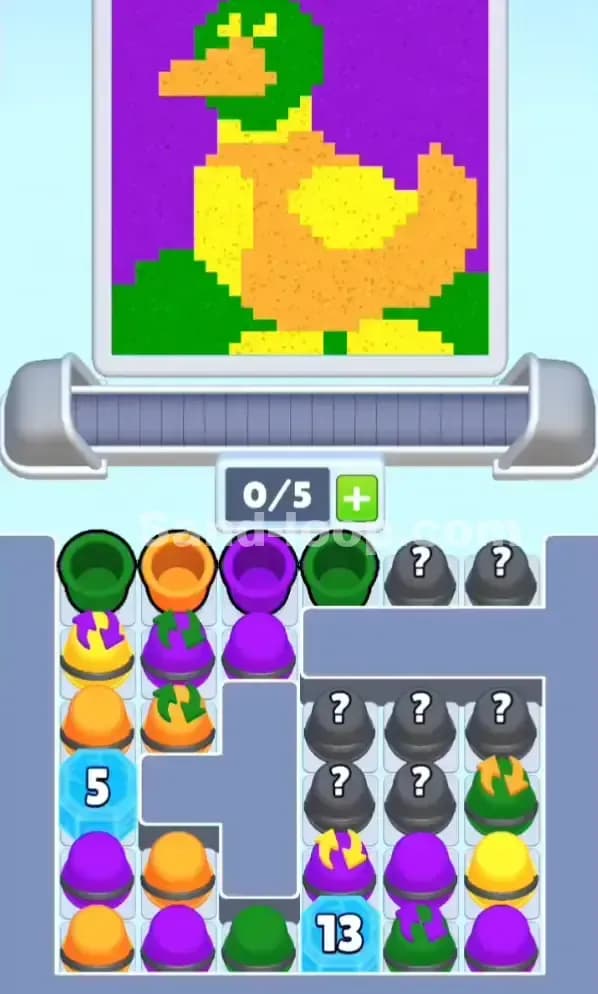
Sand Loop Level 75 presents a colorful pixel duck sitting on a vibrant background. Your target image is split into four main color regions: purple dominates the upper left and right corners, green anchors the bottom left and right, yellow fills the center-bottom area, and orange spreads across the duck's body and head. The color progress meter shows you're starting at 0/5 capacity on the conveyor belt, which means you've got room for exactly five cups at once. This tight slot economy is your first hint that careful planning beats rush-and-pray gameplay.

The Starting Setup

You're looking at a supply tray packed with cups in a deliberate stack. Green, orange, and purple cups are available in the top row—these are your immediate tools. Below them lie more purple, orange, and hidden cups (marked with question marks) that you'll need to unblock as you progress. The belt itself is currently empty; you control when to load cups and when to leave gaps. The "0/5" indicator tells you that you can safely load five cups before the belt jams and you're forced to wait. Your challenge is reading which colors the picture actually needs and ignoring the temptation to spam every color equally.

Win Condition

Fill the duck pixel-by-pixel by matching the color requirements. Purple and green each need significant coverage, orange needs precision placement on the duck itself, and yellow fills the lower third. You'll win when all color meters hit their targets without overflow, waste, or contamination. Sand Loop Level 75 rewards restraint—every pour counts, and overshooting even one color by a few pixels can block your path to victory.


Why Sand Loop 75 Feels Hard (The Actual Bottleneck)

The Real Puzzle: Color Balance Under Pressure

Sand Loop Level 75 isn't about pure speed—it's about proportion. The image screams for green and purple (big background blocks), but the duck demands orange and yellow in smaller, more precise amounts. Many players load all four colors equally and watch helplessly as orange explodes past its target while green sits half-finished. The bottleneck is deciding which colors to load first and how many of each without jamming your five-slot belt.

Three Traps Hiding in Plain Sight

Trap One: The buried orange stack. Look at the supply tray—orange cups are stacked multiple layers deep. If you grab one orange cup early, you're stuck waiting for the entire stack to shift before you can access another. This slowdown forces you to either overfill orange (bad) or switch colors prematurely and lose momentum.

Trap Two: Purple's false abundance. You see purple everywhere in the tray, and the background needs purple, so you load four purple cups in a row. By the time they cycle through, you've overshot purple by 15% and now the belt is locked with useless cups while you're desperately hunting for green.

Trap Three: The timing lag you can't feel. You tap "green" and a green cup loads. But it takes three or four more cup-cycles before that green cup reaches the pour point. Players often mistime this and accidentally trigger a pour when the wrong color is underneath. I choked the timing here twice before realizing the lead time isn't intuitive—you have to count the belt movements after you tap.

Why It "Looks Easy But Isn't"

The image itself is simple—a duck and four colors. The tray has plenty of cups. But Sand Loop Level 75 punishes auto-pilot brains. You can't just rotate colors blindly; you have to read the meter, predict the stack delays, and reserve belt slots like you're playing a rhythm game where the beat is the conveyor speed. That gap between "looks fun" and "requires focus" is where most runs fail.


Step-by-Step Walkthrough to Beat Sand Loop Level 75

Opening Rhythm: Load Smart, Not Hard

Start by loading one green, one orange, one purple, one yellow, then one more green—in that order. This fills your 0/5 belt to exactly 5/5 without overfilling. Why this order? Green and purple need volume, so you're starting both. Orange and yellow are smaller targets, so you load one of each early to "reserve" them, preventing the stack-shuffle trap later. The second green ensures you're establishing green momentum before the first green has finished cycling.

Don't load the purple cup from the second row yet. That's your trap—it's easy to grab, but it'll lock up your belt with a color you don't need right now. Keep at least one slot free after this initial load. Yes, the belt looks "empty" with a free slot, but that free slot is your escape hatch if you need to pause and recalculate.

Unblocking Plan: Free the Hidden Cups Without Jamming

Watch your first five cups cycle all the way through the pour point. As soon as the first cup exits the belt (the green one), immediately load the next color based on your meter. If purple is lagging, load purple. If yellow is still at 0%, load yellow. The key is never load the same color twice in a row—this prevents accidental overfill bursts.

The buried orange in the tray is your middle-game unlock. Once the orange cup currently on the belt (your first pour cycle) exits, you'll see the stack shift and reveal another orange underneath. That's your signal: if orange is below 20% progress, load the new orange. If orange is above 30%, skip it and grab purple or green instead. This reactive approach prevents the over-stack trap.

By the time you've cycled ten cups, most of the question-mark cups in the tray will be visible. Prioritize any color that's visibly lagging. If green is at 40% and purple is at 35%, you're doing it right—no single color is running away.

Mid-Game Control: Maintain the Rhythm Without Losing Count

Once you're past the first ten cups, establish a pattern: load two high-priority colors, then one low-priority color, repeat. If your meter shows green at 55%, purple at 50%, orange at 25%, yellow at 20%, load green, purple, yellow, then restart. This rotation keeps all four colors climbing evenly and prevents any single color from spiking.

Keep your belt between 3/5 and 5/5 capacity at all times. A belt at 1/5 means you're wasting travel time; a belt at 5/5 means you're rigid and can't react if a color suddenly needs a pause. Three to five cups is the sweet spot—enough momentum, enough flexibility.

Watch your color meters like a hawk. Sand Loop Level 75 is won or lost in the 40%–70% range, when meters start climbing fast and overfill is real. If purple suddenly jumps from 50% to 62% in two cycles, don't load purple again for at least three more loads. Let the belt cycle through and "cool down" before you feed that color again.

End-Game Precision: The Final 10–20%

The last stretch of Sand Loop Level 75 is brutal because you can see the finish line, but one wrong pour wastes it all. By now, two or three colors should be nearly capped (80%+), and one or two should be lagging. Load only the lagging colors. If green is at 91% and yellow is at 62%, ignore green entirely. Load yellow, yellow, purple, yellow, repeat until yellow catches up.

Your belt will feel "sparse" at this stage—maybe only two or three cups cycling. That's fine. You're trading speed for accuracy. A belt with two yellow cups and one orange is safer than a belt crammed with random colors hoping something hits the mark.

When any color hits 95%+, it's radioactive—don't load it again. Cover it with your hand mentally and pretend it doesn't exist. Focus on the bottom 20% of the remaining colors.

If You Mess Up: Quick Recovery Tactics

Scenario: You overshot orange to 35% and it needs to stay at 22%. Stop loading orange immediately. Load only green, purple, and yellow for the next eight cups. Let the orange already on the belt cycle through and exit. The overshoot will sting, but most Sand Loop Level 75 runs tolerate a 5–8% overshoot if you nail the other three colors.

Scenario: You loaded five purple cups in a row and the belt is jammed with unusable color. Don't panic. The belt will cycle. Mentally note: "I won't load purple again until three more cups exit." Use the downtime to recalculate your remaining target. If purple is already at 78%, you're actually okay—just shift focus to green and yellow now.

Scenario: You miscounted the lead time and triggered a pour on the wrong color. This happens. Accept the loss and restart if it's early (under 20% progress). If you're already at 50%+, the mistake is already sunk—focus on recovering the other colors instead of chasing a perfect run.


Why This Strategy Works in Sand Loop Level 75

Conveyor Lead Time + Slot Economy

The strategy works because it respects the delayed timing. When you load a cup, it doesn't pour immediately—it travels the belt first. By loading cups in a calculated sequence (green, orange, purple, yellow, green), you're building a "queue" that spaces out the pours naturally. The belt moves at a fixed speed, so the time between your tap and the actual pour is predictable once you count two or three cycles. Keeping 1–2 slots free gives you the flexibility to interrupt a bad sequence before it compounds.

Waste Prevention and the Overfill Lock

The biggest failure mode in Sand Loop Level 75 is "background color overfill"—pouring purple or green too aggressively early and locking yourself out of progress on the duck (orange, yellow). This strategy staggers colors so that purple and green climb in parallel with orange and yellow. By forcing a balanced load order (never two of the same color in a row), you prevent the spike-and-freeze problem. When one color pulls ahead, you explicitly skip it rather than hoping restraint happens by accident.

Consistency Across Runs

If Sand Loop Level 75 has attempt limits or move limits, this method keeps your runs predictable. You're not improvising; you're following a rhythm. Once you nail the first five-cup sequence and understand the meter targets, you can repeat it cleanly. The same pattern that gets you to 50% will carry you to 95%. You're not relearning the level every attempt—you're refining your tempo.


Extra Tips and Adaptations for Levels Like Sand Loop 75

Common Mistakes and Instant Fixes

Mistake 1: Loading the first six cups without checking your meter. Fix: After your first four cups pour, pause and look at the progress bars. Adjust your next load based on which color is visibly behind. Don't assume you know the targets—the game changes per level.

Mistake 2: Treating question-mark cups as "wildcards." Fix: Question-mark cups are usually the same color as the cup below them—they're not bonus chaos. They're locked until their neighbors exit the tray. Plan around them, not with them.

Mistake 3: Leaving the belt at 1/5 capacity, "waiting for clarity." Fix: A sparse belt is actually a dead belt. Load something—even a "wrong" color—rather than stall. The belt slowing down gives you zero new information; moving it forward might unlock a cup stack you needed.

Mistake 4: Pouring continuously for three cycles straight. Fix: Break your pour into bursts: pour two cups, pause one cycle, pour two more. Bursts let you see the meter climb and recalculate. Continuous pouring is how you overfill a color and trash a run at 60% progress.

Mistake 5: Ignoring the lead time and tapping "yellow" three times because yellow is stuck at 15%. Fix: Tap yellow once, watch it cycle, and then tap it again if needed. Three taps in a row means three yellow pours are queued, and they'll land together when they reach the dispenser. That's an automatic overfill.

Mistake 6: Panicking at 80% and scrambling to load colors randomly. Fix: At 80%, most colors are nearly locked. Identify the one or two that are still climbing, load only those, and trust the belt. Panic loading is how you blow a 15-minute run in the last minute.

Booster Notes

If your version of Sand Loop Level 75 offers boosters, use them sparingly. An extra slot booster (raising the belt to 7/5 or 8/5) is helpful if you're stuck juggling five colors and constantly jamming. Use it after your first 30% progress so you understand the level's natural rhythm first. A slow belt booster stretches the timing, giving you more reaction time—grab this if you're consistently miscounting the lead time. An undo or swap booster is a last-resort panic button; save it for the 85%+ stage if a single overfill would tank an otherwise solid run.

Final Encouragement

Sand Loop Level 75 tests your patience and your math sense, not your reflexes. You've got this. The duck is waiting, and once you nail the opening rhythm and trust the meter, you'll see the pattern click into place. Every run teaches you something—if you don't beat it this attempt, you've already gathered data for the next one. Stick with the balanced load sequence, keep your slots strategic, and remember: a clean, slow cycle beats a frantic mess every time.

For more Sand Loop walkthroughs and strategy breakdowns, visit sand-loop.com and join thousands of players crushing every level. You're closer than you think!