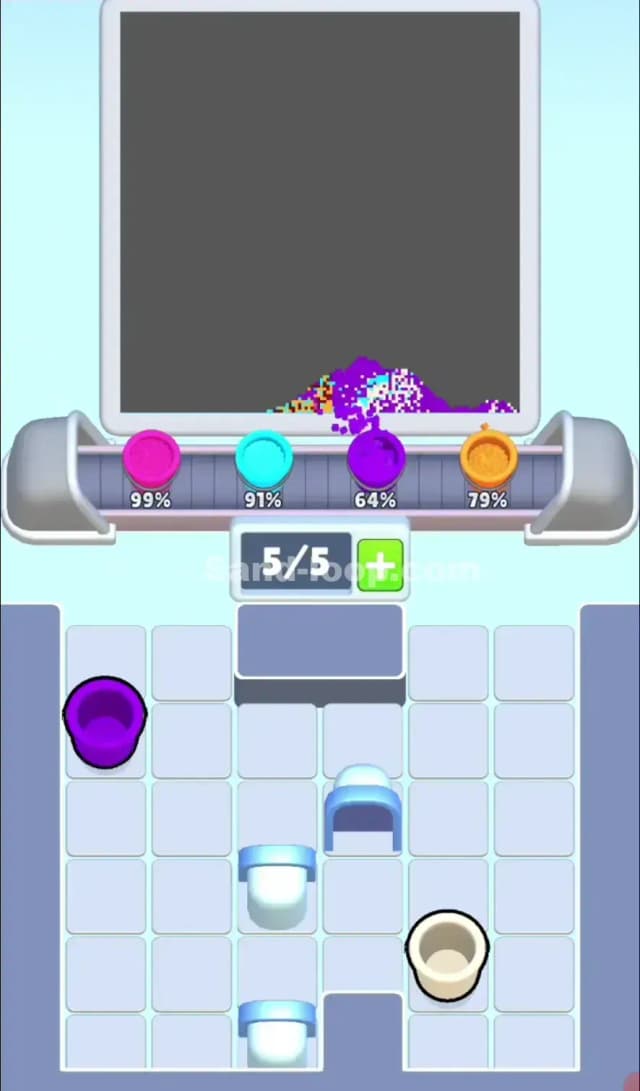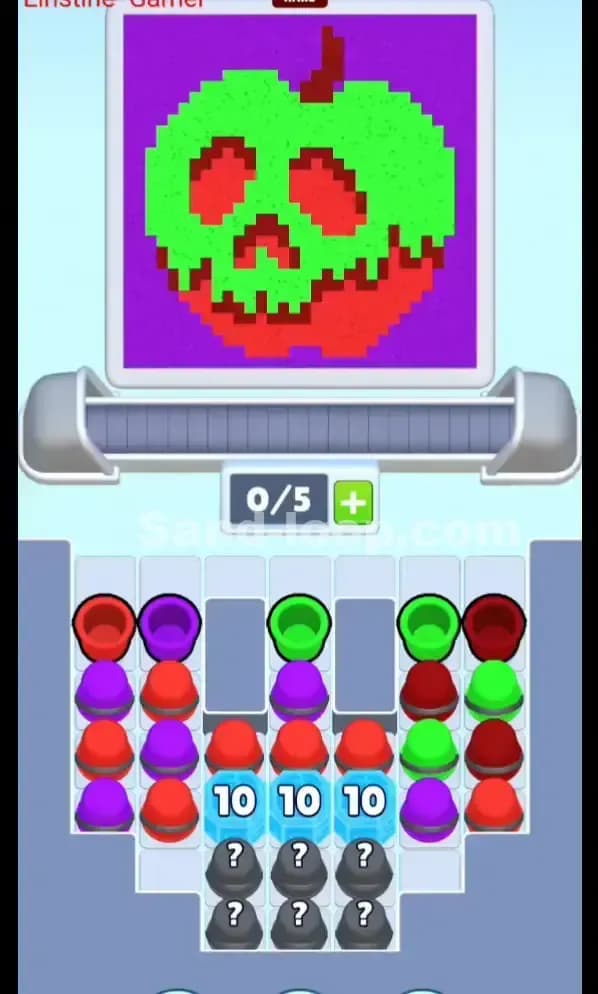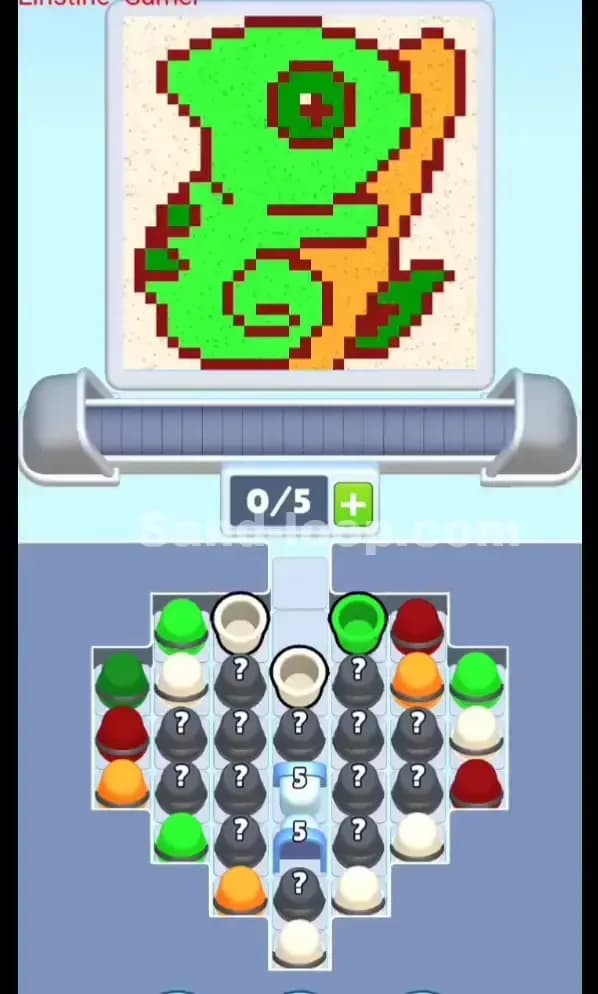
Sand Loop Level 146 Solution Walkthrough | Sand Loop 146

How to solve Sand Loop level 146? Get instant solution for Sand Loop 146 with our step by step solution & video walkthrough.
Share Sand Loop Level 146 Guide:
Sand Loop Level 146 Gameplay
Sand Loop Level 146 Solution 1
Sand Loop Level 146 Solution 2

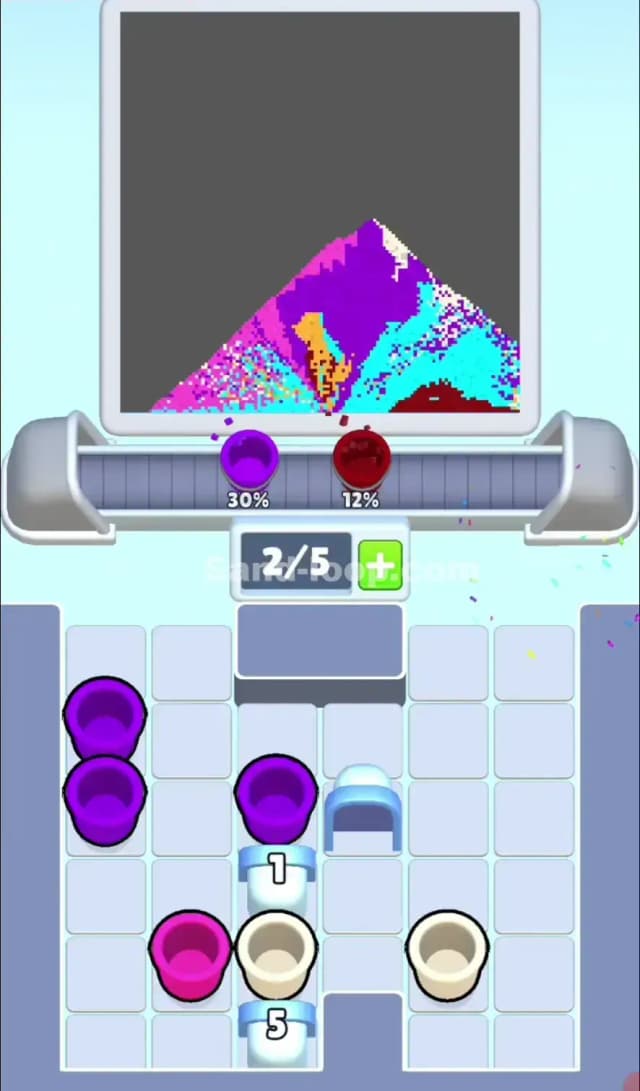
Sand Loop Level 146 Snapshot

The Canvas Goal

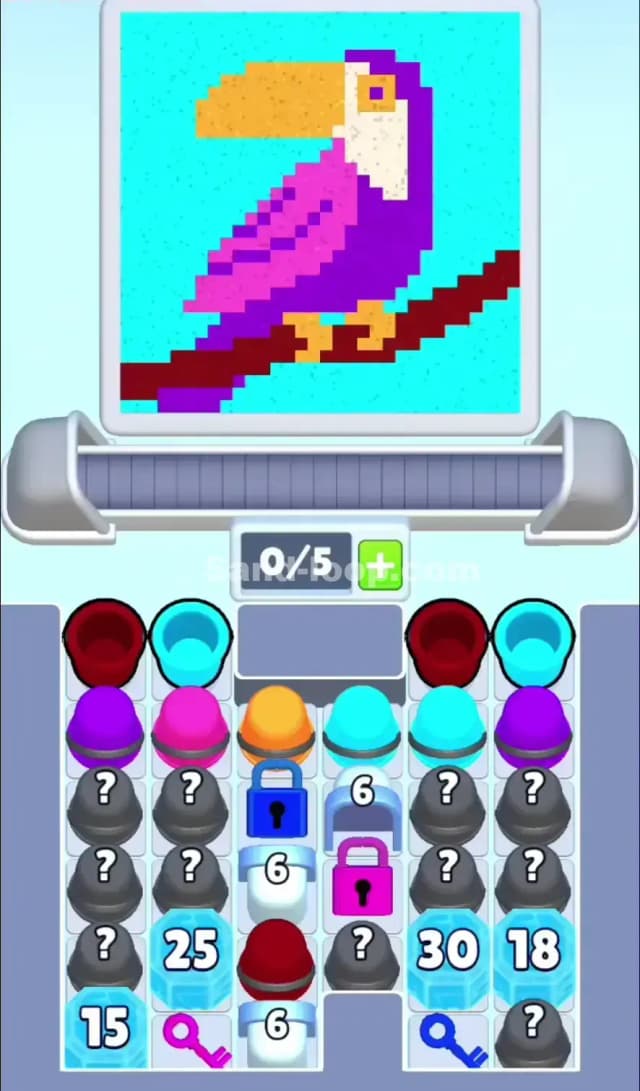
Sand Loop Level 146 asks you to paint a pixel-art bird in flight against a bright cyan background. The bird is rendered in vibrant layers: golden-yellow wings, creamy white and hot magenta body feathers, deep purple and dark maroon accents, and a small orange beak detail. The cyan background dominates most of the canvas, but it's those intricate color regions—especially the magenta-to-purple gradient on the wings and the maroon underbelly—that demand precision. You'll need to fill cyan liberally while carefully controlling smaller pours of yellow, magenta, purple, dark maroon, and white to avoid bleeding into the wrong zones.

Starting Setup

You begin with a conveyor belt that holds 5 cups out of 7 total slots, meaning you have just 2 free slots to work with. The immediate cup roster shows cyan and dark red buckets sitting at the top of the tray, plus magenta and purple buckets one layer down. Further down, you'll find stacks of gray "mystery" buckets, several cyan reserves, and an orange bucket tucked beneath locks. Many of these lower cups are blocked by keyed containers (blue and magenta locks visible), so you can't grab them until you've cycled the right cups through and freed up tray space. The supply tray's tight stacking means poor planning will jam your conveyor within two or three moves.

Win Condition

Complete Sand Loop Level 146 by filling all color zones on the canvas without wasting pours or overshooting any single color. You'll need cyan to dominate, but precise hits on magenta, purple, maroon, yellow, and white are non-negotiable. Overfilling the cyan background early, for example, won't lock you out of the level—but it will waste turns and force you to rely on boosters. The real win is a clean, efficient run with minimal waste and no contamination.


Why Sand Loop 146 Feels Hard (The Actual Bottleneck)

The Real Puzzle: Blocked Cup Access

The single biggest headache in Sand Loop Level 146 is that your most useful cups are buried under locks. You can see orange and multiple cyan reserves trapped in the lower tray, but you can't reach them until you've made room by cycling cyan and dark red through the belt. With only 5/7 conveyor slots occupied at the start, you're tempted to just keep loading cups—but that leads to a deadlock. You need to leave at least 1–2 empty slots on the belt to cycle cups back into the tray and unlock the lower stacks. Get greedy with cup placement, and you'll watch your belt fill up while the tray remains inaccessible.

The Traps

Trap 1: Cyan overshoot. Cyan is your biggest color by far, but it's easy to pour too much too fast. Early in Sand Loop Level 146, you'll feel pressure to "fill the background," and if you load three cyan cups back-to-back, you'll overshoot within two or three pours. The bird's body sections then become impossible to paint cleanly.

Trap 2: Magenta and purple confusion. These colors are side-by-side on the bird's wings, and their regions overlap slightly. If you pour magenta out of order or without a clear gap, you risk contamination. Similarly, purple can bleed into dark maroon territory if you're not disciplined about timing.

Trap 3: Orange isolation. The orange bucket is locked away and only appears late. Many players forget about it entirely and then panic in the final 5% when they realize the beak still needs color. By then, they've wasted moves and may not have the conveyor space to retrieve and pour the orange cup.

Why It Looks Easy But Isn't

I'll be honest—the first time I saw Sand Loop Level 146, I thought it was straightforward: load some cups, pour colors, fill the bird. But the tray layout and the 5/7 conveyor pressure make it surprisingly punishing. You're not fighting the visual complexity of the bird itself; you're fighting your own cup sequencing and the clock. It looks like a relaxing coloring puzzle, but it's actually a rhythm-game-meets-inventory-Tetris kind of challenge.


Step-by-Step Walkthrough to Beat Sand Loop Level 146

Opening Rhythm: Loads 1–3

Start by loading a cyan cup first. Cyan dominates the background, and getting one cycle through the belt immediately gives you breathing room on the tray—you'll free up a slot and reduce crowding. Wait for the cyan to reach the dispenser, pour it, and watch the background fill. Don't oversaturate; a single cyan pour should give you roughly 15–20% coverage without waste.

Next, load a dark red cup. The maroon underbelly of the bird is small but essential, and dark red appears immediately accessible in the tray. Position it so it pours after cyan finishes—this prevents any mixing and keeps your move count clean. Pour it onto the lower belly region of the bird.

For your third load, grab a magenta cup. Magenta forms the bright wing feathers and the cheek highlight, so it's a linchpin color. Load it with a one-cup gap after dark red; this gap prevents the belt from jamming and gives your fingers time to rest before the next decision. Pour the magenta onto the bird's left wing (the brightest section). You should now be at roughly 3 cups on the conveyor out of 5 slots, with 2 slots still free—exactly where you want to be.

Unblocking Plan: Freeing Orange and Extra Cyan

After those first three pours, you'll notice the tray is slightly loosened but the orange bucket (and second/third cyan reserves) are still locked. Here's the unlock sequence:

Move 4: Load a purple cup. Purple sits in the mid-tray directly accessible. The dark maroon of the bird's tail and belly has purple overlays, so this color is worth a dedicated pour. Space it two cups behind magenta on the belt (so your belt now reads: dark red → [gap] → magenta → [gap] → purple, all flowing). This pour protects you from accidentally contaminating maroon with purple.

Move 5: Cycle an empty cup slot. Don't load anything this turn. Let the purple pour and finish. This forces a gap on the belt and frees up one more tray space, which is crucial.

Move 6: Now that you have 3 free conveyor slots, load the orange cup if you can see it. If it's still locked, load a second cyan cup instead. Cyan needs multiple pours anyway, so a second pass through is natural. This keeps your tempo steady and prevents the belt from ever feeling too empty.

By the end of move 6, you should have cycled 4–5 cups with 2–3 still on the belt, and your tray should have loosened considerably. The orange bucket should be near the top of the tray or already on the belt, ready for deployment.

Mid-Game Control: Moves 7–12

This is where discipline matters. You'll now have cyan reserves unlocked and the bird's major color zones (cyan, magenta, purple, maroon, orange) all within reach. The temptation is to fire off all remaining cups in rapid succession, but you must maintain 1–2 empty conveyor slots to prevent a deadlock.

Load a second cyan cup, pour it, and monitor the background fill. Sand Loop Level 146's cyan target is roughly 60–70% of the canvas, so two generous cyan pours should get you close. Avoid a third cyan pour unless you see a clear gap on the canvas that needs it.

Load white or the beak detail cup if it's visible. White is tiny (just the bird's eye), so a single, careful pour suffices. The timing here matters: you want white to pour after all the magenta and purple are locked in, so you don't accidentally tint it.

Load a second magenta cup if the wing shading isn't complete. Remember, Sand Loop Level 146 has a multi-layer magenta effect: the bright outer wing and a duller inner transition. Two magenta pours (separated by gaps) give you that gradient without waste.

Check your conveyor occupancy after every 2–3 pours. If you hit 6/7 slots, stop loading and let cups cycle through until you're back to 4–5/7. This habit prevents the jam that kills lazy runs.

End-Game Precision: Moves 13–16

By now, cyan, magenta, purple, and maroon should be nearly complete. Zoom in and check for gaps, especially in the feather details and the tail. Sand Loop Level 146's final 10–15% is usually fine-tuning: a top-up cyan pour, a micro-adjustment of purple in the tail overlap, maybe a second white pour if the eye is faint.

Load and deploy these finishing cups one at a time, pouring carefully and checking the canvas after each. Don't load three cups and assume they'll all be perfect; you'll almost certainly overshoot at least one color.

The orange beak, if it hasn't been poured yet, gets its own final move. Orange is so small that even a half-second pour can overfill it, so tap the dispenser briefly and watch for the beak to fill. A second or third tap is overkill and wastes a move.

If You Mess Up: Recovery Tactics

Overfilled cyan? If the background is too dark or bleeding into the bird, you've wasted a move, but it's not fatal. Shift focus to the smaller, precision colors (magenta, purple, white) and paint around the over-saturation. You'll use more moves overall, so finish as efficiently as possible and accept a lower star rating rather than restart.

Wrong cup order (e.g., purple poured before magenta)? If the colors bleed or blend messily, you have two choices: (1) If you're early (moves 1–5), restart now—it's faster than recovering. (2) If you're mid-game (moves 7+), forge ahead but adjust your remaining cup selection to mask the error. For example, pour more magenta to "overwrite" the purple spill.

Locked out of a cup (e.g., orange still blocked)? This usually means you didn't free enough tray space. Load an empty slot or a "junk" cyan pour to cycle the belt and open the tray. It costs a move, but it's better than giving up.


Why This Strategy Works in Sand Loop Level 146

Conveyor Lead Time and Slot Economy

The walkthrough respects Sand Loop Level 146's mechanical reality: cups don't pour instantly when you load them. There's a 2–3 second lead time from load to dispenser. By maintaining 1–2 empty conveyor slots, you ensure that when a cup reaches the dispenser, you're ready to pour without panic, and when you tap to unload, there's always space on the tray to receive the empty cup. This prevents the nightmare scenario where your belt is full, your tray is full, and you're stuck.

Avoiding the Background Overfill Lock

Many players pour cyan greedily because it's the "safest" color—wrong. In Sand Loop Level 146, overfilling cyan doesn't literally lock you out, but it does waste moves that could go toward precision colors. This strategy limits cyan to 2–2.5 dedicated pours and uses gaps between other colors to let the cyan "settle." The result: cyan fills naturally without conscious overkill, and you preserve move efficiency for the details.

Consistent, Repeatable Runs

By following this sequence—cyan, dark red, magenta, purple, white, orange—you're moving through Sand Loop Level 146 in a logical order that mirrors the bird's own structure: background first, then body, then wings, then details, then beak. This rhythm makes it hard to forget a color and easier to spot when a shade is done. Your runs become predictable, which means you can replicate success across multiple attempts.


Extra Tips and Adaptations for Levels Like Sand Loop 146

Six Common Mistakes and Fixes

  1. Loading three cups in a row without a gap. Your belt fills to 7/7, the tray locks, and you're stuck. Fix: After every two cups, leave one cycle empty.

  2. Pouring cyan last instead of first. You're forced to rush the background at the end and overspill. Fix: Cyan goes first. Always.

  3. Forgetting orange exists. You finish 19/20 colors and realize the beak is blank. Fix: Before you start, identify orange's location in the tray and note when it'll unlock. Plan one move slot for it.

  4. Mixing magenta and purple without a gap. They blend into a muddy hot-pink mess. Fix: Pour magenta, let it finish, load something else, then load purple.

  5. Pouring white or orange too aggressively. A two-second hold fills the entire eye/beak and wastes a cup. Fix: Tap, release, and watch. A single one-second pour is usually enough.

  6. Panicking and restarting after a small overspill. One extra shade of purple doesn't ruin your run. Fix: Assess the damage. If it's minor (< 5% of the canvas affected), keep going. Only restart if you've fundamentally mis-sequenced a major color.

Using Boosters Wisely

If your game version includes boosters, here's when they matter for Sand Loop Level 146:

  • Extra Conveyor Slot: Use this if you hit 6/7 slots and still have three or more cups to pour. It costs premium currency but saves you from a deadlock. Otherwise, avoid it.
  • Slow Belt: Useful if your timing is off and you're pouring too fast. A slowed belt gives you more reaction time. Only grab this if you're consistently overshooting cyan or magenta.
  • Undo Last Pour: If you made a critical color error (e.g., dark red spilled into magenta zone), undo and re-pour. Don't use it for minor imperfections.
  • Cup Swap: If orange is still locked after move 8, a swap booster can shuffle the tray and expose it. This is niche but occasionally lifesaving.

Most runs of Sand Loop Level 146 succeed without boosters if you follow the walkthrough closely. Deploy them only when you see a clear disaster in progress.

Encouraging Closing

Sand Loop 146 isn't a level that punishes you for a single mistake—it rewards you for understanding the rhythm and respecting the tray limits. Spend one practice run just watching your belt and tray fill and empty without worrying about perfection. Feel the tempo. On your second or third attempt, you'll breeze through. If you're still stuck, visit sand-loop.com for video walkthroughs, community strategies, and detailed color-by-color guides. You've got this.