Sand Loop Level 160 Solution Walkthrough | Sand Loop 160
How to solve Sand Loop level 160? Get instant solution for Sand Loop 160 with our step by step solution & video walkthrough.
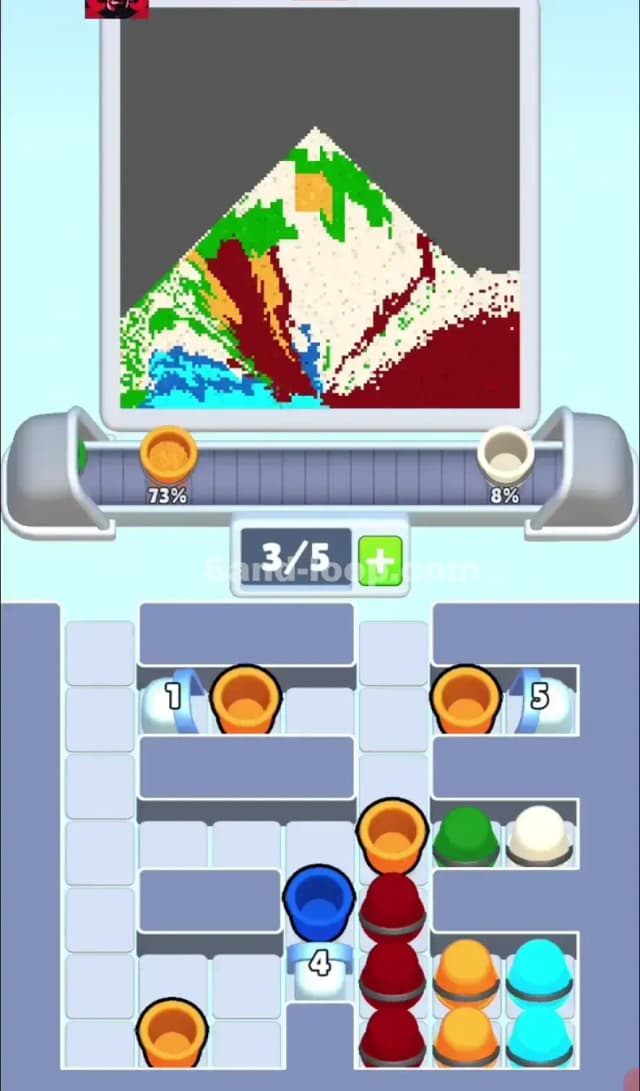
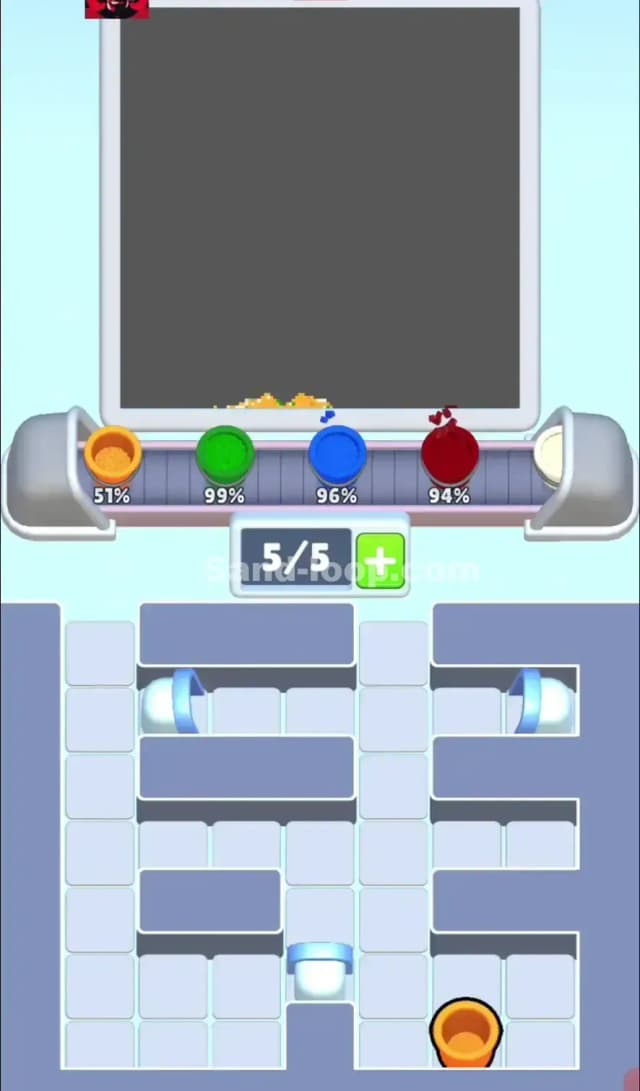
Sand Loop Level 160 Snapshot
The Canvas: A Multi-Color Challenge
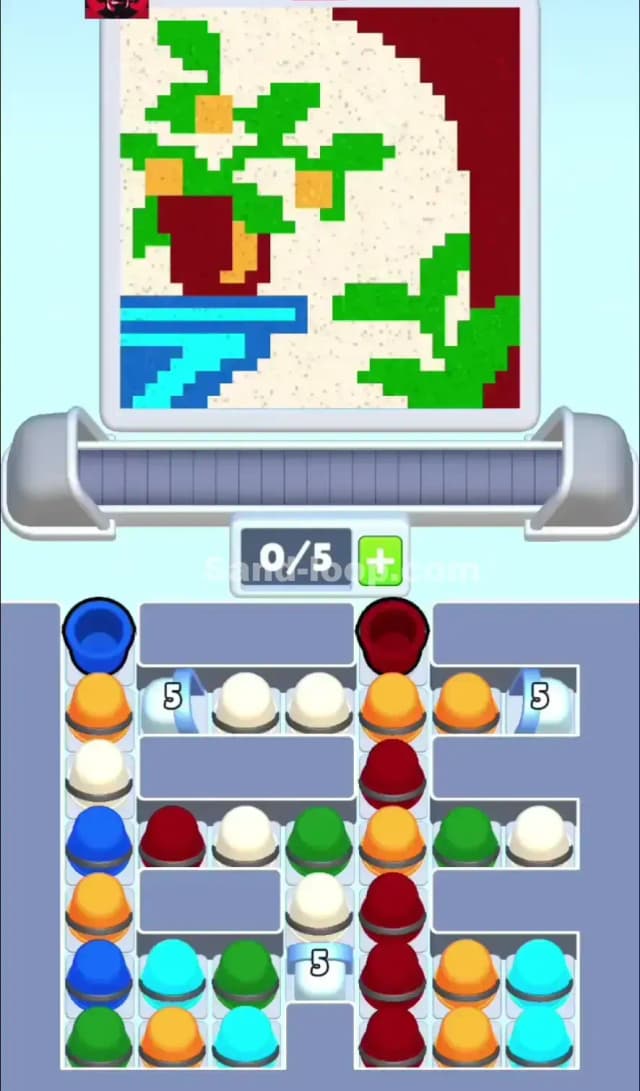
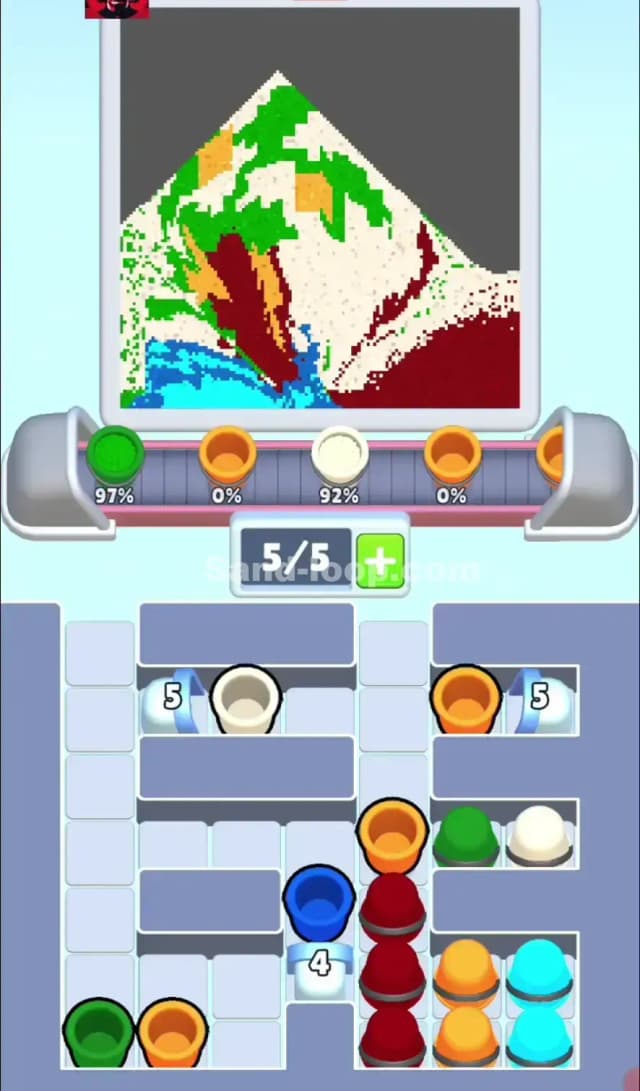
Sand Loop 160 puts you in front of a complex, multi-region picture. The dominant background is a light beige, but you're tasked with filling several distinct zones: a large area of bright green, blocks of deep maroon/burgundy on the upper right and right edge, scattered golden-yellow accent squares, and a lower-left section featuring layered blues and cyans that form a wave or stair-step pattern. The color progress meters tell you exactly what you're working toward—and Sand Loop 160 demands precision across all four colors without wasting a single pour.
The Starting Setup: Tight Slots, Buried Gold
Your conveyor belt starts at 0/5 capacity, which means you have just five slots to work with—a tight economy. Looking at your cup tray, you've got a diverse stack: blues, oranges, whites, reds, cyans, and greens are all present. The catch? Several colors are buried deep or blocked by stacks of other cups. For example, some of your green and orange cups are locked beneath layers of reds and whites, and your cyan supply sits at the bottom of one tower. This blocking is intentional—Sand Loop 160 is testing whether you can unblock key colors at the right moment without jamming your conveyor.
The Win Condition
To beat Sand Loop 160, you must fill the entire canvas to completion while hitting each color's target. You cannot afford overflow, contamination (wrong color in a zone), or wasting slot space on the wrong cups. Every pour counts, and every gap on the belt is valuable real estate.
Why Sand Loop 160 Feels Hard (The Actual Bottleneck)
The Real Problem: Buried Colors Block Your Flow
I'll be honest—Sand Loop 160 looks deceptively simple at first, but the moment you start loading cups, you realize your best colors are trapped underneath. You need green and orange badly to hit those bright zones, but they're sitting three and four cups deep. The level is forcing you to decide: do you waste slot space cycling "junk" cups to free them, or do you find a rhythm that unblocks them without clogging your belt?
Three Traps You'll Hit
Trap One: Loading All Five Slots Too Fast. It's tempting to grab every available cup and load the belt to capacity. But if you do, you'll jam—no new cups can enter, and you're locked into pouring whatever's ahead, whether it fits your plan or not. Sand Loop 160 punishes greed.
Trap Two: Prioritizing the Wrong Color. The red and white cups are easily accessible, sitting on top of stacks. If you pour red and white early without a clear strategy, you'll overfill those zones before you've even freed your green and orange. Then you're stuck watching the meters maxed out while the rest of the canvas sits blank.
Trap Three: Not Leaving Gaps on the Conveyor. This is the subtle one. You load cups, they roll forward, you tap to pour—but the timing is delayed. If every slot has a cup, and you miscalculate the pour window, you can't insert a different color mid-cycle. Gaps are your escape hatch.
Why It "Looks Easy but Isn't"
Sand Loop 160 doesn't have a billion cups or a spinning wheel mechanic. It's just a belt, five slots, and a tray of stacked colors. But that simplicity is the trap. You're fighting logistics, not chaos. One wrong load decision in the first 30 seconds can brick your entire run.
Step-by-Step Walkthrough to Beat Sand Loop 160
Opening Rhythm: Controlled Load, Intentional Gaps
Start by loading just two cups onto the belt—grab an orange and a white. Don't fill all five slots immediately. Tap to pour the orange into an orange zone, then pour the white into a white zone. Your goal here is threefold: (1) confirm the pouring timing so you know when a cup reaches the pour point, (2) generate early progress on easy colors, and (3) keep three slots open so you can adapt.
After those two pours, stop and assess. You should have two empty slots on the belt now. Load one more cup—let's say a red—and tap to pour it. Watch it roll into the pour zone. This is your rhythm training. Sand Loop 160 requires you to feel the delay, not just see it.
Unblocking Plan: Free Green and Orange Methodically
Once you're comfortable with timing, it's time to unblock. Your green and orange cups are buried. Here's the sequence:
First, load a white cup (easy access) into an empty slot. Then, quickly load a second white (or a red—whichever is on top next). Pour both of these in rapid succession. This clears two cups from the tray without you needing the colors yet. Now, your orange and green are one or two layers higher.
Load an orange cup next. It should now be within reach. Pour it. Repeat this "dummy load" strategy once more—load a red or white, pour it, then grab an orange or green. By the third cycle, your green and orange supplies are unlocked and accessible. You're now three pour cycles in, with maybe 15–20% of the canvas filled, and you've just freed your key colors.
Do not rush this unblocking phase. Hurrying leads to loading the wrong cup and wasting a slot.
Mid-Game Control: Cycle Cups, Maintain Rhythm, Avoid Overfill
Now that green and orange are flowing, establish a sustainable rhythm. Load two cups at a time—typically one green and one orange, or one green and one cyan (for that blue wave section). Pour them both. Then load two more. Keep one slot permanently empty so you can inject a different color if a meter climbs too fast.
Watch your color meters religiously. If green is at 80% full and you've got two green cups loaded, hit pause mentally. Load an orange or cyan instead for the next cycle. This is the essence of Sand Loop 160's difficulty: you're constantly balancing four colors and a five-slot belt. One slip, and green overflows, locking you out.
Aim to keep every meter between 50–85% filled until you're in the final push. If one color hits 90% and you still have 30% of the canvas left, you've misallocated pours, and you'll need to pivot hard to the other colors.
End-Game Precision: Finish the Last 10–20% Safely
In the final stretch, every pour is counted. Load single cups now, one at a time. Check the meter before you load—if green is at 92%, skip the green cup and grab cyan. Pour with surgical precision. You're aiming to finish all four colors simultaneously, or at least within 1–2 pours of each other. Leaving one color at 50% while another is 100% is a failure state for Sand Loop 160.
If you're close—say, blue is 95% and cyan is 85%, and everything else is done—load a cyan cup. Pour it. That's it. You win.
If You Mess Up: Quick Recovery Tactics
Scenario: You overfilled red and it's at 105%. You can't pour red anymore, but you still have three colors to finish. Load only non-red cups from here on. You'll have to rely on orange, green, and cyan to fill the remaining canvas. This is recoverable if you still have space in the other three colors. Sand Loop 160 allows for one color to be "done early" as long as the others catch up.
Scenario: You loaded a cup and it's about to pour into the wrong zone. Quick—don't tap. Let the belt cycle empty. The cup rolls past without pouring, and you can tap the next cup when it aligns. This costs you one cycle but prevents contamination.
Scenario: Your belt is jammed (all five slots full, no way to inject a new color). Let the belt auto-cycle. Pour everything in sequence. As slots free up, load the colors you actually need. It's inefficient, but you can still win Sand Loop 160 this way—it just takes a few extra cycles.
Why This Strategy Works in Sand Loop 160
Conveyor Lead Time + Slot Economy = No Jams
By keeping one slot empty and loading in pairs (instead of all five at once), you maintain flexibility. The delayed pour timing in Sand Loop 160 means that when you load cup A, it takes about 2–3 seconds to reach the pour point. If you've left a gap, you can load cup B during that time, ensuring a steady flow without backups. You never jam because you're never forcing the belt to choose between cup C and cup D when they both need to go in different directions.
Controlling Waste and Avoiding Overfill Locks
The classic fail in Sand Loop 160 is "background overfill." You pour green all day because it's easy, then halfway through you realize you've hit 100% green and still need to fill 40% of the canvas with other colors—except now you can't pour green, and you're bottlenecked by your slow orange supply. This strategy prevents that by checking meters constantly and deliberately alternating colors. You starve the easy color and feed the starved ones. It sounds counterintuitive, but it keeps all four zones balanced.
Move Consistency (If You Have Attempt Limits)
If Sand Loop 160 has a move cap or attempt limit in your version, this plan is designed to win in 8–12 pour cycles. Early pours (the "dummy loads" unblocking your colors) are an investment that pays off in efficiency later. You're not grinding—you're executing a pre-planned sequence. Repeat it twice, and you'll beat Sand Loop 160 consistently.
Extra Tips and Adaptations for Levels Like Sand Loop 160
Six Common Mistakes and Fixes
-
Mistake: Loading all five slots immediately. Fix: Load two at a time max. Keep slots open for adaptation.
-
Mistake: Prioritizing accessible colors (red, white) over locked colors (green, orange). Fix: Unblock early, even if it means "wasting" a few pours on dummy cycles.
-
Mistake: Pouring continuously without checking meters. Fix: Pause after every two pours. Glance at the progress bars. Adjust your next load.
-
Mistake: Forgetting the pour delay and tapping too early. Fix: Count "one-Mississippi, two-Mississippi" after loading. Tap on beat two. This syncs your timing with the belt.
-
Mistake: Finishing one color at 100% while another sits at 40%. Fix: Once a color reaches 80%, stop loading it. Pivot to the others. End the level with all colors within 10% of each other.
-
Mistake: Panic-tapping when you realize you're about to pour the wrong color. Fix: Don't tap. Let the cycle continue. The cup passes the pour zone unloaded, and you get a second chance on the next rotation.
If Boosters Are Available
If your version of Sand Loop 160 offers an extra slot booster, use it only if you hit a true deadlock (all five slots filled, none are the color you need). The moment you unlock that sixth slot, load the correct color immediately. This costs premium currency but saves a failed attempt.
An undo booster is worth it if you're at 90% complete and realize two cycles ago you made a critical error. Undo just that move, reload the right cup, and continue.
A slow-belt booster is rarely necessary for Sand Loop 160 but can help if you struggle with timing. It gives you an extra half-second to react between pours.
Final Encouragement
Sand Loop 160 is a checkpoint level—it's testing whether you've internalized the core mechanic (load → delay → pour → balance → win). You absolutely can beat it. The trick is patience. Don't rush the opening, don't overfill any color, and keep your belt breathing (one empty slot at all times). You've got this.
For more detailed solutions and video walkthroughs of Sand Loop 160 and other tricky levels, visit sand-loop.com. Happy pouring!