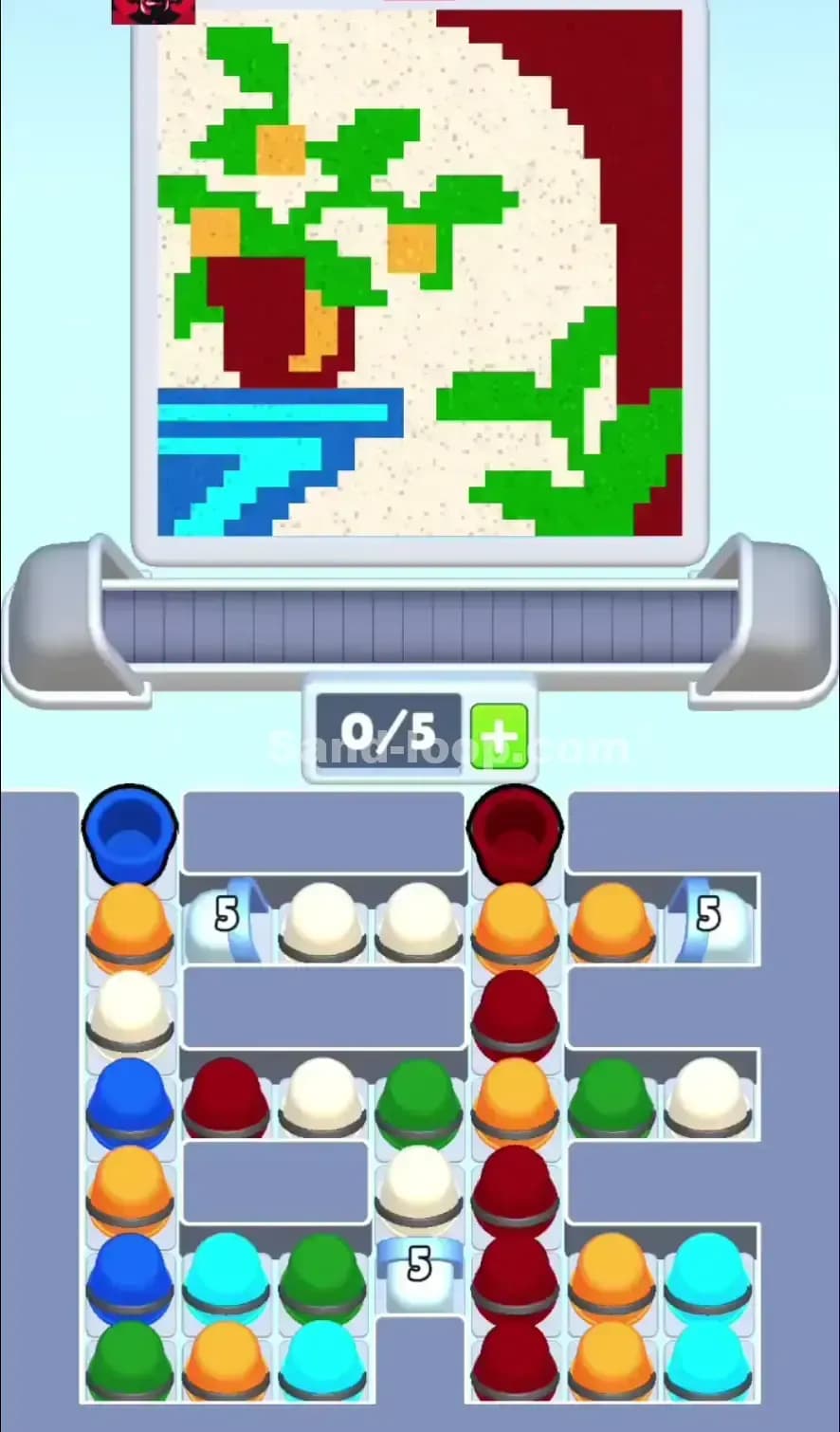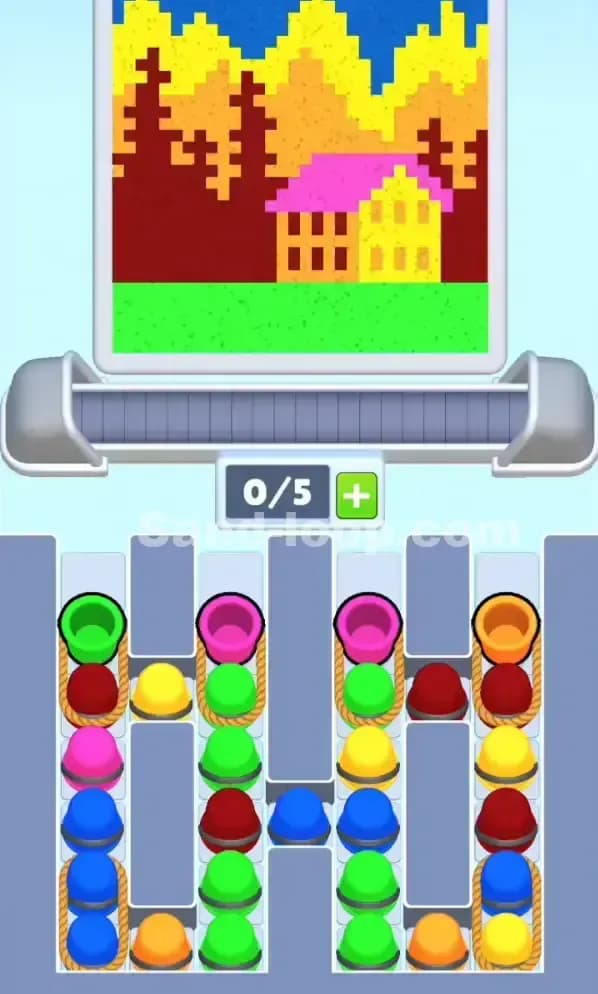
Sand Loop Level 161 Solution Walkthrough | Sand Loop 161
How to solve Sand Loop level 161? Get instant solution for Sand Loop 161 with our step by step solution & video walkthrough.
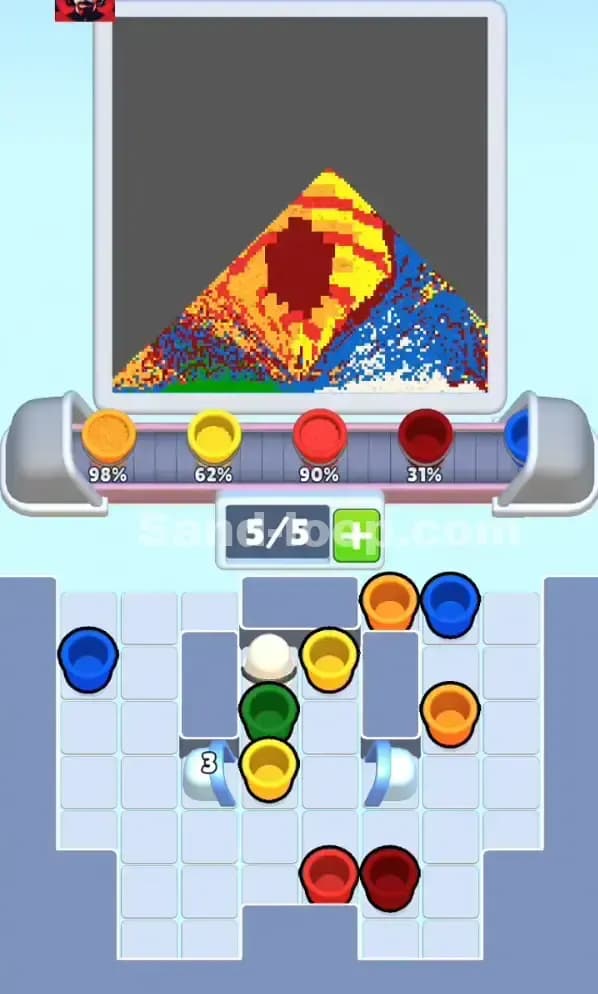
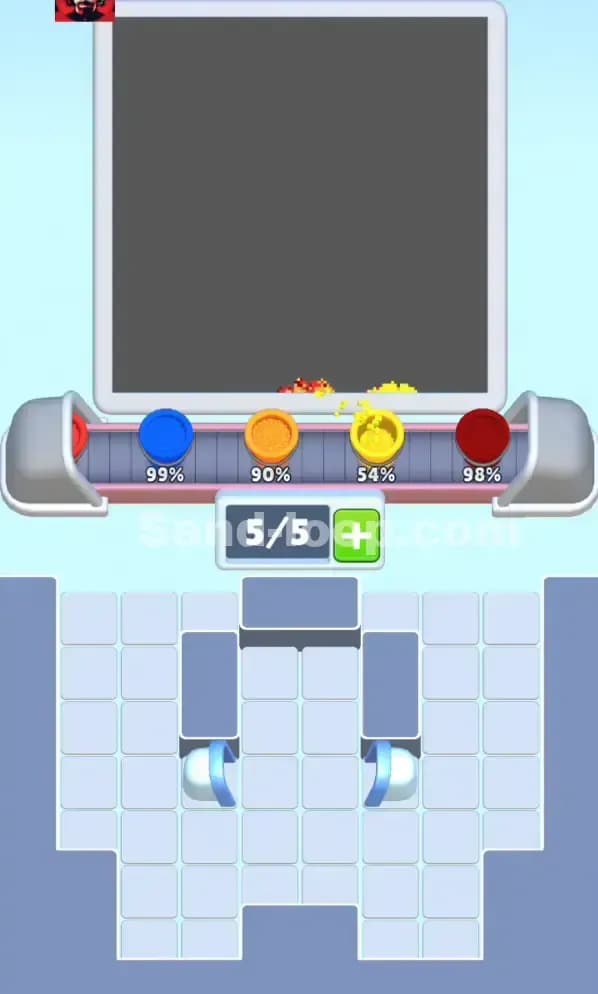
Sand Loop Level 161 Snapshot
The Canvas and Color Goal
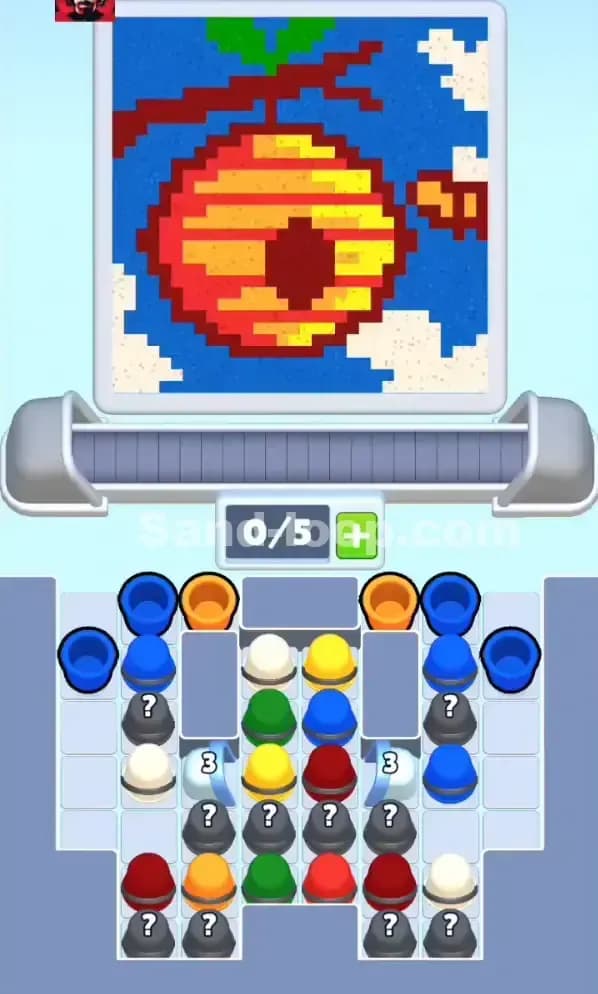
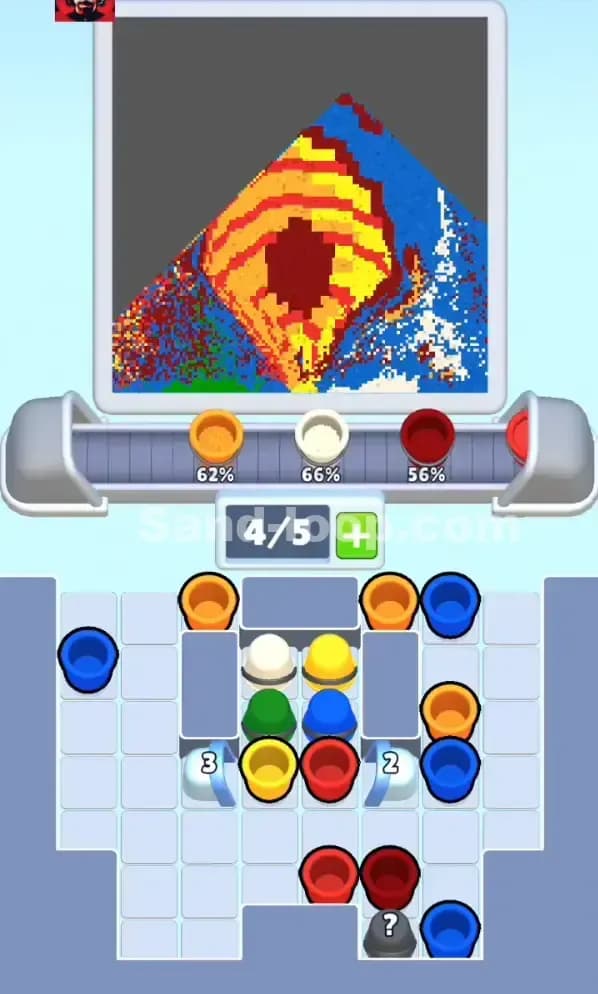
Sand Loop 161 tasks you with filling a vibrant pixel-art eye—dominated by a rich blue background with a striking red and yellow iris at the center, plus green accents and cream-colored highlights scattered around. The color progress meters show you're starting with zero fills across multiple colors: blue (the heavyweight), red, yellow, green, white, and orange all need precise portions. The eye's design means you can't just dump one color and call it done—the layered iris requires careful red-to-yellow balance, and the blue surround is huge but forgiving only up to a point.
Starting Setup and Bottleneck
You begin with 0/5 conveyor capacity—meaning all five slots are empty and ready. Your cup tray is tightly packed with a mixed selection: blue cups dominate the sides, orange and yellow cups sit in accessible upper positions, and critical colors like red and green are partially buried deeper in the stack. Several question marks indicate unknown or locked cups you'll need to unblock as you progress. The small "+1" booster icon is available, hinting that you might need an extra slot before the end.
Win Condition
Fill Sand Loop Level 161 by matching the target color distribution: predominantly blue for the background, significant red and yellow for the iris, and smaller hits of green, white, and orange for detail. You must do this without overflow (which wastes a color and stalls progress), without contaminating pours, and without jamming your conveyor with the wrong cups at the wrong time.
Why Sand Loop 161 Feels Hard (The Actual Bottleneck)
The Real Problem: Red-Yellow Iris Timing
The biggest trap in Sand Loop 161 is the iris itself. Red and yellow must fill the central region in the right order and proportion—too much red too early, and you'll overshoot the red meter before the yellow is ready, locking you into a cycle where you're pouring yellow with nowhere to go. Conversely, if you load yellow too greedily, the red gaps leave dead zones. The puzzle isn't just "get these colors on the belt"; it's "get them there in the right rhythm to match the visual progress."
Traps You'll Hit if You're Not Careful
Trap 1: Blue Overload. Blue is abundant and the first instinct is to load it early and often. But Sand Loop 161's blue background is huge—if you pour blue carelessly in the opening, you'll lock your red and yellow progress behind a wall of blue saturation, and you'll run out of time. Trap 2: Buried Yellow. Yellow sits in the middle of the cup tray, somewhat accessible but blocked by other colors. If you don't unblock it early, you'll find yourself with red loaded and ready but no yellow to follow, forcing awkward waits. Trap 3: The Cream/White Anomaly. The white highlights in the corners look small, but they require precision pours—one careless burst and you've wasted a slot.
Why It Looks Easy but Isn't
Sand Loop 161 presents as a straightforward "fill a big blue area with small colored details," but the actual bottleneck is sequencing and slot economy. You have five conveyor slots and six colors to manage. The visual is forgiving, but the math is tight. I choked the timing here twice before realizing I was trying to load all six colors too eagerly—I should have picked four core colors to nail, parked my remaining slots empty, and let gaps do the work.
Step-by-Step Walkthrough to Beat Sand Loop 161
Opening Rhythm: Load Smart, Stay Light
Start by loading one blue cup and one red cup into the first two conveyor slots. Do not load everything at once. Tap the blue dispenser once to send the first blue cup through, then wait. Let it ride the belt for a moment while you assess the meter. Your opening goal is to establish the blue baseline without overshooting. After the first blue pours, immediately load a red cup into the next available slot. The key is rhythm: pour, wait two seconds, pour again. This gives you real-time feedback and prevents the "flooded belt" scenario where three cups hit the dispenser at once and you lose control.
Keep two slots deliberately empty. Yes, you have capacity for five, but holding back ensures you're never locked into a bad sequence. If you realize mid-run that you need to swap out a cup or pause a color, those empty slots are your safety net.
Unblocking Plan: Free Yellow and Green Early
Within the first 30 seconds, you need to unblock yellow and green from the cup tray. Yellow sits behind orange in the middle stack; green is buried lower on the left side. Rotate your attention to the tray: load the orange cup in front of yellow, let it ride through once, and immediately load yellow into the next free slot. This unblocks the path and prevents a bottleneck later. Do the same for green—load whatever's on top of it first, clear the jam, then load green when you're ready for it.
By the 45-second mark, you should have blue, red, yellow, and green all accessible in your cup rotation. This is the moment Sand Loop 161 becomes manageable. Before this unblock is done, the level feels impossible because you're rationing a tiny pool of colors.
Mid-Game Control: The Iris Balancing Act
Once you've got your core colors loaded and flowing, the real puzzle emerges: balancing red and yellow as they fill the iris. Watch the progress meters closely. If red is climbing faster than yellow, skip a red pour—load a blue or yellow instead and let the meter equalize. If yellow is lagging, load yellow and hold back on red for two belt cycles. This alternating rhythm is what separates a clean run from a choked one.
Pour in short bursts. Don't hold the tap for three seconds expecting "continuous pouring"; instead, tap once, lift, wait, and tap again. Each clean burst gives you a moment to see what landed and adjust. This also prevents overflow—a common killer in Sand Loop 161.
Maintain your empty slots. If you've got five slots and six colors loaded, you've already lost: you can't pause, you can't swap, and you're stuck with whatever order the tray gives you. Keep at least one slot empty at all times during mid-game. This flexibility is what lets you dodge mistakes.
End-Game Precision: The Final 15%
As you approach the win condition—when blue, red, and yellow are all nearly filled and only green, white, and orange remain—slow down dramatically. Switch to single-tap pours for these detail colors. Green and white especially occupy small regions; overshooting either one even slightly can waste a full cup. Load green, tap once, wait for it to settle on the canvas, and observe. If the meter jumped significantly, wait before the next green pour. Repeat for white and orange.
Sand Loop 161's final stretch rewards patience. You'll likely sit idle for 10–15 seconds at the end, watching a single cup trickle across the belt as you wait for the meter to tick over. That's not a waste; that's precision.
If You Mess Up: Recovery Tactics
Scenario 1: Overfilled blue early, red/yellow now stuck. Load only yellow or red for the next 4–5 cycles, ignore blue entirely. This rebalances the meter ratio and prevents a soft lock. Scenario 2: Yellow is buried and inaccessible. Load whatever's on top of it (orange, typically) into an active slot, let it cycle through the belt, and immediately load yellow next. Scenario 3: You've accidentally poured white/green twice and wasted a slot. Don't panic—focus on the three major colors (blue, red, yellow) and let the damage sit. You can still win if those three are close to target.
Why This Strategy Works in Sand Loop 161
Conveyor Lead Time Control
Sand Loop 161's conveyor has a built-in delay: you tap a color now, but the cup doesn't reach the canvas for 2–3 seconds. This strategy accounts for that lag by teaching you to load one cup, observe the result, and load the next. You're not reacting to the tap; you're reacting to what landed, which is the correct mental model for this game. By staggering your loads and keeping gaps, you turn that delay into an advantage—it gives you time to see if a color is rising too fast and course-correct.
Slot Economy Prevents Deadlock
The limit of 0/5 capacity means you're juggling five cups at once. Most players load all five, then realize they're stuck in a fixed sequence they can't change. By keeping two slots empty, you retain agency: you can pause a color, swap the order by timing your pours differently, and respond to what the meters actually show. Sand Loop 161 rewards flexibility, not full-throttle pouring.
Waste Prevention and the Background Overfill Trap
Blue is the obvious color to pour first, but overfilling blue locks you out of the iris entirely. The strategy here is to front-load blue just enough to establish a baseline, then switch to a red-yellow focus for the mid-game. This avoids the classic trap where your blue meter hits 95% before red even starts, forcing you into a frustrating endgame where every pour is wasted or misplaced. By balancing all three major colors in tandem, you keep all meters moving and prevent any single color from locking you out.
Extra Tips and Adaptations for Levels Like Sand Loop 161
Six Specific Mistakes and Fixes
-
Mistake: Loading all five slots immediately. Fix: Load two cups, observe two pours, then load the third. You'll catch mistakes early.
-
Mistake: Tapping the dispenser without gaps between cups. Fix: Tap once, count to two (mentally), then tap again. This syncs your inputs with the conveyor rhythm.
-
Mistake: Ignoring the cup tray stack order. Fix: Before you load a cup, ask yourself: "What's blocking this color if I need it later?" Unblock immediately.
-
Mistake: Chasing a single color all the way to 100%. Fix: Stop pouring a color once it hits 80–85%. Let other colors catch up, then finish the final taps.
-
Mistake: Panicking when a meter spikes. Fix: A meter spike just means you need to switch colors—it's not a loss condition. Load a different color and rebalance.
-
Mistake: Using the booster slot too early. Fix: Reserve the +1 slot booster for the final third of Sand Loop 161, when you genuinely need five active colors at once. Before that, staying organized with four is faster.
Booster Strategy
If you unlock the "+1 Slot" booster during a run, use it after the first 90 seconds—once you've got blue, red, yellow, and green all loaded and flowing. That sixth slot is most useful in mid-game when you want to load a color without sacrificing one you're already pouring. Don't waste it at the start; the opening works better with constraints because it forces good discipline.
Final Encouragement
Sand Loop 161 is a rhythm puzzle disguised as a color-fill. The moment it clicks—when you realize that gaps and timing matter more than sheer pouring speed—you'll beat it cleanly. Stick with the staggered load strategy, respect the conveyor's lead time, and keep your slots flexible. You've got this. For more detailed solutions and community strategies, check out sand-loop.com and compare notes with other players tackling this precise level.