Sand Loop Level 170 Solution Walkthrough | Sand Loop 170

How to solve Sand Loop level 170? Get instant solution for Sand Loop 170 with our step by step solution & video walkthrough.
Share Sand Loop Level 170 Guide:
Sand Loop Level 170 Gameplay
Sand Loop Level 170 Solution 1
Sand Loop Level 170 Solution 2
Sand Loop Level 170 Solution 3

Sand Loop Level 170 Snapshot

The Canvas & Color Targets

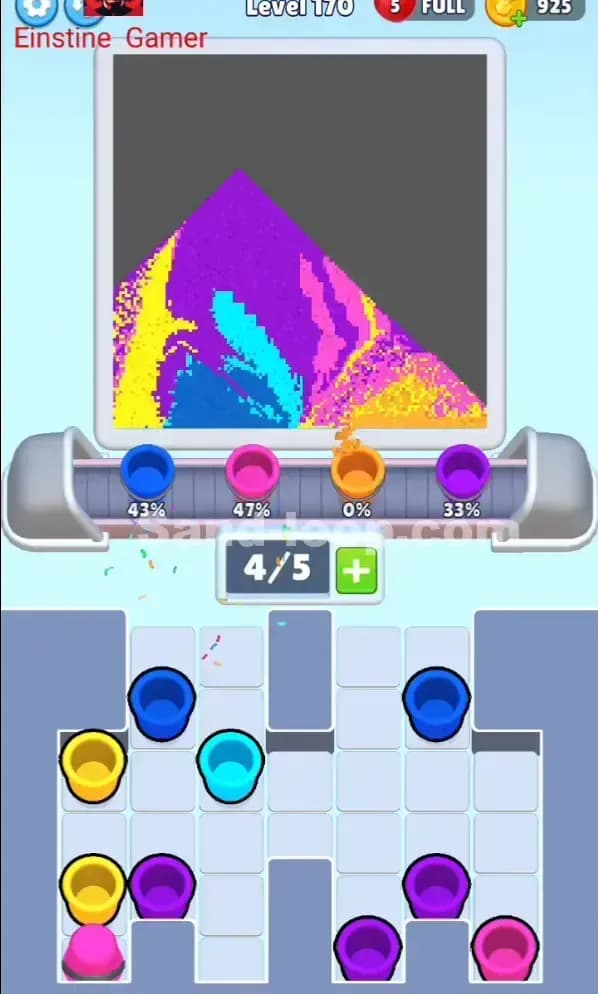
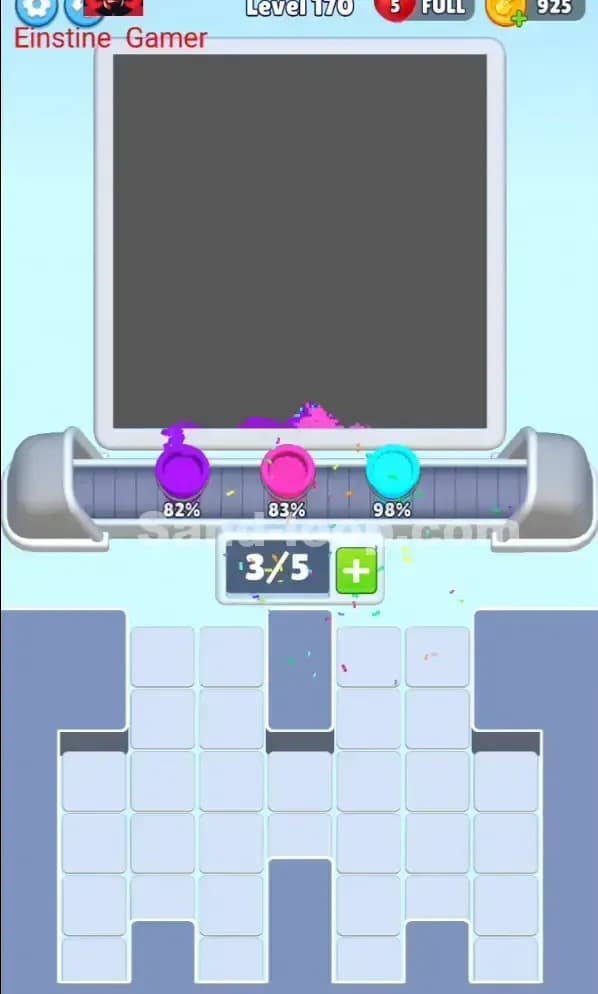
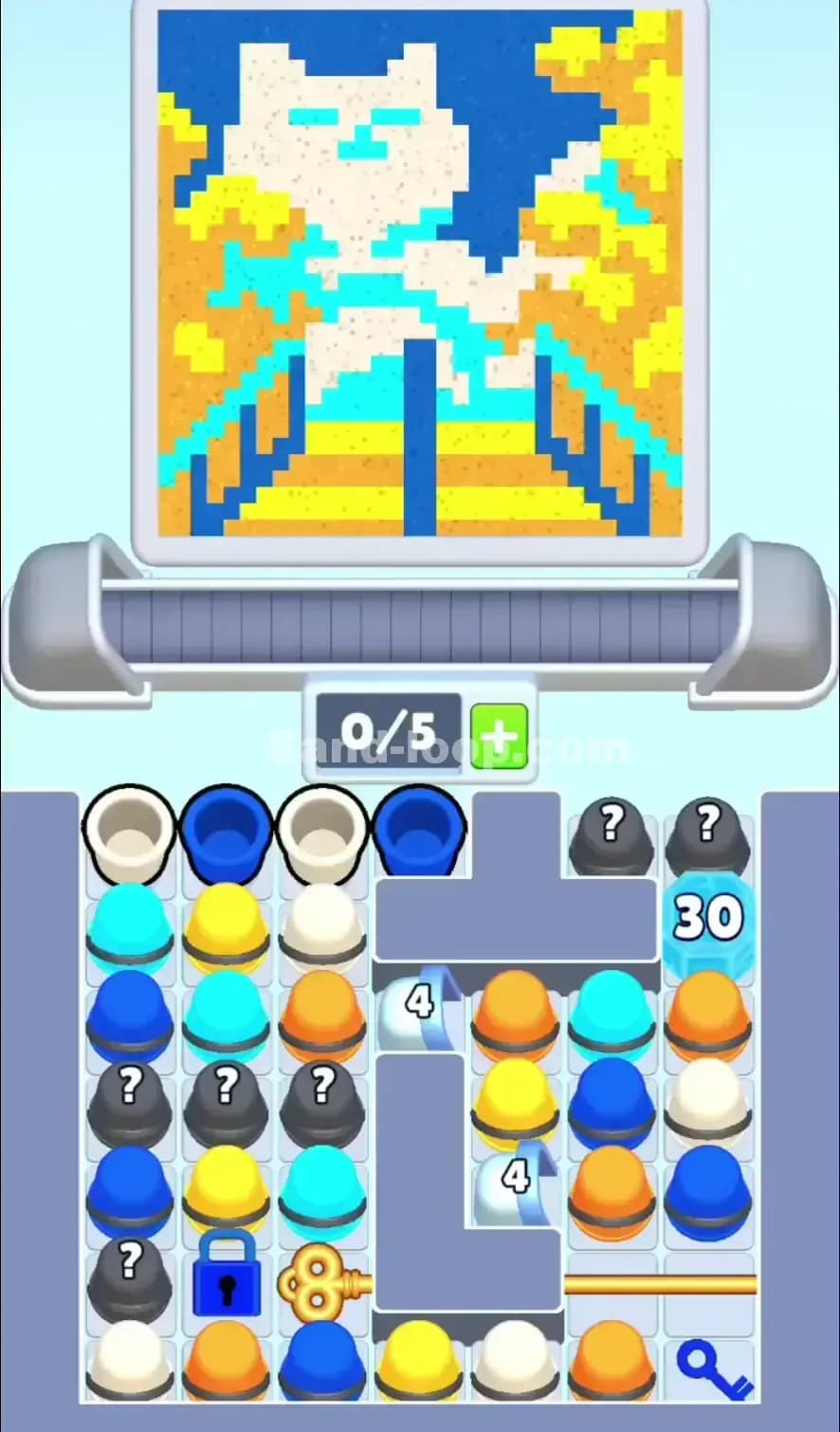
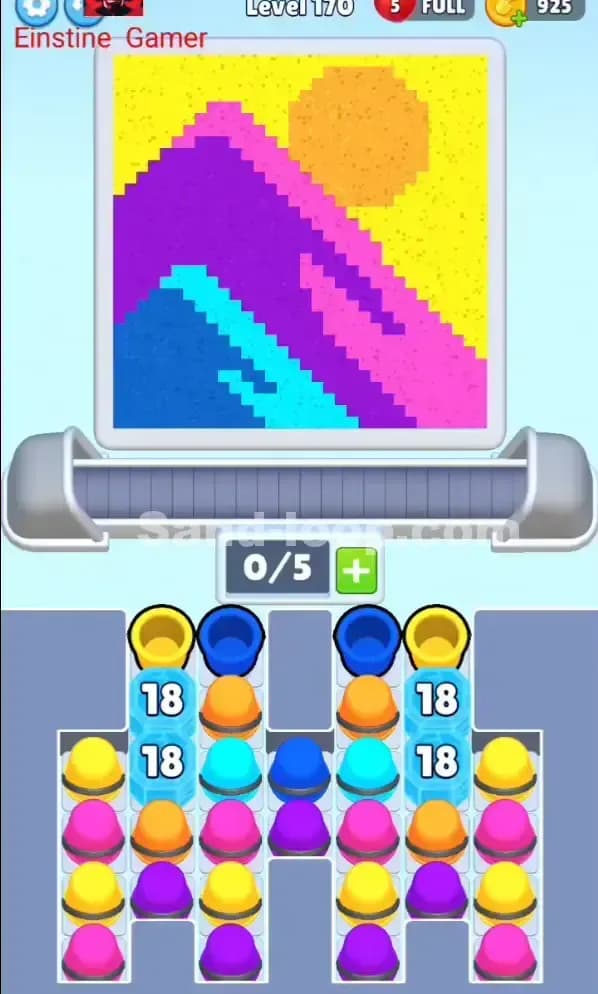
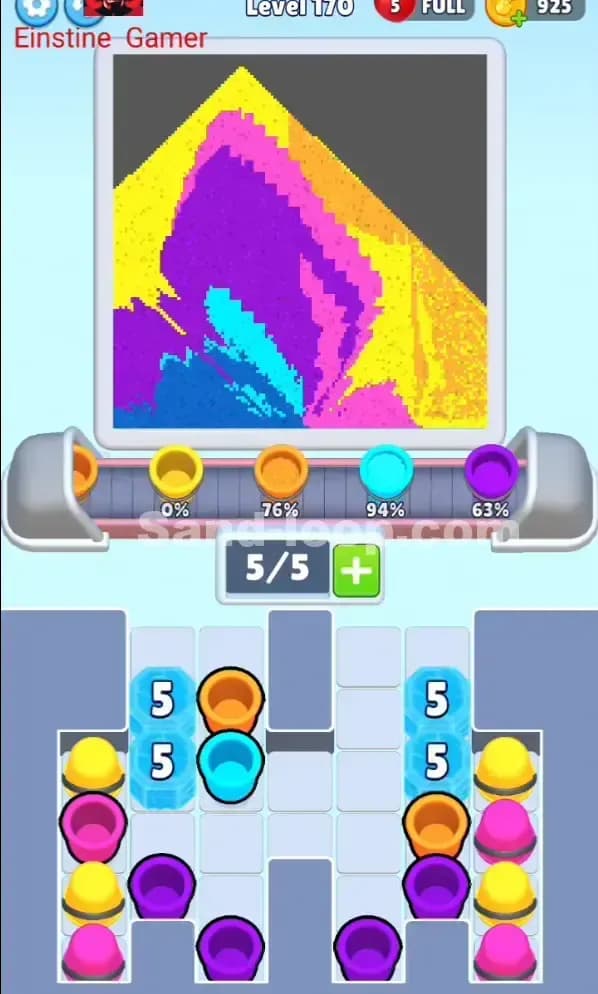
Sand Loop Level 170 presents a vibrant, multi-color mosaic on your canvas. You're looking at a dominant bright yellow background covering roughly the top third, with an orange circular shape nestled in the upper right. Below that sits a large purple/magenta wedge occupying the middle-left portion, and the lower half is split between cyan/light blue and dark blue gradients forming diagonal stripes. A pink accent area threads through the middle-right. The color-progress indicators tell you exactly what you need: you're starting at 0/5 capacity on the belt, and you need to fill each of these five distinct colors—yellow, orange, purple, magenta/pink, cyan, and dark blue—without overshooting or contaminating.

Your Starting Setup

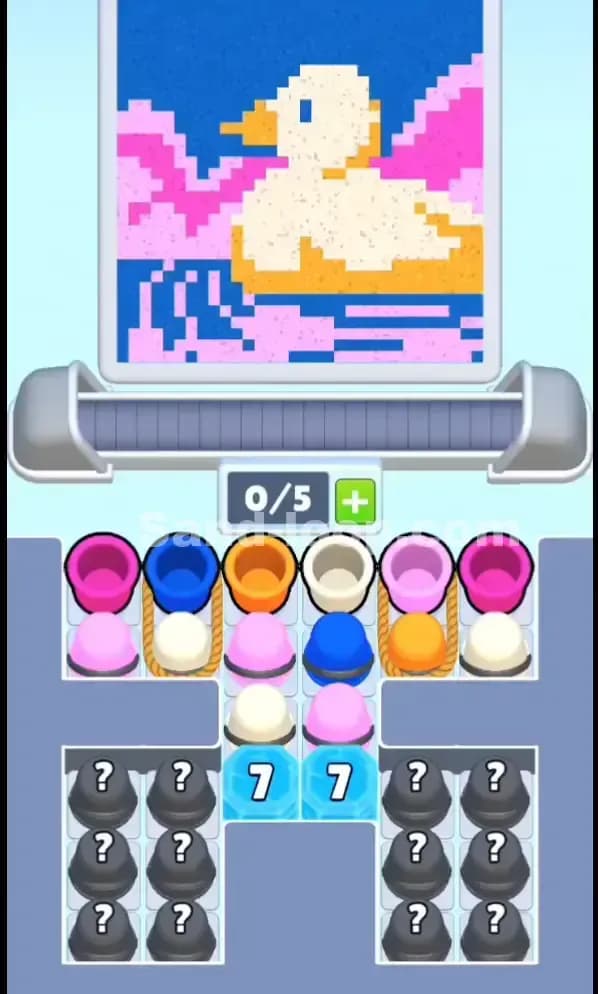
When you load Sand Loop Level 170, your conveyor belt is empty: 0 out of 5 slots available. You have plenty of room to work. Down in the supply tray, you'll see stacks of colored cups arranged in two main columns. On the left side, there are yellow cups (top), cyan cups (middle layer), and magenta/pink cups (bottom). The right side mirrors this with blue cups at the top, orange cups in the middle, and purple cups at the bottom. The tricky part? Some of these cups are stacked or partially blocked, meaning you can't always grab exactly what you want right away. You'll need to unblock strategically.

The Win Condition

To beat Sand Loop Level 170, you must fill the entire canvas by matching the color requirements shown on the canvas progress meter. You do this by loading the right color cups onto the conveyor belt in the right sequence, timing your pours so each cup arrives at the dispenser at exactly the moment you tap, and managing your belt capacity so you never jam up with too many cups waiting. The level ends successfully when all five colors are distributed across the canvas in the correct proportions, with no wasted pours and no overflow spilling into wrong zones.


Why Sand Loop Level 170 Feels Hard (The Actual Bottleneck)

The Real Puzzle: Supply Tray Geometry

I'll be honest—Sand Loop Level 170 looks deceptively simple at first glance. You've got five colors, a decent belt, and a clear canvas. But here's the killer: the supply tray layout means you can't instantly access all your colors freely. The yellow and blue cups at the top are immediately reachable, but to get to the purple and orange cups buried in the middle, you have to move or empty the cups above them first. This isn't a "pour until the color is done" level; it's a "unblock the right cup type at the right moment" puzzle. If you burn through your yellow too fast without freeing cyan, you'll suddenly have no cyan cups available when the meter demands it, and you'll be stuck.

Three Classic Traps in Sand Loop 170

First trap: Loading all five colors at once. The belt is only 5 slots, and if you jam it with one of each color immediately, you lose all flexibility. Your lead time is dead, and you can't react if a color overfills. Second trap: Assuming the background (yellow) is endless. Yellow looks like it dominates the canvas, but the meter is strict. Pour too much yellow too early, and you'll lock yourself out from the purple and blue zones, wasting moves. Third trap: Ignoring the stacked cups. Those magenta and purple cups at the bottom are tempting to save for "later," but if you don't free them early, you'll hit a point where they're unreachable and you're forced to overfill yellow or orange instead.

Why It "Feels Easy But Isn't"

I choked the timing here twice before I cracked the pattern. Sand Loop Level 170 doesn't have any crazy timer pressure or hidden obstacles—it's pure logistics. The trap is psychological: you see the colorful canvas and think, "I'll just pour each color until it's full," but the supply-tray geometry punishes that approach ruthlessly. You have to plan ahead, meaning you're freeing cups before you strictly need them, and that feels wasteful until suddenly it isn't. That mental shift from "reactive pouring" to "proactive unblocking" is where most people slip up.


Step-by-Step Walkthrough to Beat Sand Loop Level 170

Opening Rhythm: First Three Pours

Start by loading one yellow cup and one blue cup onto the belt immediately. Do not fill all five slots yet. Your belt will now show 2/5. Tap to send the yellow cup through first—it'll fill the top-left yellow zone quickly. While that's processing, load a cyan cup (you should be able to grab one from the left stack). Now you're at 3/5, and you've got a nice rotation forming: yellow → blue → cyan. Here's the key discipline: leave at least one empty slot on your belt at all times during the opening. This buffer prevents the conveyor from locking up if you miscalculate a pour timing. After your first cyan pour lands, you'll have a clearer picture of the color progress. Peek at the meter: yellow should be climbing steadily, cyan should be modest, and blue hasn't even started yet. This confirms you're on pace.

Unblocking Plan: Freeing the Mid-Tier Colors

Once you're three pours in, it's time to get aggressive about unblocking. Look at your tray: you need to expose the orange and purple cups that are buried. Load a magenta cup into slot 4 on your belt (don't pour it yet; let it sit behind the cyan cup still on the belt). This move doesn't immediately cost you anything, but it signals to yourself that you're shifting toward the mid-game colors. Next, load a purple cup into slot 5. Now your belt is full (5/5), but you've got no empty slots, so stop loading. Tap your next pour, sending the blue cup through. The magenta sits, the purple sits—they're queued but patient. This "queue-and-wait" technique is essential in Sand Loop Level 170 because it lets you pre-position colors without committing to pouring them immediately. Once the blue pour registers on the canvas, your belt drops to 4/5, and now you have one free slot again. This is when you load a second yellow cup—not because you desperately need it, but because yellow still dominates the canvas and you can afford one more. Keep one slot free.

Mid-Game Control: The Balancing Act

By pour five or six, your belt is cycling smoothly: yellow, blue, cyan, magenta, purple rotating through in waves. Here's where discipline matters most: do not pour more than two cups of the same color in a row. Why? Because Sand Loop Level 170's color zones fill at different rates. Yellow is huge, but it's not infinitely huge. If you send three yellows back-to-back, you risk overfilling the yellow zone and contaminating the purple or pink zones below it—and there's no undo for that mistake. Instead, alternate: yellow, blue, yellow, cyan, magenta, purple, yellow, cyan. This rhythm prevents any single color from spiking too fast. Watch the color-progress meter like a hawk. When you notice yellow is at, say, 60% full, start reducing yellow pours and increase your blue and cyan frequency. The meter is your real-time feedback loop. Also, maintain your one-slot buffer. If all five slots are full, stop loading cups. Wait for a pour to complete, drop to 4/5, then load the next cup. This rhythm might feel slow, but it's what prevents jams in Sand Loop Level 170. A single jammed belt can cost you two or three moves, so the upfront patience is always worth it.

End-Game Precision: The Final 10–20%

When your color meters are climbing past 70%, you're entering the high-stakes zone. Now you need precision pours, not volume. At this stage, you likely have only magenta, purple, and maybe one more cyan/orange left to fill. Load these colors individually with full slots in between—don't chain them. If your magenta meter says 80%, load a magenta cup, pour it, wait for the meter to update, then load the next color. This feels slower, but it prevents accidental overfill. Sand Loop Level 170 does not forgive the last pour going 1% over the limit. By this point, you should have one or two cups of each remaining color left in the tray. If purple is nearly full and you accidentally load a second purple cup before checking the meter, you'll overshoot. So discipline is paramount. Tap one pour, watch the meter settle, load the next cup. Repeat until all five colors show 100% and the canvas fills completely.

If You Mess Up: Quick Recovery

Did you overfill yellow and can't reach the purple zone? Don't panic. Undo the last pour if your game allows it, or restart the attempt. If you have no undo, your best bet is to accept the waste and pivot: immediately start loading and pouring purple/magenta cups to shift the canvas focus downward and compensate for the yellow overfill. You'll lose a move or two, but it's better than letting the level time out. If the belt jams (all five slots occupied and nothing moving), stop immediately and do not load any more cups. Wait for one pour to complete, then resume. Jamming is a sign you loaded too aggressively; Sand Loop Level 170 punishes that instantly. If you find yourself locked out of a color (e.g., all cyan cups blocked and no way to free them), restart. The level design should never fully lock you out if you play cleanly, so being locked out is a signal you went off-plan early.


Why This Strategy Works in Sand Loop Level 170

Conveyor Lead Time + Slot Economy

The core reason this walkthrough works is that it respects Sand Loop Level 170's mechanical reality: your tap initiates a pour, but the cup takes time to arrive at the dispenser. By loading cups one or two at a time with a full slot buffer, you're building lead time—you're always thinking one or two pours ahead. This means when you tap, the cup that's currently under the dispenser was loaded three or four taps ago, so you have time to react if the meter changes unexpectedly. Contrast this with the trap strategy: load all five cups at once, and now you're committed to pouring them in sequence with no flexibility. If yellow spikes to 90% after your second yellow pour, but you already have three more yellows queued up, you're done—they're coming whether you like it or not. By maintaining the one-slot buffer and cycling deliberately, you keep control.

Waste Prevention & the Background Overfill Lock

Yellow is the background, and it's tempting to fill it first and move on. But Sand Loop Level 170 punishes greed. The canvas is a system—each color is a compartment, and the compartments are adjacent. Overflow from yellow bleeds into purple; overflow from orange bleeds into magenta. The alternating-color rhythm prevents this. By interleaving yellow with blue and cyan, you're spacing out your large pours and giving the canvas time to "settle" between colors. This distributes the load evenly and prevents the catastrophic scenario where yellow is maxed out but the rest of the canvas is starving. Also, by unblocking magenta and purple early and having them ready to pour, you're never in a position where you have to pour yellow just because it's the only option. Options equal control.

Consistency & Repeatability

If you follow this strategy in Sand Loop Level 170, your runs become predictable. You know you'll load yellow-blue-cyan in the opening, unblock purple-magenta mid-game, and finish with precision pours. Even if you make a small mistake (pour one extra cyan, for example), the buffer slots and the lead-time planning give you room to correct without the level spiraling. Most players who struggle with Sand Loop Level 170 do so because every run feels different—chaotic loads, random overfills, belt jams appearing unexpectedly. This strategy removes the chaos by imposing structure. Structure = consistency = victory.


Extra Tips and Adaptations for Levels Like Sand Loop Level 170

Six Specific Mistakes & Fixes

Mistake 1: Loading all five cup colors at the start. Fix: Load only three colors (yellow, blue, cyan) initially. Unblock the remaining colors passively while cycling. Mistake 2: Pouring the same color three or more times in a row. Fix: Alternate every two pours. Yellow, blue, yellow, cyan keeps the rhythm alive. Mistake 3: Ignoring the color-progress meter. Fix: Check the meter after every third pour. If yellow is at 70%, start swapping to blue or cyan. Mistake 4: Filling all five conveyor slots every cycle. Fix: Always keep one slot empty. Two seconds of patience beats one jammed belt every time. Mistake 5: Treating the supply tray as infinite. Fix: Count your cups. If you see only three yellow cups in the tray and the meter shows yellow is only at 20%, you'll run out. Plan ahead. Mistake 6: Rushing the final 20% of the canvas. Fix: Slow down. Tap one pour, let the meter update, load the next cup. This level rewards patience over speed.

Boosters & When to Use Them

If your version of Sand Loop Level 170 offers a +1 Slot booster, use it only if you hit a jam early (turns 3–5). The booster gives you breathing room, but it's overkill if you're already playing with the buffer-slot discipline described above. If you find yourself jamming repeatedly, that's a sign to restart and re-plan, not a signal to spend a booster. An Undo booster is valuable insurance for the final pour—if you accidentally overfill a color by 1%, undo saves the run. If your game includes a Slow Belt booster, skip it entirely. Sand Loop Level 170 doesn't have time pressure, so slowing the belt doesn't help. Cup Swap boosters (if available) can unblock a color early, but again, planning ahead makes this unnecessary.

Closing Encouragement

Sand Loop Level 170 is a beautifully designed level that teaches you the real skill of Sand Loop: planning and discipline. It's not about having fast reflexes or lucky colors; it's about thinking two pours ahead and respecting the constraints. Once you clear it, you'll feel the mental shift—future levels suddenly feel easier because you've internalized the rhythm. If you're stuck, don't just retry blindly. Take a screenshot, map out your tray in your head, and plan your first six pours before you start. That ten-second pause is what separates frustrated players from those who clear consistently. For more Sand Loop strategies, tips, and community solutions, check out sand-loop.com. You've got this!