Sand Loop Level 67 Solution Walkthrough | Sand Loop 67
How to solve Sand Loop level 67? Get instant solution for Sand Loop 67 with our step by step solution & video walkthrough.
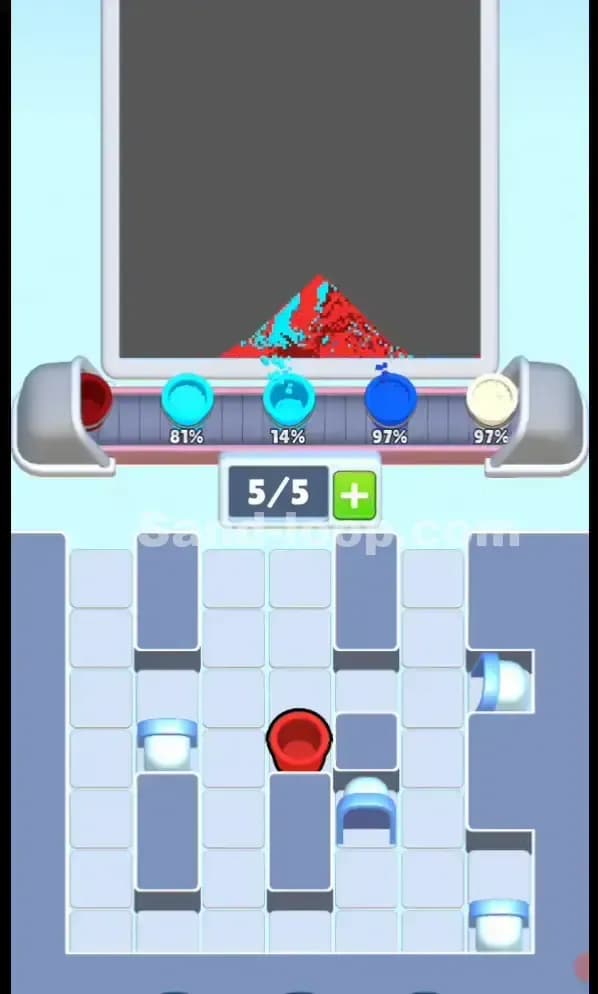
Sand Loop Level 67 Snapshot
Canvas Goal and Color Breakdown
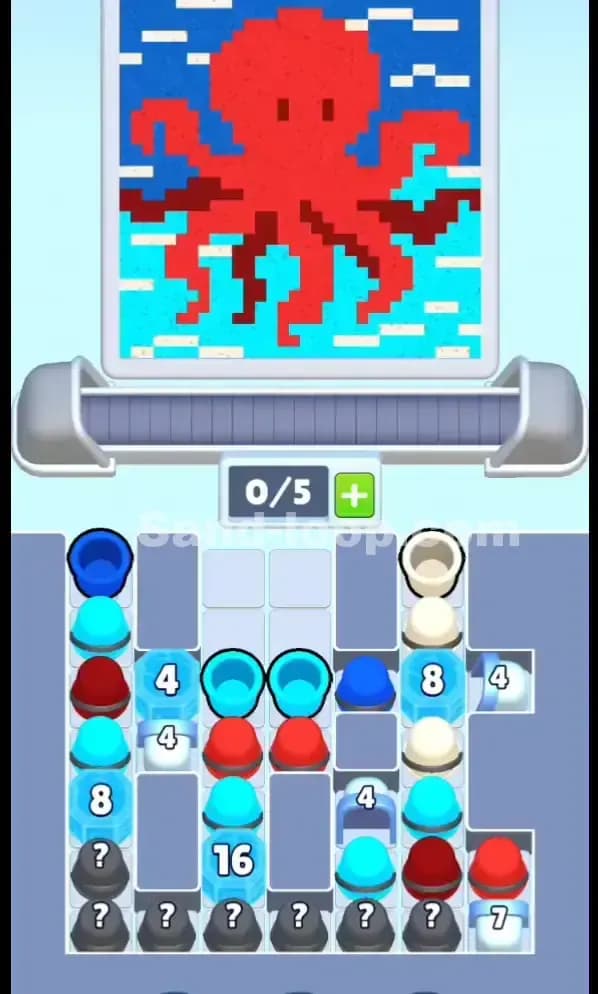
Sand Loop Level 67 asks you to paint a cheerful red octopus against a bold blue background, with cyan water splashes framing the creature. The canvas is dominated by three colors: red (the octopus body and face), cyan (the water and tentacle details), and blue (the sky backdrop). You'll also spot small white accent blocks scattered across the top—these are precision zones that demand careful placement. The color progress meters at the top will tell you exactly how much of each shade you've filled and how much remains. Red and cyan compete for your attention early; blue is the "filler" color that rounds out the picture.
Starting Setup and Conveyor State
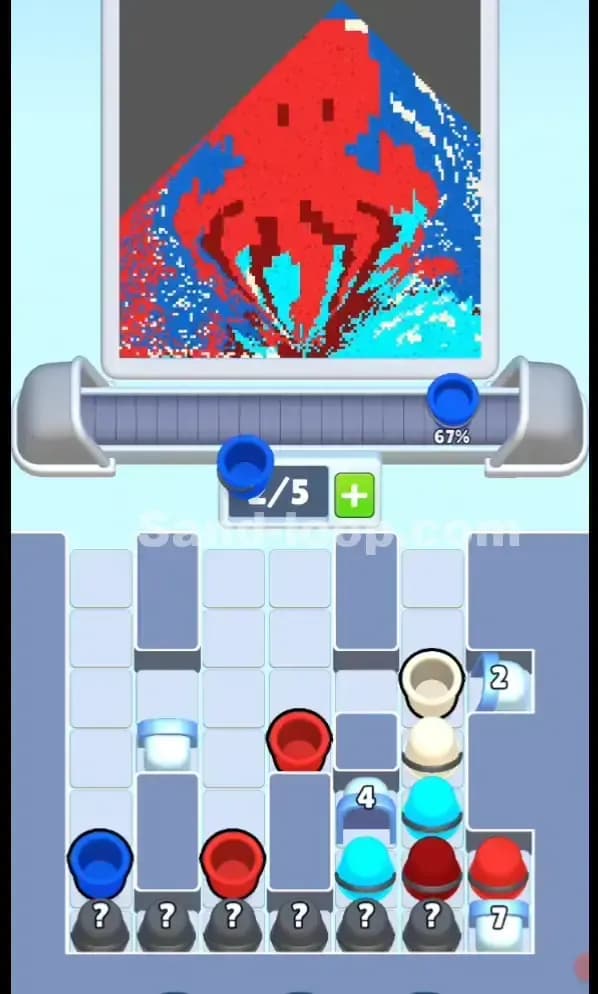
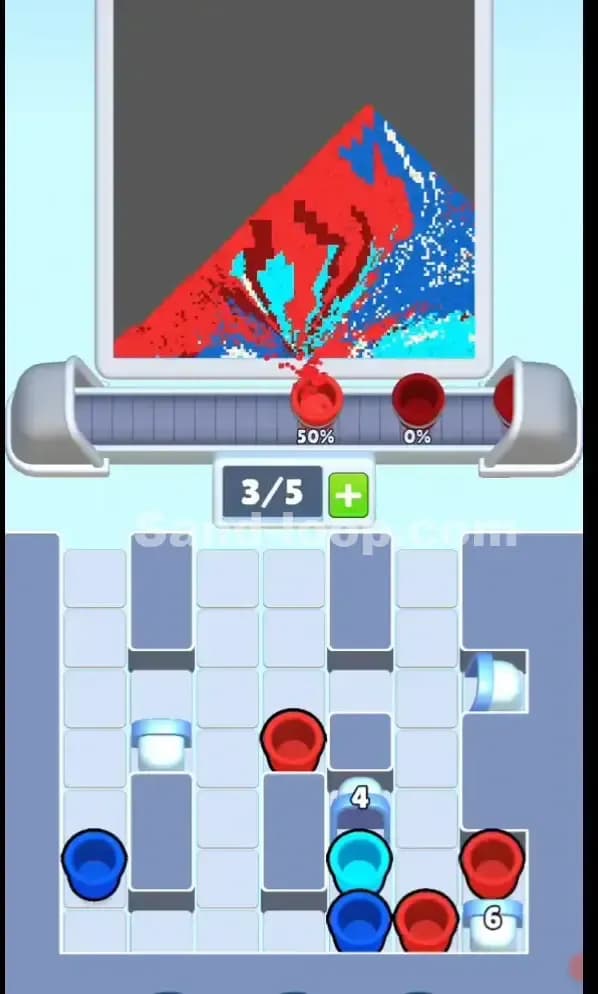
You begin Sand Loop 67 with a 0/5 slot economy—meaning your conveyor belt has room for five cups, and it's currently empty. The supply tray below is a tangled puzzle: you've got red, cyan, blue, and white cups stacked and scattered in various positions. Some cups are immediately accessible (the red and cyan pair near the top left), while others sit buried under numbered blocks ("4," "8," "16," "?") that act as weight restrictions. You can't grab a cup until its weight limit is satisfied by coins or matching tiles. The conveyor belt itself is a steady, rhythmic machine—whatever you load enters from the left and travels predictably toward the pour point on the right.
Win Condition and Threat Assessment
To beat Sand Loop Level 67, you must fill the octopus and background without overshooting any color (which locks you out of further progress) or letting your conveyor jam (which kills your flow). The level ends when all three dominant colors reach their target meter, and the white accents are complete. You're fighting a clock-based puzzle: timing is tight, and one careless "hold the pour button too long" will ruin your run.
Why Sand Loop 67 Feels Hard (The Actual Bottleneck)
The Real Puzzle: Unblocking Cyan Without Red Overflow
Here's the thing: Sand Loop 67 looks simple—just load red and cyan, right?—but the tray layout is the monster. Cyan sits underneath heavy weight tokens ("16," "8"), meaning you can't grab those cups until you've spent resources elsewhere. Meanwhile, red is immediately available and hungry. If you greedily pour red for the first 30 seconds, you'll max out red way before cyan is even accessible, and you'll watch helplessly as cyan cups remain locked. Your color progress will flatline, and you'll be forced to retry.
Classic Trap #1: Premature Red Saturation
Red dominates the canvas visually, so your instinct is to fill red first and fast. Don't. Red fills quicker than you think because the octopus is a large, connected shape. Pour red too aggressively, and you'll hit 100% red while cyan is still sitting in the tray under a "16" weight block. At that point, you're stuck—you can't pour any more red (it's full), and you can't access cyan (it's buried).
Classic Trap #2: Slot Deadlock
The conveyor can hold only five cups. If you load red, red, cyan, red, red in quick succession without leaving a gap, you might find yourself unable to grab the next cup you need because all five slots are occupied and none have exited yet. The timing delay between tapping a cup and it reaching the pour point means you have to plan ahead—think three cups in advance, not one.
The Frustration Factor
I choked Sand Loop 67 three times before I realized the tray was the puzzle, not the pouring mechanics. It feels like a speed challenge when it's actually a sequencing puzzle. You're not racing; you're solving a jigsaw of when to load which colors so that the meter fills evenly and the tray doesn't trap you. That cognitive shift is what catches most players.
Step-by-Step Walkthrough to Beat Sand Loop Level 67
Opening Rhythm: Load Cyan First (Yes, Really)
Your first move in Sand Loop 67 should feel counterintuitive: grab a cyan cup and load it immediately. Here's why: cyan is "expensive" to access (it's buried under weight), so you want to claim it early before the tray gets congested. Loading cyan first doesn't mean pouring it first; it means queuing it on the belt.
Then, tap red and load it second. Now your belt holds cyan-then-red, stacked in that order. The cyan cup will reach the pour point first, so when it arrives, you'll pour cyan into the water regions. This synchronizes your pouring with your unblocking strategy.
Keep two empty slots free on the five-slot conveyor. This buffer prevents jams and gives you flexibility if you need to load a surprise cup (like white for the accents later).
Unblocking Plan: Free Cyan, Then Manage Weight Tokens
As soon as your cyan cup exits the belt and gets poured, grab another cyan cup from the tray. You'll notice the second cyan is also under weight. Check the numbers: if a cyan cup has a "4" or "8" label, it means you need 4 or 8 worth of coin or block matches to lift it. Glance at the tray—there are numbered placeholder tiles scattered around.
Here's the trick: don't try to match all the weight in one go. Instead, load cyan cups strategically and use red as a counterweight provider. When you pour red, blocks sometimes unlock automatically (depending on your game version's rules). This frees cyan cups bit by bit. Load red, pour it, watch the tray rearrange, then claim the newly-freed cyan.
By the time you've poured 3–4 reds, at least two cyan cups should be accessible. Load them in succession (maintaining your two-empty-slot rule) and cycle them through.
Mid-Game Control: Cycle and Monitor Meters
Once cyan and red are both flowing, check your color meters every two pours. Red should climb steadily (it fills fast because the octopus is huge). Cyan should climb, but slower (water is fragmented). Blue, the background, should stay low for now—you don't want to fill it until you're sure red and cyan are on target.
Maintain a rhythm of "load, wait, pour, observe." Don't panic-tap; don't queue five cups blindly. Load one cup, watch it travel to the pour point, tap the pour button when it arrives, then assess the meters before loading the next. This steady pace prevents overfill mistakes.
If red is climbing faster than cyan, pause red pouring and load only cyan for 2–3 cycles. Rebalance. If cyan suddenly surges and threatens to overshoot, switch back to red. You're a conductor tuning the colors to meet their targets in sync.
End-Game Precision: The Last 10–20%
When both red and cyan are near 80–90%, zoom out mentally and look at the remaining blank spaces. They're probably blue and white. Blue is your "dump color"—it'll fill the rest of the background without much precision. White is surgical; there are only a handful of white blocks, and they sit in exact spots (top corners, edges).
Load blue cups and pour them in quick bursts to finish the background. Don't overthink blue; it's forgiving. However, reserve a white cup or two for the very end. Load a white cup, watch it travel, and tap pour only when you can see where it'll land—make sure it hits one of the white-designated slots. If you're uncertain, wait; let the cup cycle back (if your game allows cup reuse) or hold it in reserve.
Finish with blue until the entire canvas fills. The octopus and water should already be complete, so blue just caps off the background.
If You Mess Up: Recovery Tactics
If you've overfilled red early and locked yourself out of cyan, accept the retry. There's no "undo" for color overfill; it's a hard stop. Learn from it: next attempt, pour cyan earlier.
If your conveyor jams (all five slots full, none exiting), stop loading immediately and wait. Don't tap anything. The belt is moving; a cup will exit in a few seconds, freeing a slot. Then resume loading carefully.
If you accidentally pour a color into the wrong region (e.g., red onto a blue background zone), don't panic. You've wasted one pour, but the level isn't lost. Refocus: load and pour correct colors for the remaining meters.
Why This Strategy Works in Sand Loop Level 67
Timing Lead Time Prevents Jams
By loading cyan first and red second, you're front-loading the high-friction cup (cyan, the buried one). By the time you need to load more cyan, the first one has exited, freeing a slot. The belt's steady pace becomes your metronome. You're not fighting the conveyor; you're dancing with it.
Slot Economy Discipline Keeps Flow Alive
Keeping two empty slots means you always have room to grab an unexpected cup or respond to a meter spike. If cyan suddenly needs a boost, you can load two cyan cups in quick succession without deadlocking. This buffer is the difference between a smooth run and a frustrating jam.
Balanced Pouring Avoids the Color Trap
By monitoring meters and swapping between red and cyan, you don't let any one color run away. Overfill isn't a risk; underfill isn't a worry. You hit the target zone for all three colors in one clean attempt.
Precision at the End Saves Waste
By reserving white for last, you avoid accidentally pouring white when you need blue (and vice versa). You pour blue in a "spray and pray" mode because blue is abundant and forgiving. Your limited white cups hit their exact marks. It's an economy of precision: spend it where it matters.
Extra Tips and Adaptations for Levels Like Sand Loop Level 67
Mistake #1: Ignoring the Weight Numbers
Fix: Before you load any cup, glance at its label. "?" means random; "4," "8," "16" mean you need that many units of unlocked resources. Plan accordingly. Don't load a "16" cup if your tray is empty; it'll sit there useless and clog a slot.
Mistake #2: Pouring Red Continuously
Fix: Tap, pause, pour a short burst. Release immediately. Don't hold the button; short taps give you micro-control. Sand Loop 67 rewards precision, not aggression.
Mistake #3: Forgetting the Cyan-Under-Weight Problem
Fix: Cyan is your lynchpin. Prioritize freeing cyan cups in the first half of the level. Every cyan cup you liberate early is one more opportunity to balance your meters mid-game.
Mistake #4: Loading Cups Blindly Without Watching Meters
Fix: After every 2–3 pours, pause and glance at the progress bars. Are they aligned? Is one color surging? Adjust your next three loads based on what you see. Reactive play beats autopilot.
Mistake #5: Forgetting About the White Accents
Fix: White isn't optional; it's part of the win condition. Don't assume white cups will appear by magic. Reserve space in your conveyor planning for 2–3 white pours near the end. Scout the tray early: where are the white cups? Are they blocked?
Mistake #6: Panicking When a Meter Caps Out
Fix: If red hits 100%, it's okay. You still have cyan and blue to fill. Shift focus. Don't retry unless you're truly stuck (e.g., red maxed and cyan unreachable). One capped meter isn't failure if the others are on track.
Boosters (If Available in Your Version)
If you have access to an extra slot booster, use it early in Sand Loop 67 (around the 30–40% mark). Extra slots give you breathing room and let you load three cyan cups in succession without fear of deadlock—this is especially valuable when unblocking cyan.
If you have an undo pour booster, save it for the end. If you accidentally pour red when you meant to pour cyan in the final 10%, undo and correct immediately. It's a safety net, not a crutch.
If a slow belt booster exists, don't use it. Sand Loop 67's standard belt speed is your friend; slowing it down just prolongs your agony.
Final Encouragement
Sand Loop 67 is a designed puzzle, not a reflex test. The first time you beat it, you'll feel the satisfaction of solving a system. You've balanced colors, unblocked a tray, and managed a conveyor all in harmony. Subsequent attempts should be smooth; you now know the dance.
If you're still stuck, revisit the unblocking sequence: Is cyan truly accessible in your first ten pours? If not, your tray strategy is off. Adjust and retry. And if you want more detailed strategies or video walkthroughs for Sand Loop Level 67 and beyond, head over to sand-loop.com—the community there has optimized dozens of similar levels and loves helping players break through.
You've got this. Load that cyan, tap that pour, and paint that octopus. 🐙