Sand Loop Level 66 Solution Walkthrough | Sand Loop 66
How to solve Sand Loop level 66? Get instant solution for Sand Loop 66 with our step by step solution & video walkthrough.
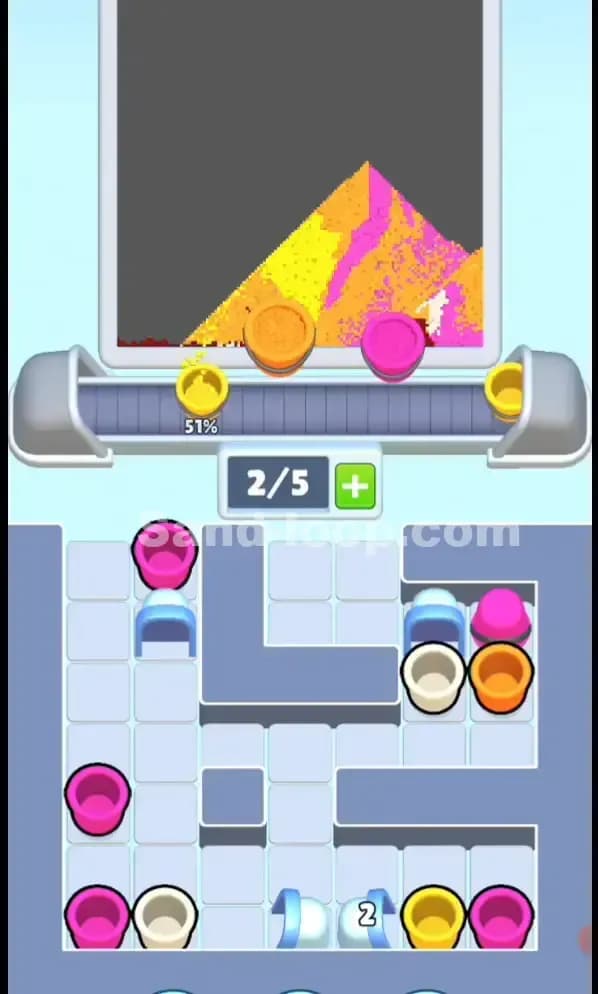
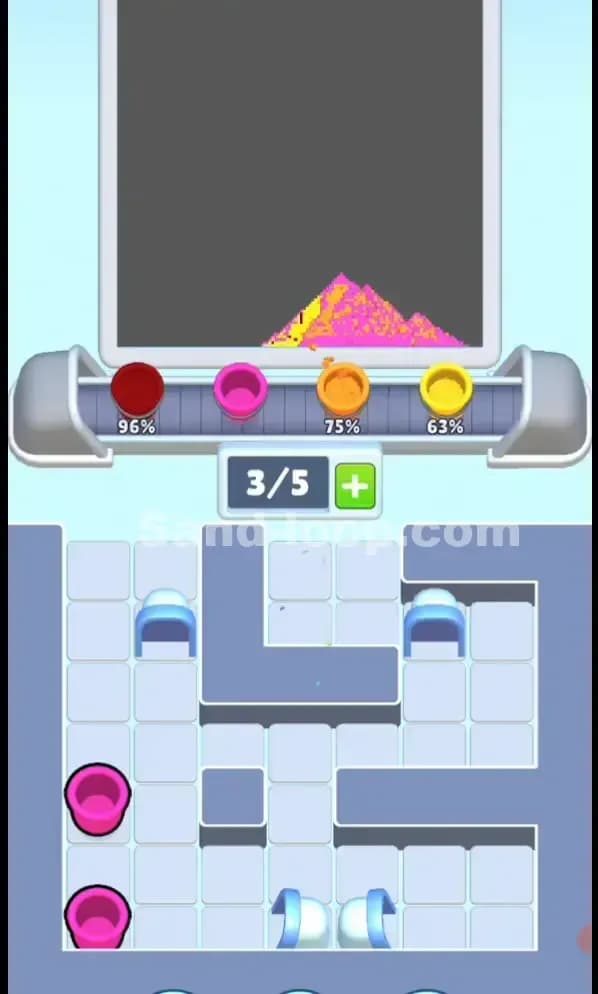
Sand Loop Level 66 Snapshot
The Goal Canvas and Color Targets
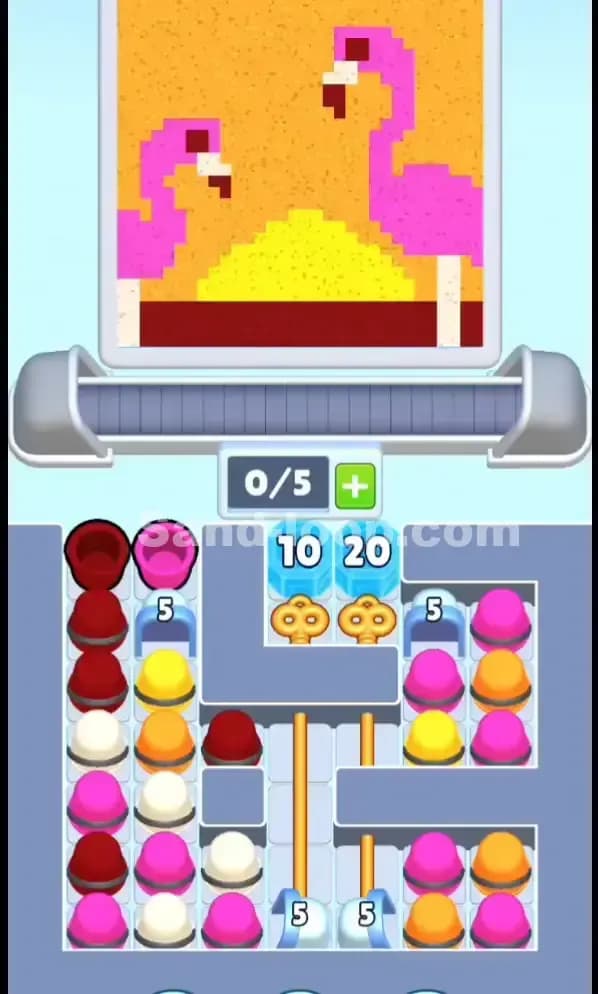
Sand Loop Level 66 presents a vibrant but demanding puzzle. The canvas is dominated by a warm golden-yellow background covering most of the upper and central areas. You'll see magenta (hot pink) shapes forming a frame-like border on the left and right sides, with small dark-red accent squares nested inside those magenta regions. Below the yellow sits a solid dark-red (maroon) horizontal bar that runs across the bottom third of the canvas. The color progress meters tell you exactly what you're up against: you need to fill significant portions of yellow and magenta while carefully controlling the dark-red contribution to avoid overshooting that bottom bar.
Starting Setup: The Conveyor and Tray Layout
You're starting with 0/5 cups on the conveyor belt—completely empty. That's both a blessing and a curse. The tray below shows a dense, stacked supply of cups in multiple colors: dark-red, magenta, yellow, white, and orange are all present, but they're layered and blocked in ways that force you to think several moves ahead. The dark-red cups are buried deep in the left column, magenta cups are scattered across the middle and right, and yellow cups sit in a relatively accessible position. The conveyor capacity is tight at just five slots, so every decision about which cup to load and when matters enormously.
Win Condition: Fill Without Waste
To beat Sand Loop 66, you must fill the canvas to completion by delivering the correct amounts of each color through your conveyor system. You cannot afford to overpour dark-red (or you'll lock yourself out of finishing the magenta and yellow areas). You cannot waste yellow by pouring it when slots are full or when the timing misses the dispenser. And you must avoid contaminating colors—a wrong-color cup passing under the wrong dispenser is a run-killer. The goal is a clean, controlled sequence that respects the slot economy and uses the timing window precisely.
Why Sand Loop 66 Feels Hard (The Actual Bottleneck)
The Core Difficulty: Buried Dark-Red and Magenta Chaos
Sand Loop Level 66's real puzzle isn't the yellow—it's managing the dark-red and magenta cups while they're locked in the tray. The dark-red cups are stacked at the bottom of the left column, which means you have to cycle through several non-dark-red cups before you can access them. Meanwhile, magenta cups are scattered across multiple slots, so unblocking one color often re-blocks another. This creates a cascading bottleneck: you want to load magenta early to fill that border quickly, but doing so blocks your access to other colors. And if you try to dig for dark-red too early, you'll jam your conveyor with cups you don't need yet.
The Traps You'll Fall Into
Trap 1: Loading magenta greedily because it looks urgent, then realizing you've buried the yellow cups you actually need next. You'll stall at 70% completion with no way forward.
Trap 2: Pouring dark-red continuously to "make progress," only to overfill the bottom bar by 15–20% and watch the level reject your solution. The dark-red bar is deceptively small—you need far less than your intuition suggests.
Trap 3: Keeping the conveyor completely full thinking you're "maximizing efficiency." In truth, a full belt creates deadlock: new cups can't load, old cups can't leave, and you're frozen. Sand Loop 66 requires you to keep 1–2 slots free at all times.
Why It Looks Easy but Breaks You
I choked the timing here three times before I realized the bottleneck wasn't about speed—it was about order. The canvas looks straightforward: big yellow area, frame it with magenta, add dark-red at the bottom. But the supply tray is a Tetris puzzle in disguise. You're not just pouring colors; you're solving a stacking problem while the conveyor ticks away. One wrong load sequence and you're watching cups cycle uselessly while your progress meter stalls.
Step-by-Step Walkthrough to Beat Sand Loop 66
Opening Rhythm: Load Smart, Not Fast
Start by ignoring the urge to fill every conveyor slot immediately. Instead, load your first three cups in this exact order: yellow, magenta, dark-red. Why? Yellow is the dominant canvas color, so it'll give you early visible progress and keep you motivated. Magenta is second because it unblocks more color options in the tray once you've removed a couple of magenta cups. Dark-red goes third as a "test load"—you're not pouring it yet; you're just staging it so you can assess the tray situation without committing a full pour.
Keep slots 4 and 5 empty for the next 30 seconds. Yes, that feels slow. But those two empty slots are your insurance policy against jamming. As your first three cups roll toward the dispensers, you'll see the canvas meters start climbing. Don't panic if the numbers seem small—conveyor physics means the meter doesn't update instantly. Trust the process.
Unblocking Plan: Free the Magenta and Yellow Bottleneck
Once your first yellow cup has been poured, the yellow column in the tray shifts. Load your second yellow cup immediately (slot 4). Now look at the magenta stack: you'll see that removing one magenta cup from the right side exposes at least two more magenta cups and sometimes a hidden white or orange cup beneath. Load a magenta cup into slot 5. This is your "unblock move"—you're sacrificing one magenta pour to expose the rest of your supply.
The dark-red stack in the left column is still blocked, and that's intentional. You don't want dark-red flowing yet. Let it sit there for another 20–30 seconds while you cycle your yellow and magenta cups. By the time you're ready to tackle dark-red, the left column will have shifted enough that you can load dark-red without it jamming other colors.
Mid-Game Control: The Cycle and the Gap
Now you're in the rhythm: every 5–7 seconds, a cup reaches the dispenser. Your job is to watch the color meters climb and deliberately leave gaps in the conveyor. For example, after you load your fourth cup, wait 8 seconds before loading cup five. That gap lets the first cup complete its pour and exit, freeing a slot. You're not wasting time; you're preventing deadlock.
As the yellow meter climbs past 50%, start tapering yellow loads. You'll know it's time when the meter visibly slows down—that's Sand Loop 66 telling you "okay, you've got enough yellow." Shift to loading magenta more aggressively. The magenta border on the canvas is thick, so it needs sustained pours, but it doesn't need to be first—it just needs to be consistent.
Dark-red is the sneaky one. You're aiming for roughly 20–25% of the dark-red bar filled, not more. Here's the trick: load one dark-red cup, pour it completely, then stop pouring dark-red. Load a white or orange cup next. This breaks the dark-red momentum and lets you visually confirm that you haven't overshot the bar. If the bar looks full or nearly full, skip dark-red entirely for the next 30 seconds.
End-Game Precision: The Last 10–20%
When you're at 80–90% completion, Sand Loop 66 becomes a sniper game. The meters are mostly full. You have maybe 2–3 cups' worth of pouring left. Load one final magenta or yellow cup (whichever meter looks thinnest) and let it pour completely. Watch the canvas. If both magenta and yellow are within striking distance, load one more cup of whichever color is lower. Do not load dark-red at this stage unless the dark-red bar is visibly unfilled. One wrong pour here and you're restarting.
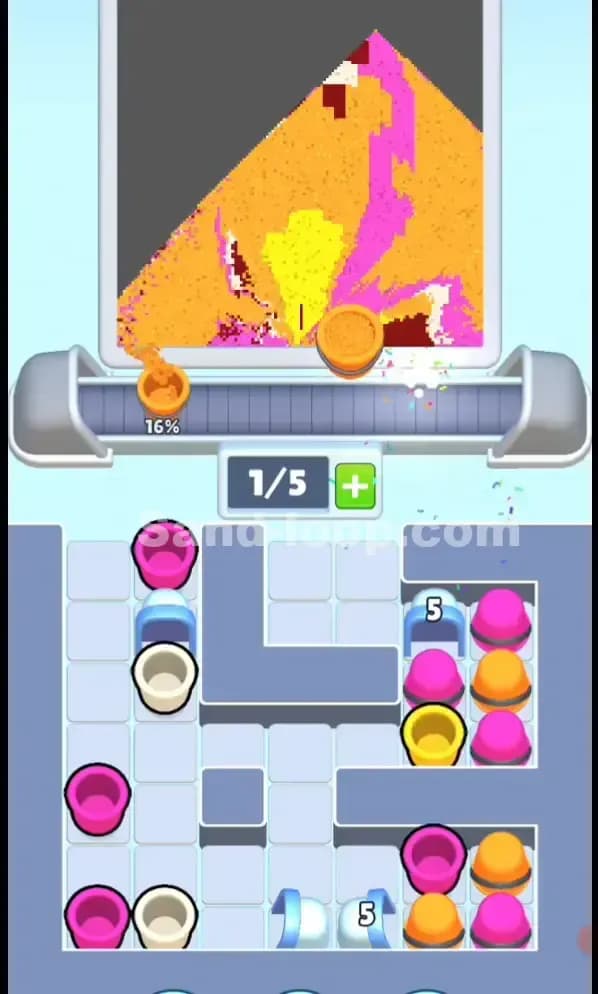
The final pour should tick the last color over the 100% threshold. You'll see the canvas flash or glow—that's your win signal. Sand Loop 66 is conquered.
If You Mess Up: Quick Recovery Tactics
If you overfilled dark-red early (it happens—the bar is tiny), you've probably failed the run. Restart. There's no partial recovery from an overfilled dark-red bar in Sand Loop 66.
If you accidentally jammed the conveyor with five full cups and nothing's moving, immediately stop loading new cups. Wait 15 seconds and watch the belt. One cup will eventually clear, and you'll be unstuck. Next time, remember the empty-slot rule.
If you're at 95% and you've run out of cups in the tray, you likely made an early mistake. Don't waste energy figuring out where—just reset and replay the opening rhythm more carefully.
Why This Strategy Works in Sand Loop 66
Conveyor Lead Time and Slot Economy
The strategy hinges on understanding that your tap doesn't happen instantly at the dispenser—it happens 2–3 seconds before the cup reaches the pour point. That delay is why you load in advance. By loading yellow, magenta, dark-red in that order, you're staggering the actual pours across a 10–15 second window, which keeps the conveyor flowing smoothly and prevents any single color from monopolizing the dispenser.
The empty-slot rule works because Sand Loop 66's belt is only five cups long. A full belt means new cups are physically blocked from loading. By keeping slots 4 and 5 open for the first 30 seconds, you're creating a natural "breathing room" that lets the system stay responsive. Once you've poured your first three cups and the belt has cycled, you can fill up again safely—but only if you maintain that rhythm of load, pour, gap, repeat.
Controlling Waste and Preventing Overfill Lock
The dark-red bar is the silent killer in Sand Loop 66. It looks huge on the canvas, but it's actually one of the smaller meter targets. The strategy prevents overfill by treating dark-red as a bonus color, not a primary color. You load it, you pour it once or twice, and then you stop. You don't keep feeding it until it's "done"—you feed it until it's sufficient. That distinction saves runs.
Similarly, the strategy keeps magenta tightly controlled. You load magenta consistently but not obsessively. The idea is to let the canvas demand tell you when to shift—when yellow meter slows, boost magenta; when magenta catches up, coast. This responsive approach beats "lock in one color and commit" because Sand Loop 66 penalizes overcommitment.
Why This Route is Consistent
This walkthrough stays consistent across replays because it's based on observable game feedback, not luck. You load yellow because it's accessible and obvious. You load magenta because the canvas is magenta-heavy. You load dark-red sparingly because the bar is tiny. You maintain gaps because the belt is short. None of these decisions rely on RNG or pixel-perfect timing—they're structured choices that adapt to what the game shows you.
Extra Tips and Adaptations for Levels Like Sand Loop 66
Common Mistakes and Quick Fixes
Mistake 1: Loading cups too fast. You tap four cups in rapid succession, the belt fills up, and then nothing happens for 20 seconds. Fix: Slow down. Tap once, count to 3, tap again. Let the belt breathe.
Mistake 2: Pouring dark-red continuously. You see the dark-red meter rising and assume you should keep feeding it. Instead, you overshoot by 30%. Fix: Treat dark-red like a garnish. One cup, maybe two. Then switch colors immediately.
Mistake 3: Ignoring the tray stack. You keep trying to load magenta, but it's buried under white cups. You end up loading white five times in a row. Fix: Before each load, glance at the tray and identify which color is actually accessible. Load what's on top, not what you want.
Mistake 4: Pouring through a full belt. You've got five cups queued and you tap "pour" on one anyway, hoping it'll interrupt the belt. It doesn't—it just queues the pour for later and confuses your timing. Fix: Only tap "pour" when you intend the current cup at the dispenser to pour. Trust the automation.
Mistake 5: Assuming "almost full" means "done." The yellow meter is at 95% so you stop loading yellow. But you've got 20 seconds of conveyor time left, and nothing's happening. Fix: Plan your final cup for the home stretch. Load it early enough that it pours in the last 10 seconds of the run.
Mistake 6: Panic-pouring when the canvas is mostly done. You're at 85% and you load three cups at once because you want to finish fast. Two of them are dark-red and you instantly overshoot. Fix: Slow down in the endgame. One cup at a time. Watch the meters after each pour.
Boosters: Use Them Only if Stuck
If you're replaying Sand Loop 66 repeatedly and keep jamming on the dark-red bar, consider an Extra Slot booster for your next run. Starting with 6 conveyor slots instead of 5 gives you one more cup to work with and slightly reduces the deadlock risk. It's not essential—this level is absolutely beatable without boosters—but it's a valid safety net if you're tired of resets.
Don't bother with a Slow Belt or Faster Belt booster. Sand Loop 66 isn't about belt speed; it's about sequencing. Those boosters won't help.
Closing Encouragement
Sand Loop Level 66 is tough, but it's also fair. You have all the tools you need—a clear canvas, visible meters, and a logical supply tray. The key is respecting the constraints: limited belt space, delayed pouring, and small dark-red tolerance. Play the opening rhythm three times and you'll internalize it. Master the gap-and-load rhythm and the mid-game will flow. Stay disciplined in the endgame and you'll cross the finish line.
Every Sand Loop 66 attempt teaches you something about tray ordering and conveyor timing. If you're stuck, revisit the unblocking plan—that's usually where players lose track. And remember, keeping two empty slots open isn't laziness; it's strategy.
For more solutions and community tips on Sand Loop 66 and similar levels, check out sand-loop.com. You've got this!